

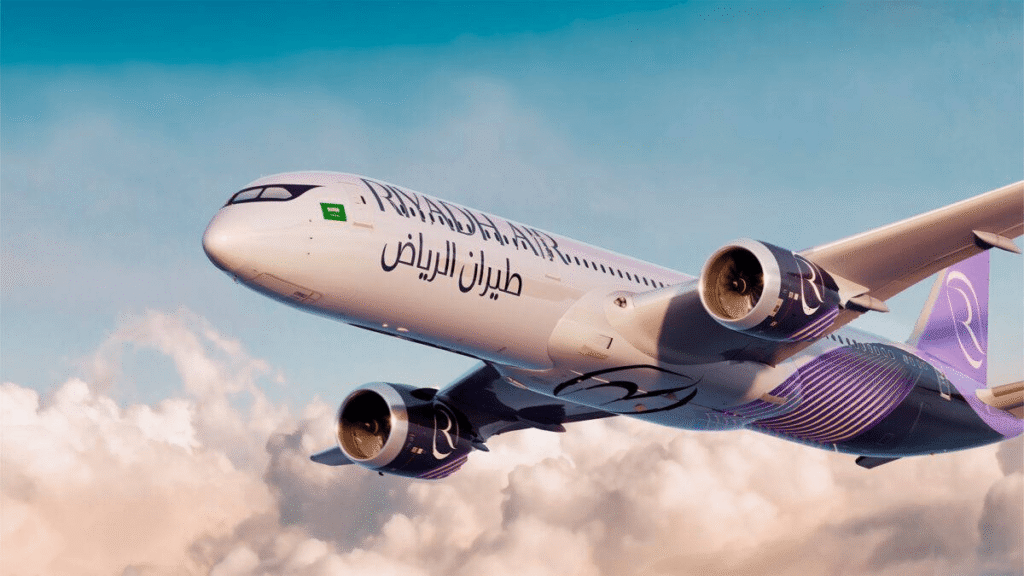
Saudi Arabia is building more than just a new airline.
Through Riyadh Air, the Kingdom is pursuing one of the most ambitious aviation strategies in modern history—one that aims to transform Riyadh into a major global transportation hub, diversify the economy beyond oil revenues, attract millions of tourists, and strengthen Saudi Arabia’s geopolitical influence.
Launched in March 2023 and wholly owned by the Public Investment Fund (PIF), Riyadh Air is a cornerstone of Vision 2030, Saudi Arabia’s national blueprint for economic transformation. The airline represents a strategic effort to position the Kingdom alongside the world’s leading aviation centres such as Dubai, Doha, Singapore, and Istanbul.
But can Riyadh Air succeed in an already crowded market dominated by established Gulf giants?
What Is Riyadh Air?
Riyadh Air is Saudi Arabia’s newest national airline, headquartered in the Kingdom’s capital city. Unlike Saudia, which primarily serves as the country’s traditional flag carrier, Riyadh Air has been designed from the outset to operate as a globally competitive, premium international airline.
The carrier’s mission extends far beyond transporting passengers. It is expected to:
- Increase Saudi Arabia’s international connectivity;
- Support tourism development;
- Create thousands of jobs;
- Attract foreign investment;
- Strengthen Riyadh’s status as a business destination; and
- Contribute to Saudi Arabia’s long-term economic diversification.
In essence, Riyadh Air is both an airline and an economic development project.
Why Did Saudi Arabia Launch Riyadh Air?
For decades, Gulf aviation has been shaped by three dominant players:
- Emirates (United Arab Emirates);
- Qatar Airways (Qatar); and
- Etihad Airways (United Arab Emirates).
These airlines transformed their respective cities into major transit hubs connecting Europe, Asia, Africa, and Oceania.
Saudi Arabia, despite being the region’s largest economy and home to the Middle East’s largest population, remained relatively underrepresented in international aviation.
Vision 2030 seeks to change that.
According to Saudi government targets, the Kingdom aims to:
- Welcome 150 million tourists annually by 2030;
- Serve 330 million air passengers annually;
- Connect Saudi Arabia to more than 250 international destinations; and
- Establish itself as a leading global logistics centre.
Riyadh Air is expected to play a central role in achieving these objectives.
Riyadh Air and Vision 2030: The Bigger Picture
The launch of Riyadh Air reflects a broader shift within Saudi economic policy.
Historically dependent on hydrocarbon revenues, the Kingdom is investing heavily in sectors such as:
- Tourism;
- Entertainment;
- Sports;
- Technology;
- Renewable energy; and
- Transportation infrastructure.
Major projects including NEOM, The Red Sea Project, Qiddiya, Diriyah Gate, and King Salman International Airport are designed to attract millions of international visitors.
However, tourism expansion requires extensive air connectivity.
Without a strong airline network capable of bringing travellers directly into Saudi Arabia, these mega-projects risk falling short of their full potential.
Riyadh Air therefore serves as the aviation backbone supporting Saudi Arabia’s economic transformation agenda.
Riyadh Air’s Fleet Strategy: Building for Scale
A world-class airline requires a modern fleet.
Recognising this, Riyadh Air has pursued aggressive aircraft acquisitions to support future growth.
Boeing 787 Dreamliner Order
In 2023, Riyadh Air announced an order for 39 Boeing 787-9 Dreamliners, alongside options for an additional 33 aircraft.
The Boeing 787 is widely regarded as one of the aviation industry’s most advanced long-haul aircraft, offering:
- Improved fuel efficiency;
- Lower operating costs;
- Enhanced passenger comfort;
- Extended operational range; and
- Reduced environmental impact compared to older aircraft.
The aircraft will form the backbone of Riyadh Air’s long-haul operations.
Airbus A321neo Expansion
The airline has also expanded its fleet strategy through orders for Airbus A321neo aircraft.
These narrow-body jets are expected to support:
- Regional routes within the Middle East;
- Short- and medium-haul international services; and
- Growing business travel demand.
The combination of wide-body and narrow-body aircraft provides Riyadh Air with operational flexibility as it expands its network.
King Salman International Airport: Riyadh’s Gateway to the World
Riyadh Air’s ambitions are closely linked with the development of King Salman International Airport.
Announced in 2022, the airport project is expected to become one of the world’s largest aviation hubs.
Saudi authorities aim for the airport to handle:
- 120 million passengers annually by 2030;
- 185 million passengers by 2050; and
- Significant cargo volumes supporting regional logistics operations.
The airport will feature multiple terminals, advanced technologies, and extensive infrastructure designed to accommodate future growth.
For Riyadh Air, King Salman International Airport provides the physical foundation required to compete with established Gulf transit hubs.
Can Riyadh Air Compete with Emirates and Qatar Airways?
Perhaps the most important question surrounding Riyadh Air is whether it can challenge the region’s established leaders.
Emirates benefits from decades of experience and a globally recognised brand.
Qatar Airways consistently ranks among the world’s top airlines for service quality.
Etihad, despite earlier setbacks, has undergone significant restructuring.
However, Riyadh Air possesses several advantages.
A Large Domestic Market
Saudi Arabia has a population exceeding 35 million people, substantially larger than other Gulf states.
Domestic and outbound travel demand provides a strong customer base.
Religious Tourism
Saudi Arabia hosts millions of pilgrims annually for Hajj and Umrah.
The expansion of religious tourism remains a strategic national priority.
Government Support
Backed by the Public Investment Fund, Riyadh Air benefits from substantial financial resources and long-term strategic commitment.
Tourism Mega-Projects
Saudi Arabia’s emerging tourism destinations are expected to generate sustained inbound travel demand over the coming decade.
Together, these factors provide Riyadh Air with growth opportunities unavailable to many competitors.
A Digital-First Airline for the Future
Unlike legacy airlines burdened by outdated systems, Riyadh Air has the advantage of starting from scratch.
The carrier has repeatedly highlighted its ambition to become a technology-driven airline.
Potential areas of innovation include:
- Artificial intelligence-powered customer experiences;
- Personalised travel recommendations;
- Advanced mobile applications;
- Seamless check-in technologies;
- Enhanced in-flight connectivity; and
- Data-driven operational efficiency.
Digital transformation is increasingly shaping competitive dynamics within the aviation sector, and Riyadh Air intends to position itself at the forefront of this evolution.
Economic Impact: More Than an Airline
The significance of Riyadh Air extends beyond aviation.
Saudi authorities estimate that the airline could contribute approximately US$20 billion to non-oil GDP growth while supporting more than 200,000 direct and indirect jobs.
Economic benefits are expected across multiple industries, including:
- Hospitality;
- Tourism;
- Aviation maintenance;
- Airport services;
- Logistics;
- Workforce training; and
- Technology development.
For policymakers, Riyadh Air represents an investment in economic resilience and diversification.
Sustainability Challenges
The aviation industry faces mounting pressure to reduce emissions.
As Riyadh Air expands its operations, sustainability considerations will become increasingly important.
Modern aircraft such as the Boeing 787 and Airbus A321neo offer improved fuel efficiency. Nevertheless, broader challenges remain, including:
- Sustainable aviation fuel adoption;
- Carbon reduction targets;
- Operational efficiency improvements; and
- Compliance with evolving international environmental standards.
Balancing growth with sustainability will be critical to the airline’s long-term credibility.
The Strategic Importance of Riyadh Air
Airlines increasingly function as instruments of national influence.
They shape perceptions, facilitate commerce, strengthen diplomatic ties, and connect economies.
Riyadh Air therefore represents more than a transportation company.
It is a strategic asset designed to reinforce Saudi Arabia’s emergence as a global economic power positioned at the crossroads of Europe, Asia, and Africa.
Its success—or failure—will serve as an important indicator of the Kingdom’s broader Vision 2030 transformation efforts.
Conclusion
Riyadh Air is one of the most significant aviation projects currently underway in the Middle East.
Backed by substantial financial resources, integrated within Saudi Arabia’s national development strategy, and supported by major infrastructure investments, the airline possesses the ingredients necessary to become a major global player.
Yet success is far from guaranteed.
Competing against established Gulf carriers will require exceptional execution, sustained investment, and the ability to deliver a world-class passenger experience.
What is certain, however, is that Riyadh Air has already become much more than an airline.
It is a symbol of Saudi Arabia’s ambitions to redefine its economy, reshape regional aviation, and secure its place within an increasingly interconnected world.



Leave a Reply