

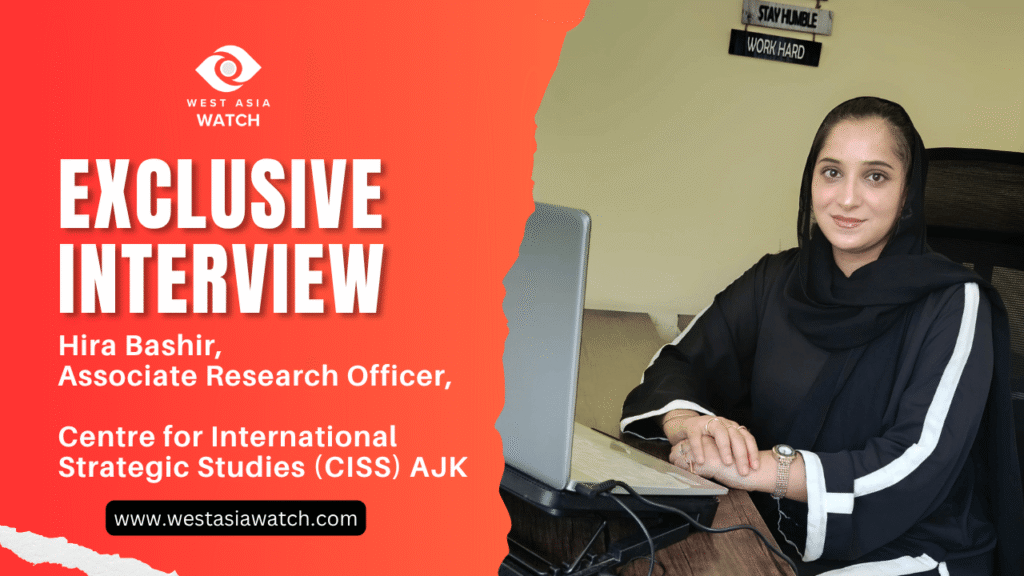
As countries across West Asia pursue energy security, economic diversification and climate resilience, the peaceful use of nuclear technology is gaining increasing strategic importance. Beyond providing reliable, low-carbon electricity, nuclear applications are contributing to healthcare, agriculture, food security and water management—supporting several United Nations Sustainable Development Goals.
In this written interview, Hira Bashir, Associate Research Officer at the Centre for International Strategic Studies (CISS) AJK, examines how nuclear energy can complement renewable sources, strengthen regional energy systems and support knowledge-based economic development. She also discusses the regulatory, financial and technical challenges facing emerging nuclear programmes, alongside the importance of public confidence, safety and responsible waste management.
Q1. How can the peaceful use of nuclear technology contribute to achieving the United Nations Sustainable Development Goals?
The peaceful use of nuclear technology can make an important contribution to achieving the United Nations Sustainable Development Goals (SDGs) by supporting clean energy, healthcare, agriculture, food security and water management. In the energy sector, nuclear power provides a reliable, low-carbon source of electricity that helps reduce greenhouse gas emissions and supports SDG 7 (Affordable and Clean Energy) and SDG 13 (Climate Action). In the context of West Asia, the UAE’s Barakah Nuclear Energy Plant is a strong example of this. It supplies around 25% of the country’s electricity while avoiding more than 22 million tonnes of carbon emissions each year, demonstrating how nuclear energy can strengthen energy security and support sustainable development in the region.
In healthcare, nuclear medicine is widely used to diagnose and treat diseases such as cancer through PET scans, radiotherapy and other medical imaging techniques contributing to SDG 3 (Good Health and Well-being).
In agriculture, the IAEA and FAO’s Sterile Insect Technique (SIT) helps control harmful pests without excessive use of pesticides while nuclear breeding techniques have produced more than 3,400 improved crop varieties with higher yields and better resistance to drought and disease supporting SDG 2 (Zero Hunger).
Nuclear technology also contributes to SDG 6 (Clean Water and Sanitation) through nuclear-powered desalination and isotope hydrology which help countries produce fresh water and manage groundwater resources more effectively. Through its technical cooperation programmes, the International Atomic Energy Agency supports countries in applying these peaceful nuclear technologies safely and responsibly.
Q2- What role can nuclear energy play in strengthening energy security and supporting economic diversification across West Asia?
Nuclear energy can play an important role in strengthening energy security and supporting economic diversification across West Asia. It provides a reliable, low-carbon source of electricity that operates continuously unlike energy sources that are affected by weather conditions. This helps countries reduce their dependence on oil and natural gas for domestic electricity generation while ensuring a stable energy supply for growing populations and industries.
For many West Asian countries, nuclear energy also supports long-term economic goals. By using nuclear power to generate electricity, more oil and gas can be reserved for export or used in higher-value industries such as petrochemicals helping to increase national revenues. This is particularly relevant for countries pursuing economic transformation strategies such as Saudi Vision 2030 and the UAE’s long-term development plans.
The UAE’s Barakah Nuclear Energy Plant is a good regional example. In addition to supplying around 25% of the country’s electricity, the project has contributed to economic diversification by reducing the country’s dependence on oil and gas for domestic power generation. This allows more hydrocarbons to be exported or used in higher-value industries such as petrochemicals creating additional sources of national revenue. The project has also helped develop a skilled workforce by training engineers, scientists, and nuclear specialists, while encouraging technology transfer, research, and the growth of local industries involved in construction, manufacturing, and technical services. As a result, it supports the transition from an oil-dependent economy to a more knowledge-based and technology-driven economy.
Similarly, Saudi Arabia is developing a civilian nuclear programme as part of its Vision 2030 strategy to diversify its energy mix, strengthen industrial development, create high-skilled employment opportunities and reduce its reliance on oil revenues.
Q3-How can nuclear power complement renewable energy sources in helping regional countries meet their climate and sustainability targets?
Nuclear energy and renewable energy should be seen as complementary rather than competing sources of clean energy. Solar and wind power are important for reducing carbon emissions, but they depend on weather conditions and cannot produce electricity all the time. Nuclear power on the other hand provides a reliable supply of electricity 24 hours a day regardless of the weather. Using both together helps ensure a stable and secure electricity supply while reducing dependence on fossil fuels.
For West Asian countries, this balanced energy mix can play an important role in achieving climate and sustainability goals. The region has excellent potential for solar energy but electricity demand is also increasing because of population growth, industrial development, and the need for water desalination. Nuclear energy can provide continuous power when renewable energy production is low helping countries meet their energy needs while reducing greenhouse gas emissions. This approach also supports national commitments under the Paris Agreement and contributes to a cleaner energy future.
A good regional example is the United Arab Emirates, which has combined the Barakah Nuclear Energy Plant with large-scale solar projects as part of its clean energy strategy. Nuclear and renewable energy are strongest when used together. By combining the reliability of nuclear power with the environmental benefits of renewable energy, West Asian countries can strengthen energy security, reduce carbon emissions, and build a more sustainable and climate-resilient future.
Q-4: Beyond electricity generation, which peaceful applications of nuclear technology offer the greatest potential for healthcare, agriculture, food security, and water management?
When people hear the word “nuclear,” they often think of power plants. However, peaceful nuclear technology has many important applications beyond electricity generation. It is already improving healthcare, agriculture, food security, and water management, making it an important tool for sustainable development.
In healthcare, nuclear technology is widely used to diagnose and treat diseases particularly cancer. Techniques such as PET scans and SPECT imaging help doctors detect diseases at an early stage while radiotherapy is one of the most effective treatments for many types of cancer. More recently, theranostics has emerged as a promising approach that combines diagnosis and treatment. It allows doctors to identify cancer cells and deliver radiation directly to them, reducing damage to healthy tissues and improving treatment outcomes. Nuclear technology is also used to sterilize medical equipment such as surgical instruments and syringes, helping prevent infections in hospitals.
In agriculture, nuclear techniques help improve food production and protect crops. One important example is mutation breeding where controlled radiation is used to develop crop varieties that are more resistant to drought, disease, and harsh environmental conditions. More than 3,400 improved crop varieties have been developed worldwide using this technique. Another successful application is the Sterile Insect Technique (SIT), jointly supported by the IAEA and FAO. In this method, male insects are sterilized and released into the environment to reduce pest populations without relying on chemical pesticides. It has been used successfully to control fruit flies and disease-carrying mosquitoes in many countries.
Nuclear technology also plays an important role in food security through food irradiation. This process uses controlled doses of radiation to eliminate harmful bacteria, insects, and parasites, helping to reduce food spoilage and extend shelf life without affecting the food’s nutritional value. It improves food safety, reduces post-harvest losses, and supports international food trade.
In water management, isotope hydrology helps scientists understand the movement, origin, and age of groundwater. This information allows governments to manage water resources more efficiently especially in water-scarce regions such as West Asia. IT is also being used for desalination where nuclear energy can provide a reliable source of power to produce fresh water from seawater.
Q5-What regulatory, financial, and technical challenges could limit the development of peaceful nuclear programmes in emerging economies?
Developing a peaceful nuclear programme is a complex and long-term process. It requires not only financial investment but also strong institutions, technical expertise, and long-term political commitment. For many emerging economies, these are the main challenges.
The first challenge is the regulatory framework. Before a country can build a nuclear power plant it must establish an independent nuclear regulatory authority, adopt comprehensive nuclear laws, and ensure compliance with international safety and security standards set by the International Atomic Energy Agency. For example before the UAE began operating the Barakah Nuclear Energy Plant, it spent several years developing its legal and regulatory framework, training regulators, and working closely with the IAEA to ensure that the programme met international safety standards.
The second challenge is financing. Nuclear power plants require significant upfront investment, and construction can take several years before any electricity is generated. Many emerging economies also need to invest in healthcare, education, and infrastructure, so allocating billions of dollars to a nuclear programme can be difficult. However, international support for peaceful nuclear energy is increasing. As countries work towards the Sustainable Development Goals and the clean energy transition, international financial institutions are showing greater interest in supporting nuclear development. For example, the IAEA and the World Bank Group have recently strengthened their partnership to support the safe and responsible use of nuclear energy, including financing for nuclear infrastructure, long-term operation of nuclear power plants, and the development of Small Modular Reactors (SMRs).
The third challenge is technical capacity. A nuclear programme requires highly trained engineers, scientists, technicians, and regulators, as well as supporting infrastructure such as research institutions, emergency response systems, and radioactive waste management facilities. Developing these capabilities takes time. For this reason, countries often work with the IAEA and experienced nuclear nations to train their workforce, strengthen technical expertise, and build the institutions needed to safely operate nuclear facilities.
Despite these challenges, they can be successfully addressed through careful planning, strong political commitment, international cooperation, and continuous investment in human capital. With the right policies and support, emerging economies can develop peaceful nuclear programmes that contribute to energy security and sustainable development while meeting the highest standards of safety and security.
Q6-How can West Asian countries build public confidence in nuclear energy while addressing concerns related to safety, waste management, and environmental impact?
Public confidence is important for the success of any peaceful nuclear programme. Many people still associate nuclear technology only with nuclear weapons or accidents such as Chernobyl and Fukushima. Therefore, governments need to build trust through transparency, strong regulation, public engagement, education, and continuous investment in safer technologies.
The first step is to ensure that nuclear facilities operate according to the highest international safety standards. Countries should establish independent regulatory authorities and work closely with the International Atomic Energy Agency to implement its safety, security, and safeguards framework. Regular safety inspections, emergency preparedness exercises, and transparent reporting can reassure the public that nuclear facilities are being operated safely and responsibly.
Governments should also communicate openly with the public. People need clear and accurate information about both the benefits and the risks of nuclear energy through public consultations, seminars, media campaigns, and regular updates on nuclear projects.
Basic knowledge about the peaceful applications of nuclear technology should be introduced in schools and universities so that students understand its role in clean energy, healthcare, agriculture, food security, and water management.
Another important concern is radioactive waste management. Governments should adopt clear policies for the safe handling, transportation, storage, and long-term disposal of radioactive waste while ensuring that these processes are transparent and comply with international standards. For example, Finland’s Onkalo deep geological repository demonstrates how long-term planning and safe waste disposal can help build public trust.
Governments should conduct environmental impact assessments before establishing nuclear facilities and continuously monitor air, water, and surrounding ecosystems throughout plant operations. The findings should be made publicly available to promote transparency and accountability.
At the same time, West Asian countries should invest in advanced nuclear technologies, including Generation III+ and Generation IV reactors, which incorporate enhanced passive safety systems, improved fuel efficiency, and technologies that can reduce the volume and toxicity of radioactive waste. These advanced reactors are designed to further minimize the risk of severe accidents while improving the overall safety and sustainability of nuclear energy.
Lastly, international cooperation plays an important role in strengthening public confidence. By working closely with the IAEA and experienced nuclear countries, West Asian states can adopt international best practices, strengthen regulatory oversight, improve emergency preparedness, and benefit from technical expertise.




Leave a Reply