

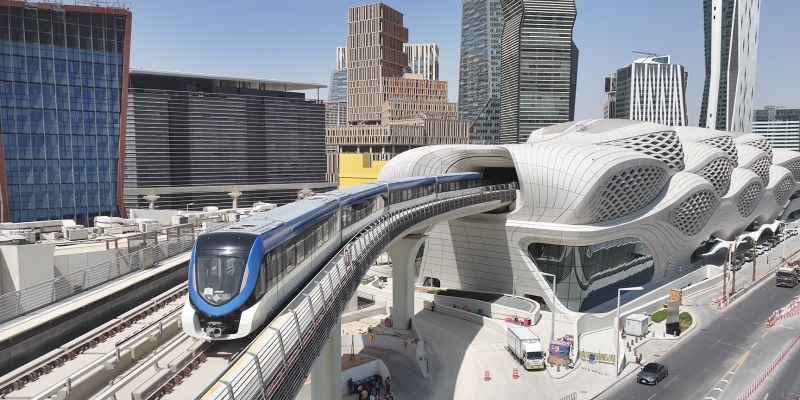
For decades, Riyadh was built around the automobile. Wide highways, sprawling residential districts, and rapid urban expansion turned Saudi Arabia’s capital into one of the most car-dependent cities in the world. However, as population growth accelerated and traffic congestion intensified, the need for a modern public transportation system became increasingly urgent.
Enter the Riyadh Metro—one of the world’s largest urban rail projects and arguably the most significant transportation infrastructure investment in Saudi Arabia’s modern history.
More than just a metro network, the Riyadh Metro represents a strategic pillar of Saudi Vision 2030, aimed at enhancing urban mobility, reducing traffic congestion, promoting sustainability, and improving the quality of life for millions of residents.
As Riyadh continues its transformation into a global business, tourism, and investment hub, the metro is expected to play a critical role in shaping the city’s future.
What Is the Riyadh Metro?
The Riyadh Metro is a large-scale rapid transit system designed to serve Saudi Arabia’s capital city. The network consists of six metro lines spanning approximately 176 kilometers and 85 stations, making it one of the largest urban rail systems ever built simultaneously.
The project was developed under the supervision of the Royal Commission for Riyadh City (RCRC) and forms a key component of the broader Riyadh Public Transport Project (RPTP), which also includes an extensive bus network.
The metro connects major residential districts, government centers, universities, business hubs, commercial areas, and King Khalid International Airport, providing residents with an efficient alternative to private vehicles.
Why Riyadh Needed a Metro System
Riyadh’s population has grown rapidly over the past few decades, transforming the city into one of the Middle East’s largest metropolitan areas.
The city’s road network, despite continuous expansion, struggled to keep pace with rising vehicle ownership and increasing commuter demand.
Before the metro project, public transportation options were limited, and private cars accounted for the overwhelming majority of daily trips.
This created several challenges:
- Heavy traffic congestion
- Increased fuel consumption
- Longer commuting times
- Higher infrastructure maintenance costs
- Growing environmental concerns
The Riyadh Metro was conceived as a long-term solution capable of addressing these issues while supporting future population growth and economic development.
Riyadh Metro and Saudi Vision 2030
The Riyadh Metro aligns directly with Saudi Arabia’s Vision 2030 strategy, which seeks to diversify the economy and improve urban living standards.
Vision 2030 emphasizes:
- Sustainable urban development
- Improved public services
- Environmental responsibility
- Economic diversification
- Enhanced quality of life
Efficient public transportation is essential for achieving these objectives.
By encouraging residents to shift from private vehicles to public transit, the metro helps reduce congestion, lower emissions, and create a more sustainable urban environment.
Furthermore, world-class transportation infrastructure strengthens Riyadh’s appeal as a destination for multinational companies, investors, tourists, and global events.
Riyadh Metro Lines and Network Overview
The Riyadh Metro network consists of six color-coded lines strategically designed to serve key areas of the city.
Blue Line
Runs along King Abdulaziz Road and serves as one of the network’s primary corridors.
Red Line
Traverses King Abdullah Road, connecting eastern and western districts.
Orange Line
Extends along Madinah Road and links several major residential and commercial areas.
Yellow Line
Provides access to King Khalid International Airport.
Green Line
Connects important government and commercial districts.
Purple Line
Serves emerging residential and economic development zones.
Together, these lines create an integrated transportation network designed to accommodate millions of passenger journeys annually.
Engineering and Architectural Excellence
The Riyadh Metro is not only a transportation project but also an architectural landmark.
Several stations feature iconic designs created by internationally renowned architects.
One of the most prominent examples is the King Abdullah Financial District (KAFD) Metro Station, designed by the late Zaha Hadid.
The station’s futuristic design has become one of Riyadh’s most recognizable modern structures and reflects Saudi Arabia’s ambition to create globally significant infrastructure.
Advanced technologies integrated throughout the network include:
- Driverless train operations
- Smart ticketing systems
- Real-time passenger information
- Energy-efficient station designs
- Intelligent traffic management systems
These features position the Riyadh Metro among the world’s most advanced public transportation systems.
Economic Impact of Riyadh Metro
Large-scale transit systems often generate substantial economic benefits, and Riyadh Metro is expected to be no exception.
The project is anticipated to:
Boost Real Estate Development
Properties located near metro stations are likely to experience increased demand and higher valuations.
Support Business Growth
Improved connectivity can increase accessibility for employees, customers, and investors.
Create Employment Opportunities
The metro has generated thousands of jobs across construction, engineering, operations, maintenance, and technology sectors.
Enhance Investment Attractiveness
Modern infrastructure is a key factor considered by international investors when evaluating cities for expansion and relocation.
As Riyadh seeks to become one of the world’s leading economic centers, transportation infrastructure will remain a critical competitive advantage.
Sustainability Benefits
Transportation is one of the largest contributors to urban carbon emissions worldwide.
The Riyadh Metro contributes to Saudi Arabia’s sustainability objectives by:
- Reducing dependence on private vehicles
- Lowering fuel consumption
- Decreasing traffic-related emissions
- Supporting sustainable urban planning
- Encouraging public transportation adoption
These benefits align with broader national efforts to improve environmental performance while maintaining economic growth.
Challenges and Public Adoption
Infrastructure alone does not guarantee success.
One of the most important factors determining the long-term impact of the Riyadh Metro will be public adoption.
For decades, private vehicles have been the dominant mode of transportation in Riyadh.
Changing commuting habits requires:
- Reliable service
- Convenient station access
- Affordable fares
- Strong integration with bus networks
- Positive user experiences
If these factors are achieved, Riyadh could witness a significant shift toward public transportation, similar to transformations seen in cities such as Dubai, Singapore, and Hong Kong.
The Future of Urban Mobility in Riyadh
The Riyadh Metro is more than a transportation network—it is a strategic investment in the future of Saudi Arabia’s capital.
As Riyadh continues to attract global businesses, host major international events, and support ambitious economic initiatives, modern transportation infrastructure will become increasingly important.
The metro provides the foundation for a more connected, efficient, and sustainable city.
For residents, it promises shorter travel times and improved mobility. For investors, it signals long-term confidence in Riyadh’s growth trajectory. For policymakers, it serves as a critical tool in achieving Vision 2030 objectives.
Ultimately, the Riyadh Metro is not simply changing how people travel. It is redefining how Riyadh grows, competes, and positions itself on the global stage.


Leave a Reply