

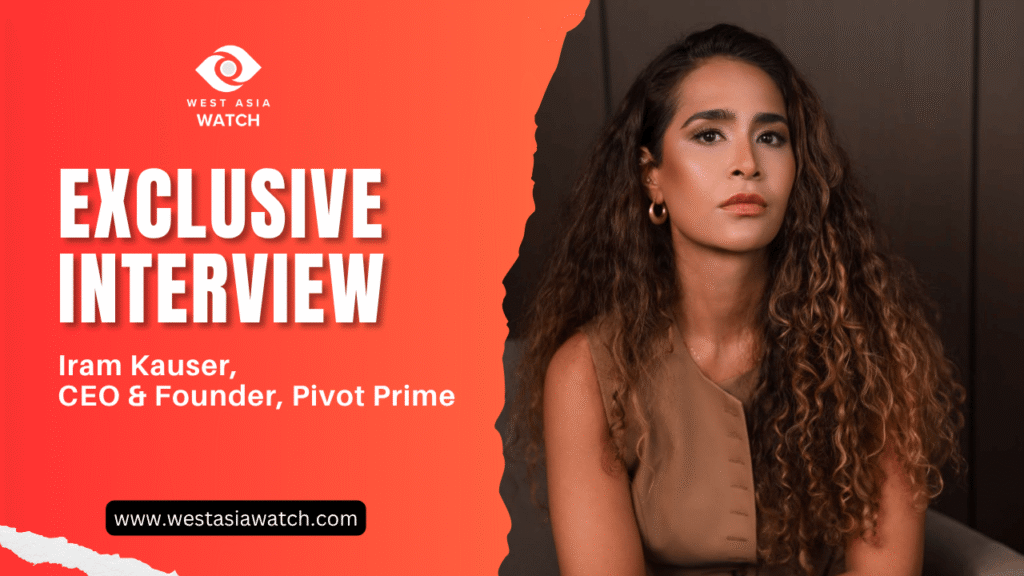
Iram Kauser, Founder and CEO of Pivot Prime, has spent more than 16 years in senior leadership roles across the Middle East, Africa, Europe and the United Kingdom. A mathematician by training and an actuary by profession, she brings a numbers-led approach to solving operational challenges. Through Pivot Prime, Kauser works with founder-led companies, expanding businesses and international firms entering the UAE, helping them translate ambitious strategies into properly resourced and commercially viable operations.
In this interview with West Asia Watch, Kauser discusses why businesses often lose momentum between strategy and execution, the growing relevance of fractional chief operating officers, and the challenges companies face when entering the UAE market. She also examines founder dependency, artificial intelligence adoption, cross-border expansion and the combination of operational discipline and human judgment that will determine which regional businesses successfully scale over the coming years.
1. Pivot Prime positions itself as an execution partner rather than a strategy consultancy. In your experience, where do most businesses in the region lose momentum between strategy and execution?
In two places: resourcing and time. Strategy is usually written by the most innovative people in the room, and innovative people are often optimists. They underestimate how long execution takes and how much resource it consumes. Often, nobody has challenged the assumptions, costed the execution properly or asked whether the organisation actually has the capacity to deliver it. So the plan launches, the first milestone slips, the team quietly loses faith in it, and six months later there is a new strategy.
Most businesses have an abundance of strategies, but they lack someone who can translate the idea into a sequence of properly resourced steps and then hold the delivery. That translation layer is the gap Pivot Prime fills.
2. You describe yourself as a mathematician by training and an actuary by profession. How does a numbers-led approach change the way you diagnose operational problems compared with a more conventional consulting lens?
Human beings are emotional and irrational, and companies are still run by humans.
For example, people will tell you a process is fine, or easy, or that the real problem is headcount.
A numbers-led approach takes the emotions out of it. We measure everything: how long each step actually takes across a representative sample, pass and fail rates, man hours per function, cost per transaction. Then we agree the KPIs that matter, baseline them, and measure again after the changes.
A numbers led approach also changes how we bill our clients. A significant part of our fee is typically structured as a success fee tied to KPIs improving. We make money when our clients make money, and that discipline is only possible because we measure properly in the first place.
On a recent engagement, that approach took a client from loss-making to a projected 13 percent profit margin through a pricing redesign, with breakeven inside eleven months.
3. The fractional COO model is still relatively new in this part of the world. What kinds of businesses benefit most from senior operational leadership without a permanent C-suite hire, and where does the model not fit?
What many businesses actually need is COO-level expertise for a season, not a lifetime.
Someone senior has to design the operating model, build the processes and SOPs, and set the standard for how things should run. But once that structure exists, the day to day can be handled by a much more junior operations lead, with the COO involved a few hours a week. That is how we phase our engagements at Pivot Prime. We start with senior COO leadership to build the machine, then help place or develop a junior operations lead who runs it and reports to the fractional COO. The client keeps the senior oversight without paying a full-time executive salary, and the structure keeps working long after the intensive phase ends. It also fits businesses facing a defined operational moment, a market entry, a turnaround, a scaling phase, where they need senior execution leadership for twelve to eighteen months, not forever.
If you are running a complex operation, with 200+ staff, many different products and services, operations across multiple sites and countries, you need a permanent COO and so a fractional model just does not fit.
4. UAE market entry is a core part of your offering. What is the most common misconception international businesses hold when they enter the UAE, and what does “operational” mean beyond simply being licensed to trade?
The misconception is that if you run a successful business elsewhere, you can copy and paste it into Dubai. Almost nothing pastes cleanly. The regulatory environment is different, and it varies again depending on whether you sit in a free zone or on the mainland. Consumer habits are different: this is a market that lives on delivery apps, expects service levels that would be considered premium elsewhere, and makes buying decisions through community and word of mouth as much as through marketing. The commercial calendar is different too. Ramadan reshapes trading patterns for a month, and a large part of your customer base leaves the country for the summer, so a business plan built on twelve even months will miss badly. Even the physical reality of heat changes how logistics, storage and footfall work for half the year. And the culture rewards relationships and patience; businesses that arrive expecting to transact at home-market speed often stall in ways they cannot explain.
Operational means everything that has to be true before you can serve your first customer profitably. There are hundreds of company formation experts in Dubai who will get you a licence and sometimes a bank account. We support with all of that, but the licence is where we start, not where we stop.
Before anything else, we build a financial model with the client: all the assumptions of the entry priced in, showing the initial investment needed, breakeven point and return on investment. We do not want to begin a UAE market entry that is not going to make money in the UAE, and this is where most international businesses go wrong – they price for the UAE using home-market assumptions and end up busy but unprofitable.
Once the numbers work, we build the operation around them: commercial real estate and office fit-out, hiring through our HR expertise in this market, regulatory and compliance work to make sure your products can legally be sold here, and manufacturing, logistics and supply chain – everything the business needs to start making money.
As I mentioned earlier, a large part of our fee is structured as a success fee, so we have no interest in helping a company enter the UAE only to watch it fail. If the client wastes their money, we have wasted our time. We take clients from licence to a functioning, properly priced operation that can succeed.
5. Founder dependency is a recurring theme in growing companies. What are the early warning signs that a business has outgrown its founder-led operating model, and what does the transition typically require?
Honestly, the signs are usually there from day one. The most common is the founder who wants to keep as much of the economics as possible, so they do everything themselves rather than hire. It works in the short term, but it is short-term thinking: work done at half capacity gets done poorly, and poor work means reputational damage, fewer referrals in a market that runs on word of mouth, and lower customer lifetime value. Hiring the right people costs you profit this year and buys you capacity and repeat business for every year after.
The second sign is personality. Some founders genuinely believe they know best about everything, and it becomes their way or the highway. They insert themselves into every decision, and a business where every decision routes through one person has a hard ceiling on how big it can get. A close cousin of this is the founder who says you simply cannot find good people, or cannot trust them. In reality, that problem has been solved many times over: proper contracts protect the business legally, and there are experts at finding talent – including people willing to join an early-stage company on commission, equity or below-market salary because they believe in the vision and want to build something. “I can’t trust anyone” is usually a hiring strategy problem, not a people problem, and it is one of the things we help founders fix.
The final sign is when the entire business lives in the founder’s head: how things should be done, what the standard is, what the vision means in practice. Nothing is written down, so nothing is repeatable, and every new hire has to be personally shaped by the founder. The transition is about getting that knowledge out of one head and into systems: documented processes, decision trees, trained behaviours, and clear rules for what gets escalated to the founder because it genuinely matters to them. Done properly, the founder ends up with people who act on their behalf, in almost the way they would act themselves – and the business finally has a version of the founder it can replicate.
6. Looking at the region over the next three to five years, which operational capabilities do you believe will separate the businesses that scale successfully from those that stall?
The obvious answer is AI, and the region is betting heavily on it – PwC estimates AI will add around $320 billion to Middle East economies by 2030, roughly 11 percent of GDP, with the UAE seeing the largest relative impact at close to 14 percent. Governments across the Gulf are actively pushing businesses to adopt. But the capability that will separate winners from the rest is not adopting AI. It is knowing where to adopt it.
There is no point applying AI to parts of your business that already work. Goldratt taught this in the eighties with the Theory of Constraints: a business is only as fast as its biggest bottleneck, and making everything else more efficient just builds a longer queue in front of it. The discipline that will matter is diagnostic – identify your single biggest limiting constraint today, then choose the right fix for it. Sometimes that is AI. Sometimes it is simple automation, a basic tool, or one more person in the right seat. Businesses that skip the diagnosis and sprinkle AI everywhere will spend a lot of money accelerating their chaos.
The second capability is the opposite one: protecting human judgement. AI will not replace emotional intelligence in the next three to five years, and probably not after that either. In this region especially, business runs on relationships, and customers buy from people who understand them. The businesses that grow will be the ones that automate the mechanical work precisely so their people have more time to sit with customers, understand their problems, and exercise judgement on the decisions that matter.
The third is the ability to operate across borders within the region, not just sell across them. The growth corridors of the next five years – Saudi Arabia’s transformation, the wider Gulf, East Africa – reward businesses that can genuinely run operations in more than one market: local hiring, local compliance, local supply chains, pricing built for each market rather than exported from the first one. Plenty of companies can open a sales office. Far fewer can stand up a real operation in a second and third market without breaking what made them good in the first. That, more than any technology, is the operational capability I would bet on.
7. You’ve held senior leadership roles across the Middle East, Africa, Europe, and the UK over sixteen years. What experience most shaped your understanding of how businesses actually operate?
The biggest lesson of sixteen years is that businesses look top down but run bottom up. Leadership sets the culture and the direction, and that matters. But the actual work – the customer service, the operations, everything the customer experiences – is done by people who are not in leadership positions. Working in operations and as Chief of Staff taught me to go and sit with those people, because they are the ones who know how things really run. Leaders often carry an idealistic picture of how the business should work. The people doing the work know what is actually possible, and the gap between those two pictures is where most operational problems live.
That is why almost every Pivot Prime engagement starts with an operational clarity audit, and why the audit is built on one-to-one interviews and workshops with the people doing the work: what works, what doesn’t, and why. You cannot fix an operation you have only seen from the org chart.
The other half of the lesson is organisational psychology. If your culture motivates people, they are loyal and they do the right thing when nobody is watching. If there is psychological safety, they raise issues before it is too late and treat the business like their own. If instead you push decisions down without bringing people on the journey, and run a culture of fear, people will comply – but you lose your best talent to competitors, and the people who stay go quiet. A quiet workforce is one of the most expensive things a business can have, because the problems are still there; you just hear about them last.
Here is a very practical example. Operations and admin staff will almost never volunteer AI and automation ideas, because they are being asked to suggest away their own roles. If you want your people to help you automate, there has to be something in it for them – a redeployment path, a stake in the gains, a genuinely better role on the other side. That is not a technology problem, it is an incentive design problem, and it is exactly the kind of thing we manage for clients during transformation. Change fails on psychology far more often than it fails on process.
8. What prompted the decision to leave a regional Head of Operations role and build Pivot Prime? Was there a particular moment that made the move feel necessary?
There was no single lightning-bolt moment. It was three realisations arriving at the same time.
The first came from the seat itself. Sitting on an executive committee, you see exactly where value is won or lost: in the gap between what leadership decides and what actually gets delivered. Large corporates have entire layers of people to close that gap. The businesses driving this region’s growth — founder-led companies, mid-sized firms scaling fast, international businesses arriving here – mostly don’t, and they feel the cost of it directly on their P&L. I had spent sixteen years closing that gap inside large organisations. I wanted to close it for the businesses that need it most and have nobody to do it.
The second was that I am a generalist, and one role stopped fitting me. I can price a portfolio, run operations, read the human psychology of a team, and coach people through change. In a corporate, that is never one job. At Pivot Prime it is exactly one job: I advise clients across all of it, and when it comes to the build, my team of experts goes in and does the work. There is also a directness I was looking for. In a large organisation you influence outcomes through many hands. In our engagements, we are accountable for them — and a significant part of our fee is tied to results, which is exactly how I want to work.
The third was the market itself. I was sitting in a seat where I could see exactly what was arriving in the UAE: family offices, hedge funds, international businesses relocating, and ambitious companies scaling across the region. They need global best practice and senior operating experience — but many need it for a season rather than as a permanent C-suite hire. Meanwhile, the world is long on ideas and short on execution. Strategies are exciting; most are never completed. I knew the demand, and I knew my execution drive was the supply.
And underneath all of it: I have lived in the UAE for ten years and I love it here. If I can help businesses set up properly and thrive, that is my service to the country I call home.



Leave a Reply