

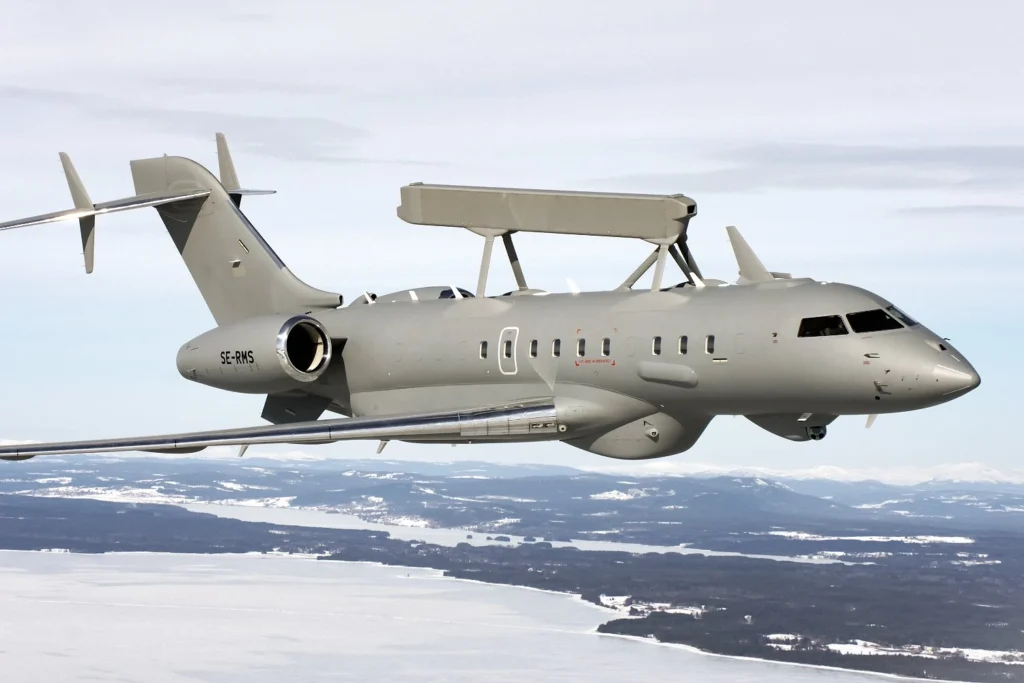
Swedish defence company Saab has received an order valued at SEK 10.1 billion for two GlobalEye Airborne Early Warning and Control aircraft from an undisclosed customer in the Middle East. Deliveries are scheduled to take place in 2030.
Saab has not identified the customer, citing commercial confidentiality, national security considerations and the sensitive nature of the defence industry.
“This order underscores our commitment to providing customers with mission-proven, multi-domain AEW&C capability. The increasing international interest in GlobalEye reflects its effectiveness and reliability in modern air defence operations,” said Micael Johansson, President and CEO of Saab.
GlobalEye is built around the Bombardier Global 6000/6500 business-jet platform and integrates Saab’s Erieye Extended Range radar with a suite of active and passive sensors. The aircraft can simultaneously monitor activity in the air, at sea and over land, providing commanders with real-time intelligence, early warning and a comprehensive operational picture.
UAE Already Operates GlobalEye
The United Arab Emirates is already the most prominent GlobalEye operator in the Gulf region and served as the launch customer for the platform. The UAE acquired the aircraft to strengthen its airborne surveillance, command-and-control and early-warning capabilities across the Gulf, Arabian Sea and wider Middle East.
The UAE’s adoption of GlobalEye has also demonstrated the growing preference among Gulf states for advanced, long-endurance surveillance aircraft capable of tracking cruise missiles, drones, combat aircraft, maritime vessels and low-flying threats across multiple domains.
Although Saab has not disclosed the identity of the latest customer, the order highlights continuing regional demand for advanced airborne early-warning systems amid the rapid expansion of missile, drone and electronic-warfare capabilities across West Asia.
Strategic Significance for the GCC
For GCC states, airborne early-warning aircraft are becoming increasingly important as the regional threat environment shifts from conventional air warfare towards complex, multi-vector attacks involving ballistic missiles, cruise missiles, unmanned aerial vehicles and electronic warfare.
Ground-based radars remain essential, but their effectiveness can be constrained by terrain, radar horizons and the low-altitude flight profiles of cruise missiles and drones. An airborne platform such as GlobalEye can extend the detection range, identify threats earlier and distribute targeting information to fighter aircraft, naval vessels and ground-based air-defence systems.
The platform could therefore serve as a central component of an integrated air and missile defence network, particularly as GCC governments seek greater interoperability between national command systems, fighter fleets, naval assets and surface-to-air missile batteries.
GlobalEye’s maritime-surveillance capability is also strategically relevant for Gulf countries. The system can monitor shipping routes, naval movements and suspicious activity around critical waterways, including the Strait of Hormuz, the Gulf of Oman, the Red Sea and the Arabian Sea.
A Wider Regional Procurement Trend
The latest order reflects a wider regional effort to improve persistent surveillance and command-and-control capabilities rather than relying solely on fighter aircraft and ground-based air-defence systems.
Gulf states are investing heavily in layered air and missile defence, counter-drone systems, intelligence platforms and networked command structures. Recent regional conflicts have demonstrated that the ability to detect and classify threats early is often as important as the interceptor used to destroy them.
By combining long-range radar coverage with maritime and ground surveillance, GlobalEye gives operators a broader intelligence picture than traditional airborne warning aircraft designed primarily for airspace monitoring.
The identity of the customer may remain undisclosed for security reasons, but the scale of the contract indicates that advanced airborne surveillance is becoming a central element of defence modernisation across the Middle East.
For the GCC, the order is another indication that future regional air defence will depend increasingly on connected sensors, airborne command platforms and the rapid sharing of operational data across multiple services and national boundaries.




Leave a Reply