As military institutions confront rapidly evolving security challenges, the debate over defense policy, procurement, and the future of warfare has become increasingly urgent. Behind every strategy, weapons program, and operational doctrine lies a deeper question: how should governments balance technology, military readiness, and the human realities of war?
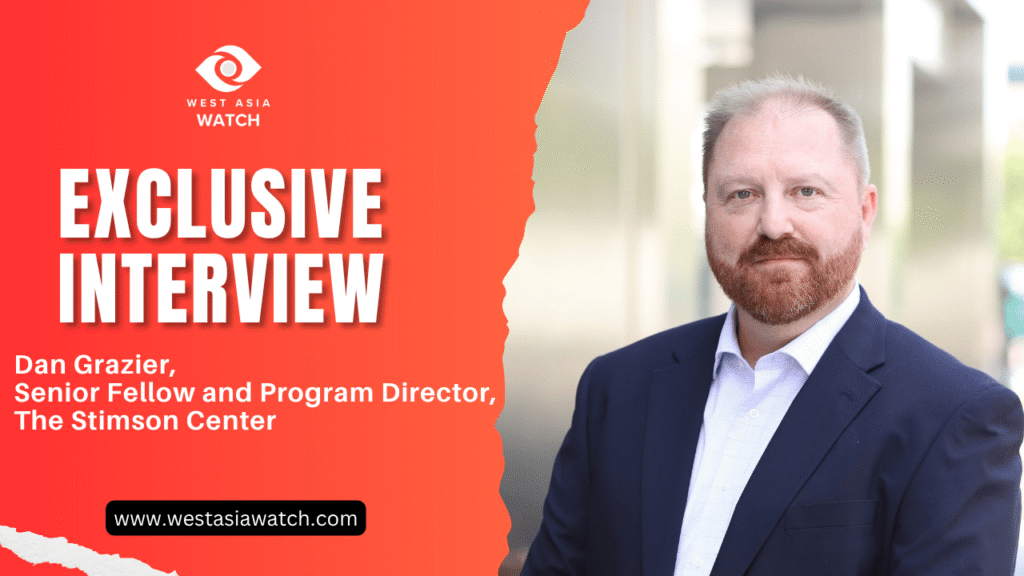
In this exclusive interview, West Asia Watch speaks with Dan Grazier, Senior Fellow and Program Director at The Stimson Center, about his journey from Marine Corps officer and journalist to defense policy researcher. Drawing on his experience in Iraq and Afghanistan, Grazier reflects on the lessons of the War on Terror, the limits of technology-driven military thinking, the role of journalism in public accountability, and why war must always be understood as a profoundly human endeavor.
How did your experience as a Marine Corps officer and journalist shape the foundation of your current policy work?
As it turned out, I was engineering myself for my current role all along and didn’t realize it. I suppose that a common experience for a person as they move through their career. Experience stacks on top of experience until you have carved a niche for yourself. My experience just happened to be a little more public. My time as a journalist taught me how to speak in public, how to ask the right questions to find the heart of a matter, and how to explain complex subjects in a publicly accessible form. I also did that job as a very young man. I was barely 23 years old when I made my first professional television appearance. I learned very quickly not to be intimidated or too impressed by anyone. I dealt with politicians, celebrities, and executives. They are all just people with all the frailties and failings like every other human being. Many of them turned out to be far less impressive than advertised, so I walk into every meeting now on equal terms.
I would need an entire book to explain how my military experience influences my work. I joined the Marine Corps because I was the exact right age to serve in the War on Terror. A major motivation for joining was to avoid having to explain now why I didn’t. My Marines and I all went through quite a lot in terms of opportunity cost, time with our families, to say nothing of the pain and stress of training and deployments. What was any of that for? The United States lost in Iraq and Afghanistan. People at the top of the National Security Establishment made their careers and fortunes during that time, while my Marines struggled once they were released back into the civilian world. Some of them still do nearly 20 years later. I work now to make sure the government does right by them and all who follow in their footsteps.
You mentioned your time in Iraq and Afghanistan during the War on Terror what key operational or human lessons from those deployments continue to influence your thinking today?
My first deployment was to Iraq in 2007. As the commander of a tank platoon, I was at the very end of American foreign and military policy. You can choose the appropriate cliché: I was at the absolute pointiest tip of the spear or where the rubber meets the road. What I experienced there was the reality of what exists as a bunch of talk in Washington. My Marines and I had to deal with a bunch of equipment that were doubtlessly talked about with great optimism in Congress, but gave us nothing but headaches because it didn’t work right. I had to deal with an army of civilian contractors, but I could not tell what any of them did other than get in our way. I spent two years going through extensive training before my deployment. All of that training focused on being the most lethal officer possible. But when I got on the ground in Iraq, I was told our job was to pacify the population and deescalate matters. No one could tell me how to do this and the only tools the government gave me for such a delicate role were four main battle tanks because you “go to war with the Army you have, not the Army you might want or wish to have at a later time.”
How did your transition from active service and journalism into policy research at The Stimson Center develop over time?
When I first started working in Washington after the Marine Corps, I very much reverted back to being a general assignment reporter focused on the immediate news cycle. Many of my earliest pieces dealt with the news of the day or very specific issues. As I spent more time, I realized the real problems were fundamental and systemic. I found that people in Washington operated under broad, general premises and that most of the discussion happened in the details. For example, a general premise in national security circles is that China will invade Taiwan. That has been received wisdom in Washington for years and nearly everyone just accepts it and frames all their work accordingly. My colleagues James Siebens, MacKenna Rawlins, and I challenged that basic premise with a report we published in 2025. The basic philosophy at the core of my work today is quite simple: we will never arrive at the right solution if we do not fundamentally understand the real problem. So my work today focuses on questioning the essential premise.
Based on your experience, how do you see the relationship between lived military experience and policy formulation in practice?
Frankly, I find it frustrating at times. There are a bunch of things I understand intuitively because I experienced it first hand, but I have a difficult time making other understand it. For example, I am a vocal critic of the Air Force as an institution and the idea that airpower has value independently of ground or naval operations. This stems directly from my experience. As a Marine Corps tank officer, I had to learn very quickly how to integrate myself into a much larger military system. We call this combined arms warfare. All elements of the force must work together to make the entire enterprise function as effectively as possible. It is a big challenge just to get Marine Corps armor and Marine Corps artillery to work together. Even though we all wore the same uniform, operate within the same institutional culture, and exist within the same hierarchy, there is still an enormous amount of internal friction that must be overcome. When dealing with a different military service with a different institutional culture and different operational concepts, the level of friction is sometimes too much to overcome. Getting people in Washington who have never dealt with those challenges on the ground to understand such things is a great challenge.
What are the most significant challenges you observed during your service that still remain relevant in today’s defense environment?
The most significant challenge that remains relevant in today’s defense environment is to make people understand that war is a human endeavor rather than a technical or mechanical exercise. The entire National Security Establishment operates as though war is a clash of machines and the side that has the fanciest machines wins. There is so much focus on airplanes, ships, and tanks, that the airmen, sailors, and soldiers almost become bit players in the overall drama. Drones may be some of the dominate tools for future soldiers, but the soldiers are still what count. Drones, like any weapon, should be designed to assist the soldier to accomplish his mission. Trying to design the soldier out of the system, trying to eliminate the humanity from war, will only ensure that future wars are more inhumane than they already are.
You mentioned your work is rooted in real experience show do you ensure that personal experience translates into balanced policy analysis?
Very much so. I want to make sure that defense policy is rooted in reality rather than slick marketing materials produced inside a corporate boardroom by people who have never even held a rifle.
How do you view the role of media and journalism in shaping public understanding of military operations and reform?
Journalists play a very important role in making sure the public knows what the people working in government are doing on their behalf. It’s important for the people to know that the National Security Establishment is squandering generational wealth on wars that fail more often than they succeed and weapons that don’t work as advertised. Without them, people in government, the military, and the defense industry will tell everyone that everything in the military is great and the people will only find out otherwise when the United States loses a war. That being said, the United States already loses a bunch of wars, but because of the free press, the reasons why can be determined.
From your perspective, what key lessons from recent conflicts are still not fully integrated into institutional military thinking?
The main lesson everyone should learn is that no amount of technology will ever change the fundamental nature of war. War remains a human endeavor, fought for human purposes. All the human elements of war; fear, confusion, horror, struggle, etc. will always remain. There is no such thing as a clean war. Those who believe such a thing is possible are very dangerous because they will effectively lower the threshold for starting a war. That is an excellent way to create the conditions for a 19 year old with a rifle to find himself in some far-away place fighting for a cause he can’t explain.





Leave a Reply