

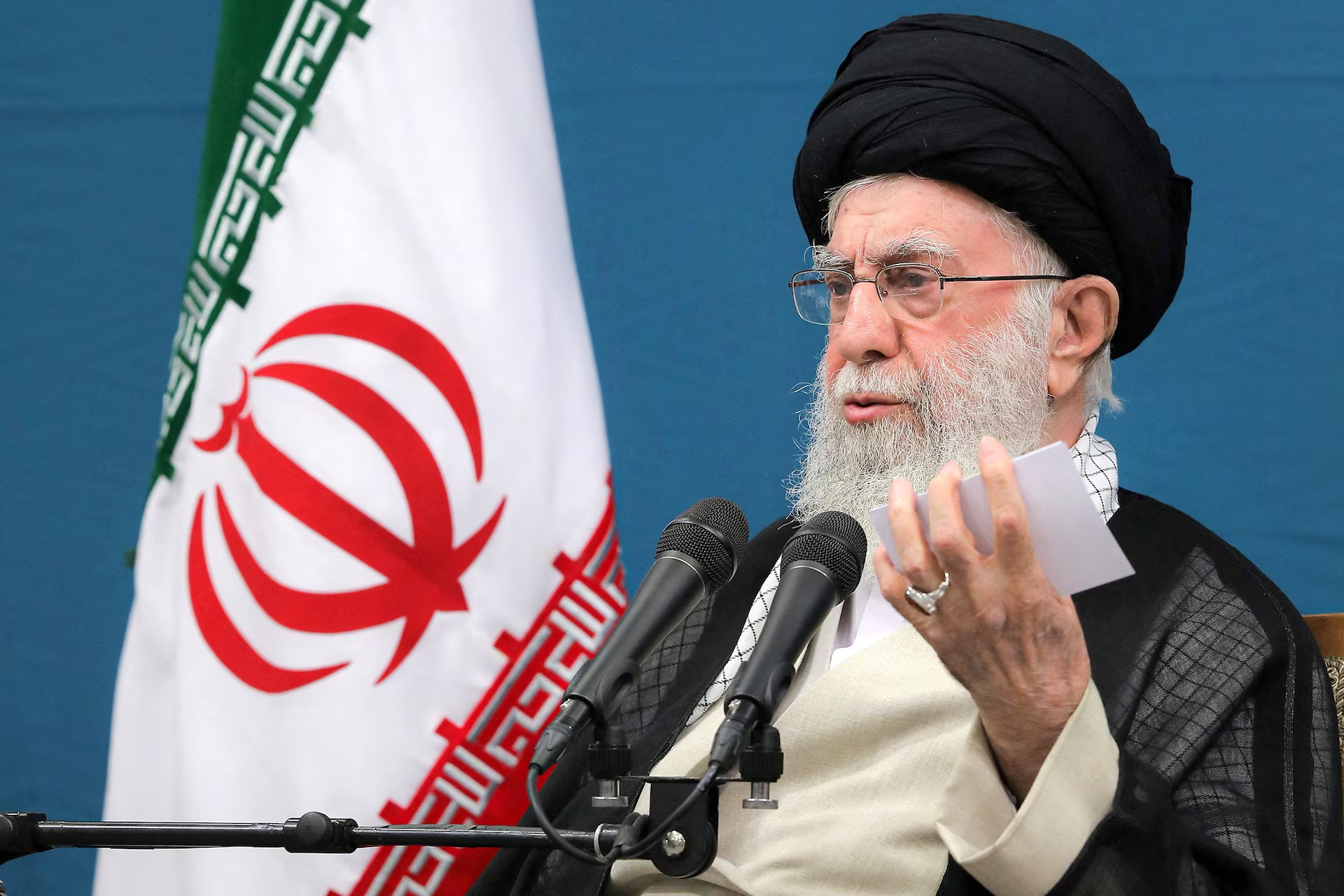
The Supreme Leader of Iran is the most powerful authority in the Islamic Republic. While Iran has a President, Parliament and elected institutions, the Supreme Leader stands above all branches of government.
The position combines:
-
Religious authority
-
Constitutional supremacy
-
Military command
-
Judicial oversight
-
Strategic policymaking power
To understand Iran’s political system, foreign policy behavior, nuclear strategy or regional posture, one must first understand the Supreme Leader of Iran.
Ideological Foundation: Velayat-e Faqih
The office of the Supreme Leader of Iran is based on the doctrine of Velayat-e Faqih, meaning Guardianship of the Islamic Jurist.
This doctrine argues that:
-
In the absence of the Hidden Imam in Shia Islam
-
A qualified Islamic jurist must supervise governance
-
The state must remain aligned with Islamic law
When the Islamic Republic was established in 1979, this principle was embedded in the Constitution, making the Supreme Leader both a political and religious guardian of the state.
This dual legitimacy is what distinguishes the Supreme Leader from ordinary heads of state.
Constitutional Authority of the Supreme Leader of Iran
Article 110 of the Constitution defines the core powers of the Supreme Leader. These powers extend across every critical state institution.
1. Supreme Authority Over State Policy
The Supreme Leader:
-
Determines the general policies of the Islamic Republic
-
Supervises their implementation
-
Resolves disputes between branches of government
This means that while elected officials may propose reforms, strategic direction is set at the top.
2. Commander-in-Chief of the Armed Forces
The Supreme Leader of Iran has full command authority over:
-
The Islamic Republic of Iran Army
-
The Islamic Revolutionary Guard Corps
-
The Basij paramilitary forces
-
National intelligence services
Key powers include:
-
Appointment of senior military commanders
-
Approval of defense doctrine
-
Authority to declare war or peace
-
Oversight of missile and deterrence strategy
In practical terms, Iran’s military posture answers directly to the Supreme Leader.
3. Control Over the Revolutionary Guard
The Islamic Revolutionary Guard Corps is not only a military force but also:
-
A political power center
-
A regional security actor
-
A major economic stakeholder
The Supreme Leader directly appoints its top commanders, ensuring institutional loyalty. This relationship makes the office central to Iran’s regional influence strategy.
4. Authority Over the Judiciary
The Supreme Leader appoints the Head of the Judiciary. Through this mechanism, he indirectly influences:
-
Senior judges
-
Prosecutors
-
Political and security-related legal cases
This judicial authority ensures alignment between legal enforcement and ideological priorities.
5. Influence Over Elections and Political Structure
Iran conducts presidential and parliamentary elections. However, candidate approval is overseen by the Guardian Council.
The Guardian Council includes:
-
Six Islamic jurists appointed directly by the Supreme Leader
-
Six legal experts nominated by the judiciary
Because the judiciary head is appointed by the Supreme Leader, this structure extends his influence over electoral vetting.
As a result, Iran’s electoral system functions within boundaries shaped by the Supreme Leader.
6. Oversight of the Executive Branch
The President manages economic policy, cabinet affairs and administration. However:
-
Major foreign policy decisions require alignment with the Supreme Leader
-
National security strategy is defined at the top
-
Nuclear policy boundaries are determined by the Supreme Leader
The President governs, but within a strategic framework set by the Supreme Leader.
7. Control Over State Media
The Supreme Leader appoints the head of the national broadcasting organization.
This provides influence over:
-
National messaging
-
Political narratives
-
Coverage of domestic unrest
-
Foreign policy framing
Media oversight reinforces ideological continuity.
Economic Influence of the Supreme Leader
Beyond formal political structures, the Supreme Leader oversees powerful economic foundations known as bonyads.
These institutions:
-
Control significant financial assets
-
Operate across multiple economic sectors
-
Function outside standard parliamentary budget scrutiny
This economic dimension strengthens institutional autonomy and long-term stability of the office.
Religious Legitimacy and Symbolic Authority
The Supreme Leader is also a senior Shia cleric. This religious authority allows the office to:
-
Issue guidance on Islamic governance
-
Define ideological red lines
-
Shape the moral narrative of the state
Political legitimacy is therefore reinforced by theological legitimacy.
Historical Context of the Supreme Leader of Iran
Ayatollah Ruhollah Khomeini
-
First Supreme Leader
-
Established the Islamic Republic in 1979
-
Institutionalized Velayat-e Faqih
-
Embedded clerical oversight into state structure
Khomeini defined the ideological blueprint of the office.
Ayatollah Ali Khamenei
-
Second Supreme Leader
-
Consolidated institutional power
-
Oversaw expansion of the Revolutionary Guard’s role
-
Maintained centralized strategic control
Under his tenure, the structure of the Supreme Leader became deeply embedded across political, military and economic institutions.
How Powerful Is the Supreme Leader Compared to the President?
President:
-
Manages administration
-
Oversees cabinet
-
Implements economic policy
Supreme Leader:
-
Defines national strategy
-
Commands the military
-
Oversees judiciary
-
Influences elections
-
Controls ideological direction
In Iran’s political hierarchy, the Supreme Leader is the final authority.
Strategic Importance of the Supreme Leader of Iran
The Supreme Leader shapes:
-
Iran’s regional security posture
-
Nuclear program policy boundaries
-
Relations with Western powers
-
Domestic political tolerance levels
-
Revolutionary identity and long-term direction
No major transformation in Iran occurs without alignment with this office.
Conclusion
The Supreme Leader of Iran is the institutional core of the Islamic Republic. The office combines religious guardianship with constitutional supremacy, military command, judicial oversight and political supervision.
While elected bodies exist, their authority operates within a strategic framework defined by the Supreme Leader. This makes the office not only the most powerful institution in Iran, but also the defining factor in the country’s domestic governance and regional strategy.
Any serious geopolitical assessment of Iran must begin with a thorough understanding of the Supreme Leader.


Leave a Reply