

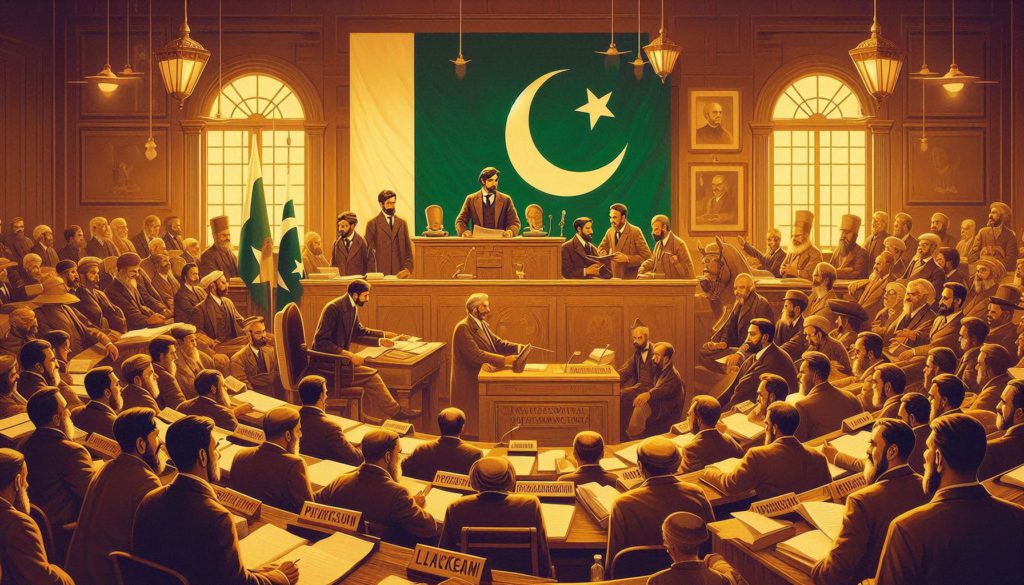
For many years, Pakistan’s public diplomacy has struggled with questions of identity. Inside the country, we have often mistaken loud propaganda for real and effective communication. Outside the country, our international image has mostly been reactive shaped by responding to crises instead of building strong and long-term relationships.
Now, as the global information world is changing faster than ever before since the rise of modern news media, Pakistan is at a very important turning point. Improving public diplomacy is no longer just a choice; it has become necessary for the country’s future survival and progress.
Although the challenges are serious, there are also great opportunities. If Pakistan deals with them wisely, with clear thinking and strong institutions, it could completely change how the world sees this country of 240 million people.
The Credibility Trap: Why Old Tactics No Longer Work
Historically, Pakistan’s diplomatic outreach has been controlled by the state, focused on defense, and heavily centered on the issue of Kashmir. While the importance and legitimacy of the Kashmir cause is still valid, focusing too much on a single issue has caused Pakistan to be seen in a limited way as a “security-obsessed state” instead of being recognized for its rich Sufi traditions, cultural creativity, and growing technology sector.
The military’s media wing, ISPR, although effective in its work, has often dominated public messaging. This has made the line between national security communication and genuine people-to-people cultural engagement unclear. Because of this strong focus on security, many audiences in the West and the Global South have been less engaged, as they are more interested in cultural and economic stories rather than only political issues.
A major challenge in this development is trust. Pakistan faces a credibility gap created by many years of conflicting messages. On one hand, it promotes regional peace, while on the other hand, it is accused of tolerating militant elements. It also highlights democratic progress, while experiencing repeated political instability. In today’s world of instant fact-checking and open-source information, empty slogans are no longer convincing.
The digital age has made things even more complex. It gives countries a chance to bypass traditional Western media, but it also spreads misinformation very quickly. Rivals and sometimes even overly enthusiastic supporters online spread exaggerated or misleading content, turning serious foreign policy issues into online battles. In reality, authenticity, not online noise, is the real strength of modern public diplomacy, and in this area, Pakistan is currently falling behind.
Another problem is weak coordination between institutions. The Foreign Office, the Prime Minister’s Secretariat, military media units, and cultural organizations often do not work together properly and sometimes even work against each other. As a result, there is no clear or unified “Pakistan brand.” In comparison, countries like Turkey, with its Yunus Emre Institute, or China, with its Confucius Institutes both state-supported but culturally focused operate in a more organized and independent way. Pakistan’s equivalent, the Pakistan National Council of the Arts, remains underfunded and largely absent on the global stage.
The Youth and Diaspora Factor: An Untapped Goldmine
Yet within these serious challenges, there are also important opportunities.
The first opportunity is Pakistan’s young population. More than 60% of Pakistan’s people are under the age of thirty. This large youth population has also created a strong diaspora that is active online, financially successful, and deeply connected to its cultural roots. Pakistani professionals around the world such as engineers in Silicon Valley and artists in London can naturally act as ambassadors for the country. Instead of controlling the national narrative, the government should focus on supporting and enabling these voices. Even a small program of support for Pakistani filmmakers, food vloggers, and tech content creators to share stories from different parts of the country could create more positive international impact than expensive advertising campaigns in elite Western newspapers.
The second opportunity comes from changes in global politics. As the United States reduces its involvement in the Middle East and the world moves toward a multipolar system, Pakistan is no longer seen only as a “frontline state.” Instead, it has the chance to become a hub for trade and connectivity. The China-Pakistan Economic Corridor (CPEC) already provides a real story of regional development and cooperation. Public diplomacy should now highlight the next stage of CPEC, especially in agriculture, information technology, and community-based projects. Rather than focusing only on large infrastructure projects, Pakistan should share human-centered stories for example, a farmer learning modern techniques from a Chinese partner, or a young woman coding in a Lahore tech center supported by joint investment. This helps turn statistics into real human experiences.
In addition, Pakistan has a very strong but underused soft power resource: its spiritual and cultural heritage. The world is interested in stories of peace and coexistence. The shrines of Lahore, the mosques of Sindh, and the valleys of Chitral all show a different picture than the idea of extremism. A strong public diplomacy strategy could invite international travel influencers, organize global Sufi music festivals, and offer academic visas to researchers studying this heritage. The country already has rich cultural resources it mainly needs better presentation and management.
A Roadmap for the Future: From Spin to Substance
To make use of these opportunities, Pakistan needs a National Public Diplomacy Strategy that is led by civilians, managed professionally, and protected from constant political changes. This strategy should be based on three main pillars.
First, there should be a special Public Diplomacy Division within the Foreign Office. This should not only include career diplomats, but also branding experts, data analysts, and digital storytellers who understand modern communication and global media.
Second, Pakistan should create an annual “Pakistan Perspective” fellowship. This would invite foreign journalists and researchers to visit the country freely and safely, without heavy surveillance. If exposure is too limited, it becomes no real exposure at all.
Third, there should be a proper platform to engage the Pakistani diaspora. This should go beyond symbolic awards and instead focus on real cooperation in areas like trade, education, and policy development.
The biggest challenge, however, is internal. It is Pakistan’s difficulty in separating national policy from political conflict. In Pakistan, every new foreign minister changes branding and logos, and every new government removes the social media campaigns of the previous one. Public diplomacy needs continuity and stability.
It also requires honesty about past mistakes whether in Afghanistan or in how minorities have been treated without waiting for a crisis or scandal to force this discussion. Strong and mature countries accept their history and learn from it, instead of treating it as a permanent burden.
Conclusion
The future development of Pakistan’s public diplomacy reflects how mature the country is as a nation. We can either continue the expensive practice of hiring foreign PR firms just to improve our image, or we can invest in the slower and more difficult process of building real relationships through culture, trade, and genuine human connection.
The world does not need another country that only praises itself loudly. Instead, it needs a Pakistan that listens, shares its food and music, and engages with honesty and intellectual openness.
The opportunity is already there. The digital world is open to us. But if we enter it while still carrying the same old habits of defensiveness and image management, we will not truly reach the global stage. Instead, we will end up trapped in a “hall of mirrors,” only talking and arguing with ourselves.
Qandeel Zahra
Qandeel Zahra is an undergraduate student of International Relations at Fatima Jinnah Women University. Her areas of interest are worldwide affairs, diplomacy, global politics, security, and development issues.

Leave a Reply