

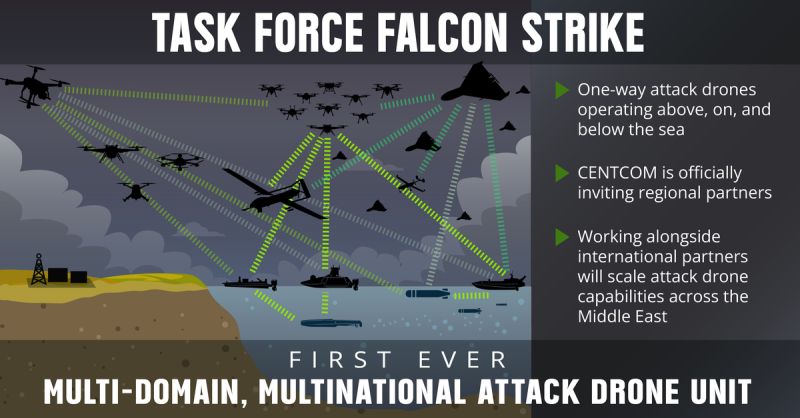
On August 13, 2026, U.S. Central Command (CENTCOM) announced raising of Task Force Falcon Strike, described by CENTCOM as the first-ever multi-domain, multinational drone task force. Led by Special Operations Command Central (SOCCENT) out of MacDill Air Force Base, the unit will field one-way attack (OWA) drones across the air, surface, and subsurface domains, crewed jointly by American operators and once formal invitations are accepted, personnel from regional partner militaries. The announcement lands nine months after CENTCOM’s earlier unit, Task Force Scorpion Strike was created to address threats in West Asia, formalizing the first launch of an aerial one-way attack drone from a U.S. Navy warship in December 2025, combat employment during Operation Epic Fury, and strikes on Iranian port infrastructure in July 2026. Falcon Strike is the first formal attempt to institutionalize what Scorpion Strike proved could work tactically, and to do so as a coalition structure rather than a purely American formation. The step also hints at the next type of warfare that will take place in the region.
Operationalizing lessons from War Theaters
CENTCOM planners, and the doctrine writers behind Falcon Strike, appear to have absorbed a more structural lesson from both Ukrainian and Iranian drone employment. Analysts at the Irregular Warfare Center noted that in one documented front-line comparison from Ukrainian theater that artillery units achieved targeting efficiency of roughly 0.5 to 1.5 percent, while first-person-view strike drone units in the same sector achieved 50 to 60 percent. This demonstrates that mass, precision, and cost can be decoupled from legacy munitions altogether, provided the force has the industrial base, the training pipeline, and the command and control to sustain it.
The US Army’s own lead experimentation unit, the 101st Airborne’s 2nd Brigade Combat Team, has been running trench-breach and bunker-clearance drills using mother-ship drones that dispense smaller loitering munitions, jam breakers, and smoke-screen systems, explicitly modeled on what field commanders observed of the Ukrainian fight. The lesson is not “buy more drones.” It is that unmanned systems have become a combat ecosystem, one that requires attritable mass, distributed command down to small-unit level, and a defense industrial base that can replace losses faster than an adversary can inflict them.
Falcon Strike is CENTCOM’s attempt to apply that ecosystem logic to a theater that, unlike the Ukrainian front, is maritime, multinational, and politically fragmented among sovereign Gulf partners with divergent threat perceptions of Iran, Israel and even amongst themselves.
The Gulf’s own Drone Buildup in 2026
What makes Falcon Strike consequential rather than symbolic is that it arrives at a Gulf security environment where regional militaries have spent the better part of a decade diversifying their unmanned systems inventories away from exclusive dependence on Washington. The UAE was among the earliest Middle Eastern operators of China’s Wing Loong family, acquiring the original Wing Loong in the mid-2010s and later becoming one of the first foreign operators of the Wing Loong II. Saudi Arabia followed a similar path, fielding both the CH-4 from China Aerospace Science and Technology Corporation and its own Wing Loong II fleet. Per SIPRI data, the UAE and Saudi Arabia together accounted for roughly 41 percent of the more than 200 Chinese combat drones exported to seventeen countries between 2013 and 2023, a period during which U.S. export policy under the Missile Technology Control Regime kept American armed drones largely out of reach for many of these same partners.
That dependency has produced real interoperability friction inside the very coalition CENTCOM now wants to nurture. In early April 2026, Iranian air defenses shot down a Chinese-built Wing Loong II near Shiraz, with open-source analysts and Iran’s own foreign ministry pointing toward Saudi or Emirati operators, since neither Washington nor Tel Aviv fields the type. The episode underscored two dynamics in parallel. Firstly, the Gulf states are willing to run offensive unmanned operations independently, or alongside U.S.-led missions. Secondly, they are doing so with platforms, data links, and a precision arsenal that lies outside the American kill chain and NATO interoperability. A multinational task force that wants genuine multi-domain integration has to reckon with partners whose fleets are not sourced, coded, or secured the same way American systems are, precisely how European NATO systems are standardized across all streams of arsenal.
Gulf states have been on a drone pursuit frenzy also, especially after Iranian Shahed volleys and expending costly air defense. Back in April, Ukrainian President Volodymyr Zelenskyy announced signing a “Drone Agreement” with Saudi Arabia, the UAE, and Qatar. This agreement would be comprehensive covering drone and counter-UAS production, tactical expertise that would obviate using pricey Western air defenses against cheap Iranian drones and bring down cost dividend ratio. This is the Gulf’s response against both Iranian saturation attacks and overreliance on expensive Western air defense interceptors. This is precisely the same attritional math that has driven USA’s strategic tilt towards LUCAS (Low-Cost Uncrewed Combat Attack System) and other low-cost systems.
Falcon Strike’s Framework and Industrial Limitations?
From a strategic defense purview, Falcon Strike is best understood as an attempt to build a multi-domain, multinational task force framework for unmanned systems, layered underneath SOCCENT rather than a conventional numbered fleet or a corps headquarters. That choice matters. Special operations task forces are built for rapid task organization, flexible rules of engagement, and coalition plug-and-play staffing, which suits a force meant to onboard partner nations incrementally as they accept CENTCOM’s invitation.
Whether this architecture can function efficiently is a question of industrial prowess as much as doctrine. The U.S. record on scaling attritable drone production is mixed. In late 2025, the Pentagon tacitly folded its 2023 Replicator initiative into a new Defense Autonomous Warfare Group. This decision followed a Congressional Research Service finding that the program had fielded only hundreds, rather than the targeted thousands, of attritable systems by its August 2025 deadline. Concurrently, the Pentagon’s Drone Dominance Program is delegating production into stage-wise “gauntlets.” In the first phase, the program tasks twelve vendors with delivering 30,000 one-way attack drones at a unit cost of approximately $5,000 each, with plans for larger production runs to follow.
These figures pale in comparison to Ukraine’s drone trajectory, where domestic industry expects to produce roughly 7 million military drones in 2026, up from 4 million in 2025. A mixed public-private financing model sustains this buildup by drawing on both state contracts and foreign investment in private firms.
The stark gap between American ambition and Ukrainian wartime output directly answers whether Falcon Strike’s architecture can work efficiently. While the task force designs a practical yet ambitious operational concept—sharing a distributed, multi-domain strike capability across a coalition—real-world industrial capacity limits its success. The strategy ultimately hinges on whether the American and Gulf industrial bases can produce and replace attritable systems at a wartime tempo, rather than the sluggish pace of a peacetime acquisition cycle.
Impact of Gulf’s Existing Battle Lines and Alliances?
Because Washington’s Middle East Gulf allies already operate Chinese military hardware, Falcon Strike will force a difficult dilemma regarding force structure and joint employment. Joining a genuinely integrated, multi-domain, American-led task force will require these partners to segregate or re-architect the command, control, and data links of their Chinese- or Russian-origin platforms, completely isolating them from Falcon Strike’s shared targeting and battle-management network.
Clearly, Washington will refuse to extend sensitive kill-chain integration to any systems that rely on adversarial state supply chains, especially China’s. In practice, this restriction will split Gulf orders of battle (ORBATs) into two distinct layers. The first is Western-Interoperable Strike Layer, which is built around LUCAS-type systems and US-compatible command networks (combining human operators and AI software) to integrate directly into Falcon Strike. And the other is a nationally-controlled sovereign layer, which retains Chinese, Ukrainian, and locally assembled systems for sovereign missions, border defense, and operations where partners wish to shield their intent from Washington, or from each other.
Rather than a flaw, this bifurcation represents the practical reality of Gulf hedging. This context fundamentally redefines how the coalition views its alliance, shifting the focus of membership from a platform’s country of origin to its strict adherence to interoperability standards.
Ultimately, Falcon Strike will measure a state’s utility by how seamlessly its unmanned systems plug into the shared command-and-control architecture while actively safeguarding the hardware and software’s operational and technological secrets.
And those technical blueprints will not end up with U.S. competitors who can not only imitate but even share details with Iran which can effectively curate its counter against the very architecture built against it. This paradigm would shift from the traditional Gulf security bargain where alliance efficacy was measured largely by arms purchases and access to regional bases for asset placements. Interestingly, the drone threat also alters the overall regional security understanding among all actors. Moving beyond Iran how, will an integrated Falcon Strike counter the threats from Houthis (that threaten Riyadh) or more interestingly the FPV drone usage by Hezbollah against Israel in Lebanon? Fundamentally how would Gulf States work with Israel in the same UAV ecosystem as regional fissures become more apparent in Middle East?
A Blueprint Beyond CENTCOM?
CENTCOM’s deployment of Falcon Strike will provide the blueprint for other U.S. combatant commands as they coordinate with allies against larger adversaries than Iran.
The U.S. Indo-Pacific Command (INDOPACOM) faces an identical challenge. Partners like Taiwan, the Philippines, and Japan independently build attritable maritime and aerial drone fleets. However, these nations rely heavily on domestic sourcing, which limits their systems’ interoperability with U.S. networks. This integration gap occurs even as China rapidly advances its own drone exports and swarming doctrines across the theater.
Meanwhile, EUCOM operates adjacent to the most advanced drone war on the planet. This proximity gives the command a direct incentive to copy the Falcon Strike model. Rather than treating Kyiv purely as an aid recipient, EUCOM must absorb Ukrainian production expertise, mirroring the approach Gulf states already employ.
Ultimately, observers will measure Falcon Strike’s success not by the number of formal partners it recruits in its first year, but by how effectively its architecture absorbs heterogeneous partner fleets—whether Chinese, Ukrainian-derived, or European—into a single, shared operational picture.
Furthermore, Washington’s inconsistent record of extended deterrence in recent years will discourage partners from outsourcing their command authority entirely to the United States.
If CENTCOM successfully unifies these diverse systems, it will write the definitive coalition drone warfare doctrine that every other combatant command must eventually adopt. This success will also galvanize other regional and multilateral military alliances to forge their own drone coalitions against mutual threats, preserving their freedom of maneuver rather than tethering themselves to major powers with divergent goals.

Hammad Waleed
Hammad Waleed is a Research Associate at Strategic Vision Institute, Islamabad. He graduated with distinction from National Defence University, Islamabad. He writes on issues pertaining National Security, Conflict analysis, Emerging Technology, Strategic forecast and public policy. He can be reached at hammadwaleed82@gmail.com.



Leave a Reply