

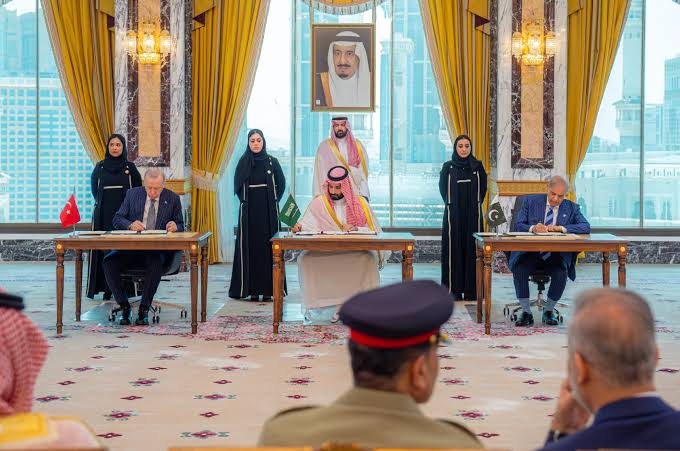
The Mecca Defense Agreement has triggered intense debate across political, defense, and strategic circles.
Some observers have dismissed it as symbolic. Others have described it as an anti-Western bloc. There are also claims that the framework is designed primarily to counter Iran.
These interpretations are too narrow.
The real importance of closer defense cooperation between Pakistan, Saudi Arabia, and Türkiye lies in the combined strengths of the three countries. Each brings a different set of military, economic, technological, and geographic advantages.
If this cooperation develops into a structured defense framework, it could become an important part of the changing security architecture across South Asia, the Middle East, and the eastern Mediterranean.
Pakistan: Nuclear Deterrence and Strategic Depth
Pakistan occupies a unique place in the Muslim world.
It is the only Muslim-majority state with nuclear weapons. It also maintains one of the largest armed forces in the region.
Its geography adds further strategic value.
Pakistan connects South Asia with Central Asia, western China, and the Arabian Sea. It also sits close to some of the world’s most important maritime energy routes.
The country has significant military experience. Its armed forces have taken part in conventional wars, counterterrorism operations, border security missions, and United Nations peacekeeping deployments.
Pakistan also has a growing defense industry.
The country produces combat aircraft, armored vehicles, missiles, naval platforms, ammunition, and unmanned systems. Several programs have been developed with foreign partners, particularly China and Türkiye.
The JF-17 Thunder program is one of the clearest examples. It shows Pakistan’s ability to participate in the development and production of advanced military platforms.
As a result, Pakistan could contribute nuclear deterrence, military manpower, operational experience, and defense manufacturing to a wider security arrangement.
Saudi Arabia: Energy, Capital, and Regional Influence
Saudi Arabia brings a different set of strategic strengths.
The Kingdom remains one of the world’s leading oil producers. It also holds some of the world’s largest proven petroleum reserves.
That gives Riyadh major influence in global energy markets.
Saudi Arabia also has unique religious importance. It is home to Makkah and Madinah, the two holiest cities in Islam.
As a result, the Kingdom has considerable diplomatic and cultural influence across the Muslim world.
Its military capabilities are also significant.
Saudi Arabia operates advanced aircraft, air defense systems, precision weapons, armored platforms, and surveillance systems purchased from the United States and Europe.
Saudi forces have also gained operational experience through regional military campaigns, especially during the Yemen conflict.
However, Saudi Arabia’s financial power may be even more important in the long term.
Riyadh is investing heavily in defense localization. It wants to build a stronger domestic military-industrial base and reduce dependence on imported systems.
Cooperation with Pakistan and Türkiye could support that goal.
Pakistan offers manufacturing capacity and military experience. Türkiye offers rapidly developing defense technologies. Saudi Arabia can provide investment, procurement capacity, and access to a large defense market.
This combination creates opportunities for joint production, technology transfer, research, and military-industrial cooperation.
Türkiye: Technology and Defense Industry
Türkiye adds another important layer to the relationship.
Its strategic importance starts with geography.
The Bosporus and Dardanelles connect the Black Sea with the Mediterranean. These waterways are among the most important maritime corridors in the world.
Türkiye also sits between Europe, the Middle East, the Caucasus, and Central Asia.
Its military position is equally important.
Türkiye is a long-standing NATO member. Therefore, its armed forces have extensive experience with NATO standards, multinational exercises, and Western military systems.
At the same time, Ankara has invested heavily in developing an independent defense industry.
Turkish companies now produce drones, missiles, radars, electronic warfare systems, armored vehicles, naval platforms, helicopters, and other advanced military technologies.
Türkiye’s unmanned aerial vehicle sector has become especially prominent.
Systems developed by Turkish companies have been exported to multiple countries and used in several operational environments.
Therefore, Türkiye could provide technology, industrial expertise, and NATO-standard interoperability within a broader defense framework.
Why Geography Matters
The geography of Pakistan, Saudi Arabia, and Türkiye gives the relationship additional importance.
Türkiye controls access between the Black Sea and the Mediterranean through the Turkish Straits.
Saudi Arabia occupies a central position between the Red Sea and the Arabian Gulf.
Pakistan sits along the Arabian Sea and close to major maritime routes connecting the Gulf with the Indian Ocean.
Together, these countries are located near some of the world’s most important energy, commercial, and military corridors.
However, this does not mean they collectively control global trade routes.
A more realistic assessment is that their locations give them significant strategic relevance.
This creates a strong basis for cooperation in several areas.
These may include maritime security, intelligence sharing, cyber defense, missile defense, critical infrastructure protection, counterterrorism, and military logistics.
Complementary Military Strengths
Another important feature of the relationship is that the three countries offer different capabilities.
Pakistan brings nuclear deterrence, military manpower, operational experience, and lower-cost defense manufacturing.
Saudi Arabia brings capital, energy influence, advanced imported military systems, and large-scale investment capacity.
Türkiye brings advanced defense technology, NATO experience, and a rapidly growing military-industrial sector.
These strengths are complementary.
For example, Saudi investment could support production facilities in Pakistan or Türkiye.
Turkish defense companies could provide technology for joint programs.
Pakistan could contribute manufacturing capacity, military testing experience, and access to South Asian markets.
As a result, defense-industrial cooperation may become more important than formal political declarations.
Defense Industry Could Become the Core
The most important outcome of the Mecca Defense Agreement may not be a traditional military alliance.
Instead, defense industry cooperation could become the real foundation of the relationship.
Joint ammunition production is one possibility.
Air defense systems are another.
The three countries could also cooperate on drones, electronic warfare, naval systems, missiles, sensors, and military communications.
Maintenance, repair, and overhaul facilities could also become part of the framework.
Such cooperation would benefit all three countries.
Saudi Arabia could accelerate its defense localization plans.
Pakistan could attract new investment and expand its military exports.
Türkiye could gain greater access to Gulf capital and South Asian markets.
Therefore, the economic and industrial dimension of the relationship deserves as much attention as the military dimension.
Not Necessarily an Anti-Western Bloc
It would also be inaccurate to automatically describe this cooperation as anti-Western.
All three countries maintain important relationships with Western states.
Türkiye remains a NATO member.
Saudi Arabia continues to operate large numbers of American and European military systems.
Pakistan also maintains defense, diplomatic, and economic relations with the United States and Europe.
At the same time, Islamabad has a close strategic relationship with China.
This suggests that the emerging framework is better understood as part of a broader trend toward strategic diversification.
Many middle powers are trying to avoid excessive dependence on a single international partner.
They are building multiple security, trade, and technology relationships at the same time.
The Pakistan-Saudi Arabia-Türkiye relationship fits this wider pattern.
It Should Not Be Reduced to Iran
The agreement should also not be viewed only through the Iran question.
Pakistan shares a long border with Iran and has repeatedly emphasized regional stability.
Türkiye also maintains major diplomatic and economic relations with Tehran.
Saudi Arabia and Iran have experienced periods of intense rivalry. However, they have also pursued diplomatic engagement.
Therefore, the strategic logic behind trilateral cooperation is broader than competition with any single country.
The three states share concerns about terrorism, maritime security, missile threats, energy infrastructure, supply chains, and regional instability.
These factors provide independent reasons for closer cooperation.
The Real Test Will Be Implementation
Defense agreements are ultimately judged by implementation.
Statements and ceremonies can create political momentum.
However, lasting strategic influence requires institutions and practical cooperation.
The three countries would need regular military exercises.
They would also need effective intelligence-sharing mechanisms.
Joint defense production would be another important indicator.
Cooperation on air and missile defense could deepen the relationship even further.
In addition, coordinated maritime security operations could give the framework a practical regional role.
If these mechanisms remain limited, the agreement may remain primarily symbolic.
If they expand, the relationship could develop into a durable security structure.
A New Strategic Triangle
The international system is becoming more multipolar.
Regional powers are seeking greater strategic autonomy.
Defense industries are expanding outside traditional Western markets.
At the same time, governments are looking for new security and technology partnerships.
In this environment, closer cooperation between Pakistan, Saudi Arabia, and Türkiye deserves serious attention.
Pakistan brings nuclear deterrence, military experience, manpower, and defense manufacturing.
Saudi Arabia brings energy influence, capital, and diplomatic reach.
Türkiye brings defense technology, industrial capability, and NATO experience.
These advantages do not automatically create a new global military bloc.
The three countries also have different interests, foreign policy priorities, and strategic relationships.
However, their capabilities are highly complementary.
If political cooperation develops into deeper military, industrial, and technological integration, the Mecca Defense Agreement could become an important feature of the emerging regional security order.
Its future significance will depend less on political symbolism and more on whether Pakistan, Saudi Arabia, and Türkiye can transform shared interests into lasting institutions, joint capabilities, and practical defense cooperation.

Khurrum Barlas
Khurrum Barlas is a distinguished writer with a multifaceted expertise that spans the skies, cyberspace, and boardrooms.
A decorated Combat Aviator and Helicopter Instructor Pilot with two decades of distinguished service in Army Aviation, he has flown into the heart of conflict zones and taught the art of flight to aspiring pilots. His illustrious career has also taken him to the forefront of technology, where he's made significant strides as an OSINT analyst, Cyber Technology enthusiast, and Aircraft Accident Investigator.
Beyond his military service, Barlas has taken his expertise global, working in corporate world across the USA, Canada, UK, Japan, Middle East, and Africa. He's pioneered innovative ventures, including Pakistan's first Fintech company, where he gained invaluable insights into the EMI ecosystem. Today, he advises a cutting-edge Blockchain Layer-1 (Web3) technology company, staying at the forefront of technological advancements.
As a prolific writer, Khurrum Barlas regularly shares his astute insights on global conflicts, IT/cyber threats, and geopolitical trends, offering a unique perspective that blends his aviation, tech, and strategic expertise.


Leave a Reply