

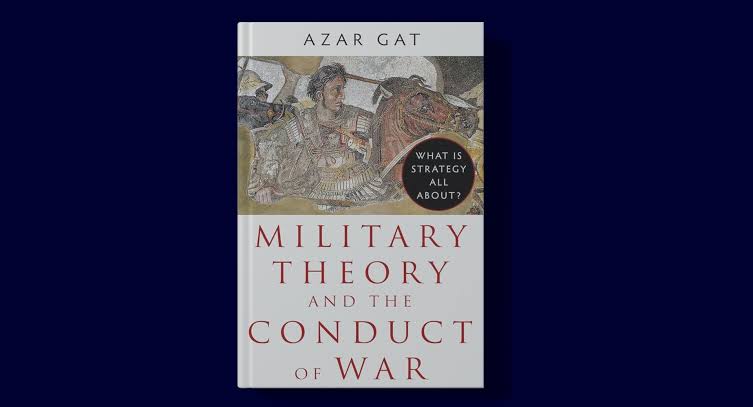
War is one of the most central features of human history. Yet the understanding of its conduct is deeply contested. The Book Military Theory and the Conduct of War by Azar Gat dives into a deep argument about the theory for the conduct of war and whether universal or general principles of war even exist. The author has debated about the issue of “continuity vs change” with respect to ‘nature of war’ and ‘character of war’. The main approach taken by the author in the book is examining major military thinkers of the past, like Clausewitz and Sun Tzu, then combining theory, history, and critique to challenge critical assumptions. The central thesis of the book is that military theory must be understood as historically contingent and politically driven rather than as a set of universal and timeless principles applicable to every conflict. Gat contests long-standing assumptions about strategy, victory, and the relationship between political aims and military means.
Dr Azar Gat is a Professor of Political Science at Tel Aviv University, Israel. He has been associated with research on war, its causes and evolution, military theory, strategy, and nationalism since the 1990s. He has written several books and research articles relating to the aforementioned research themes. He is also a Major (res) in the Israeli Army.
In the book, Gat has done a critical analysis of the classical military thinker Carl von Clausewitz’s seminal work On War. He has compared arguments made by Clausewitz in his early books with those in his later books. He found out that Clausewitz struggled with contradictions in each volume of On War. In the earlier volume of the book, as per Gat, Clausewitz argued that war’s main aim is the total destruction of the enemy. Later, Clausewitz argued that war is shaped by political goals that can change as needed.
Gat further argues about offence and defence in war theory while recognising that neither side is superior in all circumstances. The author agrees with Clausewitz’s claim that offence is always better in war than defence. Gat connects that offence is usually needed to achieve political goals, while defence is often about preservation of the status quo or resistance to change. Thus, as per Gat, the rationale for military operations depends on political objectives and military means. This highlights that military strategy must continuously balance what is desired with what is feasible.
The author has also traced the history of military doctrine. He argued that initially, there were only two levels of the conduct of war, strategic and tactical. When the size of the army expanded greatly along with firepower, they spread and fought across vast theatres of war. The author argues that militaries in the late 19th century termed it as the “operations level” of war, reflecting changes in scale, technology, and battlefield dispersion.
Gat further argues that military thinkers in the previous centuries attempted to derive timeless and universal principles of war. As per the author, they failed because they overlooked the dynamic and evolving nature of warfare. This dynamic nature of war was further revolutionised by several military technological revolutions aided by the industrial age. According to Gat, these technologically-induced revolutions have been widely recognised as historic in two ways. First, they transformed the way wars were fought and drew widespread attention in the late 19th century, and secondly, these revolutions were seen as entirely new developments, despite a few comparisons to cavalry and naval warfare being used to anticipate future mechanised forces.
The author analyses the effectiveness of guerrilla warfare and terrorism in modern war. He argues that these are strategies of the weak and their effectiveness lies in asymmetry, avoiding decisive battle and relying on attrition and psychological impact. Both guerrilla warfare and terrorism do not overturn the broader logic of war; instead, they adapt to the conditions. Gat underscores that terrorist organisations and guerrilla movements exploit stronger opponents’ sensitivities and political constraints to convert tactical weakness into strategic leverage. However, he cautions that their effectiveness is neither automatic nor universal.
Gat also debates about war and human nature. He argues that war is neither biologically inevitable nor easily eliminable; human beings have cooperative as well as conflictual tendencies. Gat claims that the world is divided into “zone of peace” and “zone of war”. He puts Western countries into the zone of peace, which are democratic and have a higher per capita income, while the zone of war includes developing and underdeveloped countries.
According to the author, peace is not a default, and stability depends upon multiple factors like deterrence, economic incentives and political order. Gat claims that traditional wars are declining, but conflict continues through irregular warfare, civil wars, proxies, and non-state violence. This reinforces the central claim that war remains a latent and enduring feature of human society, adapting to changing conditions rather than disappearing or progressing linearly towards peace.
There are also several limitations of the book. The first section, which deals with the classic study of war and theorists, is based solely on Clausewitz’s work. Other theorists like Sun Tzu, Jomini, and Mahan, while mentioned, are not analysed equally. The critique of Clausewitz is forceful and feels too sweeping. Gat has treated other theorists as more rigid and false than they may actually have been.
Another issue with his analysis is that he has overlooked most of the Eastern military thought. His analysis remains anchored in European and modern military thought. A comparative and equal treatment of different thoughts might have strengthened the author’s arguments.
In his analysis of terrorism, Gat has referred to Hamas and Hezbollah as terrorist organisations, but in reality, roughly 180 of the 195 states do not designate these organisations as terrorist because they are resistance movements against the occupying Zionist regime of Israel. His multiple examples show his leaning towards the Israeli worldview, particularly regarding issues related to war. He even claims that the innocent civilian death toll in Gaza is justifiable, and Israel’s ratio of civilian-to-armed men killed is 1.5 civilians to 1 armed man. The author has claimed this without presenting any evidence or independent study.
Similarly, the argument of different zones of peace and war is flawed. Gat argued that states in the zone of peace have not waged major wars, but he failed to mention that most of the conflicts and wars in the zone of war are due to interventions of Western, liberal, democratic, and economically developed states into the affairs of Eastern states. The author’s argument places primary emphasis on internal state capacity and development while underestimating the external interventions, great-power competition, and colonialism. Wars in West Asia, South Asia, and East Asia are due to the wrongful interventions and meddling by “civilised” states.
In conclusion, the book Military Theory and the Conduct of War is an intellectually ambitious work which adds to the military theory and conduct debates. Gat has successfully challenged the long-held beliefs about principles of war, the meaning of victory, the relationship between political ends and military means, and the future of wars. However, the book’s analytical framework shows several limitations. It has relied heavily on Western military thought, a somewhat uneven critique of classical theorists, and insufficient engagement with external drivers of conflict, including great-power interventions and colonial history, which constrain the extent of its conclusions. Despite these issues, this book is an important resource to learn about military theory and conduct of war in the ever-changing and evolving field.

Abdul Wassay
Abdul Wassay is a Research Assistant at the Centre for Aerospace and Security Studies (CASS) Lahore. He can be reached atinfo@casslhr.com

Leave a Reply