

As artificial intelligence becomes increasingly embedded in corporate decision-making, organizations are being forced to rethink how they approach governance, risk management, compliance, and internal audit. Across the GCC, rapid digital transformation is accelerating this shift, creating new opportunities for organizations to move from periodic and reactive risk management toward more continuous, data-driven, and forward-looking governance models. At the same time, the growing use of AI is raising important questions around accountability, cybersecurity, data governance, regulatory compliance, and human oversight.
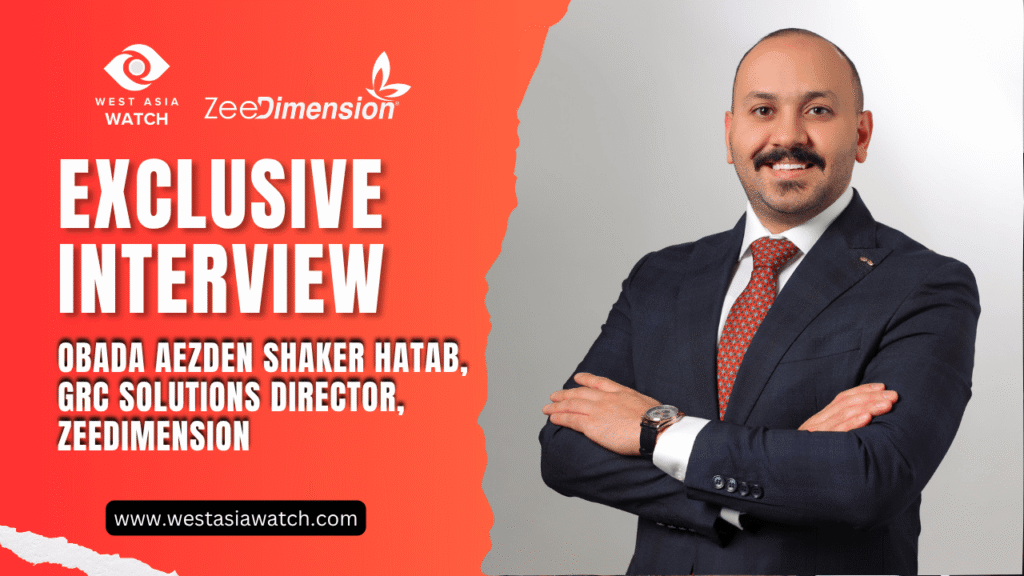
In this interview with West Asia Watch, Obada Aezden Shaker Hatab, GRC Solutions Director at ZeeDimension, discusses how artificial intelligence and advanced analytics are reshaping the GRC landscape. Drawing on his experience across internal audit, governance, risk management, regulatory compliance, and digital transformation, Hatab examines the growing importance of risk intelligence, board-level AI governance, technology-enabled internal audit, and responsible innovation. He also shares his perspective on how organizations across the GCC can combine AI, trusted data, professional judgment, and effective governance to build more resilient and future-ready operating models.
1. How is artificial intelligence transforming Governance, Risk, and Compliance (GRC), particularly within organizations operating in the GCC region?
Artificial intelligence is fundamentally changing GRC by moving organizations from a largely periodic and reactive approach toward one that is more continuous, data-driven and forward-looking.
Traditionally, governance, risk and compliance activities have depended heavily on manual reviews, periodic assessments, sampling and retrospective reporting. AI and advanced analytics allow organizations to process significantly larger volumes of information (whole populations), identify patterns and anomalies, continuously monitor risk indicators, and provide decision-makers with data-driven insights much closer to real time.
This transformation is particularly relevant to the GCC, where organizations are undergoing significant digital transformation and where governments and regulators are increasingly emphasizing responsible AI, data governance, cybersecurity and digital resilience.
From a GRC perspective, however, I believe the real value of AI is not simply automation. It is risk intelligence. The objective should be to help organizations understand what is happening, why it is happening, what could happen next, and where management attention is required.
For example, AI can help identify unusual transactions, emerging compliance issues, control weaknesses, cybersecurity patterns or operational anomalies before they become significant incidents. It can also connect information across risk, compliance, audit and operational systems, creating a more integrated view of enterprise risk.
The GCC has a particularly strong opportunity here because many organizations are already investing heavily in digital transformation. The next step is to ensure that governance and risk management evolve at the same pace as AI and its advanced technology.
2. From your experience, what are the biggest challenges organizations face when integrating AI and data analytics into traditional risk management and compliance frameworks?
The biggest challenge is often not the technology itself. It is the foundation around the technology.
Organizations can acquire sophisticated AI platforms, but if the underlying data is incomplete, inconsistent, poorly governed or inaccessible, the quality of the resulting insights will always be limited. In risk management, inaccurate data can ultimately drive inaccurate risk assessments and poor decisions.
The second challenge is organizational readiness. AI changes processes, responsibilities and, in some cases, established ways of working. Employees need to understand not only how to use these technologies, but also how to challenge their outputs.
This is especially important because AI should not be treated as an unquestionable source of truth. Models can produce inaccurate results, inherit biases, misunderstand context or generate outputs that cannot easily be explained. Therefore, organizations need appropriate human oversight, validation and accountability.
Another challenge is integration. Risk, compliance, internal audit, cybersecurity, legal and business functions have historically operated through different systems and sometimes different perspectives. AI creates enormous value when these functions can work from connected and trusted information, but achieving that requires proper data architecture, governance and ownership.
Finally, organizations need to address the human side of transformation. The successful adoption of AI requires a combination of technology expertise, business understanding, risk knowledge and professional judgment. The future will not belong to organizations that simply deploy the most AI tools; it will belong to organizations that know where AI should be used, where human judgment must remain central, and how the two should work together.
3. How is the role of internal audit evolving as organizations increasingly adopt automation, advanced analytics, and AI-driven decision-making tools?
Internal audit is moving from being primarily a retrospective assurance function toward becoming a much more technology-enabled and strategically relevant function.
Historically, auditors often had to work with samples, manually review transactions and spend significant amounts of time gathering and preparing data. With analytics and AI, auditors can increasingly examine entire populations, identify unusual behavior and focus their attention on the areas that present the greatest risk.
This does not mean that AI replaces the internal auditor. In my view, it actually makes professional judgment more important.
When technology handles more of the repetitive work, auditors can spend more time asking higher-value questions: Why did this happen? What does it mean for the organization? What could happen next? Is the control actually addressing the underlying risk?
The auditor of the future therefore needs to understand much more than auditing methodology. They need to understand data, technology, cybersecurity, AI models, digital processes and emerging risks.
The strongest internal audit functions will not simply audit technology. They will understand technology well enough to use it to improve the quality, coverage and impact of assurance itself.
4. What role can data analytics play in helping organizations move from reactive risk management toward more predictive and proactive risk identification?
Data analytics is one of the most important bridges between reactive and proactive risk management.
A traditional approach often asks: What went wrong?
A more mature, analytics-driven approach asks: What patterns are developing that could indicate something is about to go wrong?
That distinction is extremely important.
Organizations generate enormous amounts of information through financial transactions, operational systems, access logs, customer interactions, procurement activities, cybersecurity events and other business processes. When these data sources are analyzed collectively, they can reveal relationships and patterns that may not be visible through traditional periodic reviews.
For example, instead of waiting for a control failure or fraud incident to occur, analytics can identify unusual transaction behavior, repeated exceptions, abnormal access activity or changes in operational patterns that may indicate elevated risk.
The next stage is predictive analytics and machine learning, where historical patterns can be used to identify conditions associated with future events. This does not mean predicting the future with certainty. Rather, it means giving management an earlier and more informed indication of where attention may be required.
I would describe the evolution as moving from reporting what happened, to understanding why it happened, to identifying what may happen next. Therefore, becoming more proactive rather than reactive.
That is where data analytics become genuine risk intelligence rather than simply another reporting tool.
5. With regulatory environments becoming increasingly complex, how can companies balance regulatory compliance with the need for innovation, operational efficiency, and business growth?
Compliance and innovation should not be treated as opposing objectives.
The real objective should be to build organizations where compliance is integrated into the way innovation happens.
This requires moving away from a mindset where compliance is viewed primarily as a set of restrictions that must be addressed after a product, process or technology has been developed. Instead, governance, risk and compliance considerations should be incorporated early in the design and implementation process.
Technology can actually help achieve this. Regulatory requirements can be mapped to risks, controls, policies and business processes, while analytics and automation can help continuously monitor whether those controls are operating effectively.
The GCC is particularly interesting in this regard because governments are simultaneously encouraging innovation and developing stronger frameworks around AI, data, cybersecurity and digital services.
The key is proportionality. Not every AI application carries the same level of risk, and organizations should not create unnecessary bureaucracy around low-risk innovation. At the same time, high-impact systems—particularly those involving sensitive data or significant decisions—require stronger governance.
Good GRC should therefore be an enabler of responsible innovation, not an obstacle to it.
6. How important is board-level governance in ensuring the responsible adoption of AI, particularly when it comes to accountability, data governance, cybersecurity, and enterprise risk?
It is critical.
AI governance cannot be delegated entirely to the IT department or to technical specialists because the consequences of AI adoption can extend across the entire organization.
Boards ultimately have responsibility for understanding how AI affects the organization’s strategy, risk appetite, regulatory obligations, reputation, cybersecurity and long-term sustainability.
A board does not need to become a technical AI laboratory. But it does need to ask the right questions:
What AI systems are we using? What decisions are they influencing? What data are they using? Who is accountable for their outputs? What happens when the system is wrong? How are cybersecurity and privacy risks being managed? And how do these risks align with our overall enterprise risk appetite?
Ultimately, responsible AI requires three things: clear accountability, trustworthy data and meaningful human oversight.
Without board-level sponsorship, AI governance can become fragmented. With it, organizations can create a culture where innovation and responsibility develop together.
7. Looking ahead, what major trends do you believe will shape GRC, internal audit, risk management, and AI-powered enterprise governance across the GCC over the next five years?
I believe we are entering a period where the boundaries between AI, GRC, internal audit, risk management and business operations will become increasingly blurred.
One major trend will be the move toward continuous risk sensing, with organizations increasingly monitoring risk indicators in real time rather than relying primarily on periodic assessments. We will also see greater adoption of AI-assisted internal audit, where AI can analyze entire populations, identify anomalies, generate hypotheses and accelerate evidence gathering, while human validation and professional judgment remain essential.
At the same time, AI governance will become a formal component of enterprise governance. Organizations will need clearer ownership of AI systems, risk classification, model monitoring and controls covering data, cybersecurity, privacy, explainability and accountability. I also expect agentic AI to become increasingly important. As AI moves from generating information toward taking actions and interacting directly with business processes, organizations will need stronger mechanisms around authorization, oversight, auditability and accountability.
Another important development will be the convergence of GRC data. Rather than treating audit, risk, compliance, cybersecurity and operational information as separate domains, organizations will increasingly seek a unified risk-intelligence layer that gives management and boards a connected view of enterprise risk.
However, perhaps the most important trend will be cross-disciplinary collaboration. AI is opening traditionally specialized fields to new forms of collaboration. Internal audit and GRC, for example, have historically relied heavily on specialized professional knowledge and judgment, but AI and advanced analytics are creating new opportunities for technologists and data professionals to contribute without replacing the expertise of those professions.
Healthcare is experiencing a similar transformation. Medicine is one of the most specialized and expertise-driven fields, where trust, professional judgment and accountability are fundamental. AI and Agentic AI is creating new opportunities for technology and data science to contribute to healthcare, but the central question is similar to that in GRC and audit: Can we understand, explain, govern and remain accountable for what AI produces?
This is why I believe platforms that bring different communities together are increasingly important. AI-MEDx 2026, taking place in Marrakesh, Morocco, from 2–4 November 2026, is one example. The summit brings together healthcare professionals, researchers, innovators, policymakers and technology leaders around AI in medicine, explainability and digital health. Its value goes beyond discussing technology; it creates a space for different disciplines to exchange expertise, explore practical applications and address how AI can be adopted responsibly.
The recent developments and uncertainties across our region have reinforced the importance of this kind of collaboration. Whether we are discussing healthcare, internal audit, GRC or enterprise governance, the underlying principle is similar: technology can provide intelligence, scale and speed, but trust, accountability, human expertise and responsible governance determine whether it creates lasting value.
Over the next five years, I believe the organizations that succeed will not necessarily be those that adopt the most AI, but those that learn to combine AI, data, human expertise, governance and trust into one coherent operating model.
That, ultimately, is what responsible digital transformation should be about.




Leave a Reply