

In less than three decades, the UAE space program has evolved from a satellite communications industry into one of the most ambitious space programs in the Middle East. The country now designs advanced Earth-observation satellites, operates an astronaut program, has reached Mars, is preparing to explore the far side of the Moon, is contributing hardware to a future lunar space station, and is developing a spacecraft for a multibillion-kilometer journey through the asteroid belt.
The transformation did not occur through a single mission. Instead, the United Arab Emirates built its space capabilities in stages—combining government investment, international partnerships, technology transfer, domestic engineering, education, human spaceflight, and, increasingly, private-sector participation.
In March 2026, the UAE approved a new National Space Strategy 2031 that aims to place the country among the world’s top 10 space economies while doubling space-sector revenues, national space companies, export markets, infrastructure investment, and UAE-based space startups.
That target illustrates how the UAE now views space: not simply as a prestige project, but as part of its long-term economic, technological, and strategic development.
The Foundations of the UAE Space Program
The roots of the UAE’s modern space sector predate its Mars mission by decades.
Thuraya, the satellite telecommunications company, was established in 1997, followed by the creation of the Emirates Institution for Advanced Science and Technology in 2006 and Yahsat in 2007. The federal UAE Space Agency was established in 2014 to coordinate and develop the country’s national space sector. The Emirates Institution for Advanced Science and Technology was subsequently incorporated into the Mohammed Bin Rashid Space Centre (MBRSC) in 2015.
This institutional structure proved important. Rather than beginning immediately with highly complex interplanetary missions, the UAE first developed capabilities in satellite communications, Earth observation, engineering, mission operations, and international cooperation.
Early satellites such as DubaiSat-1 and DubaiSat-2 helped Emirati engineers gain experience through international partnerships. The next objective was increasingly ambitious: moving from acquiring space technology toward developing it domestically.
KhalifaSat Marked a Shift Toward Domestic Capability
A major milestone arrived in October 2018 with KhalifaSat.
MBRSC describes KhalifaSat as the first satellite to be 100 percent designed and manufactured in the UAE. The Earth-observation satellite was placed into low Earth orbit to provide high-resolution imagery for applications including environmental monitoring, urban planning, and disaster response.
KhalifaSat was significant because it demonstrated that the UAE’s space ambitions were moving beyond procurement.
Emirati engineers were increasingly becoming designers, developers, integrators, and operators of sophisticated space systems.
That domestic capability has continued to expand.
In January 2025, the UAE launched MBZ-SAT, developed entirely by Emirati engineers at MBRSC. The satellite was designed to significantly increase the center’s Earth-observation capabilities, including high-resolution imaging and faster data delivery.
Two months later, MBRSC launched Etihad-SAT, its first Synthetic Aperture Radar satellite. Developed in partnership with South Korea’s Satrec Initiative, Etihad-SAT can collect high-resolution radar imagery under different weather and lighting conditions.
Together, these programs demonstrate a broader evolution in the UAE space industry: from optical Earth observation toward increasingly diverse satellite technologies and commercial applications.
The Hope Probe Put the UAE on the Interplanetary Map
The greatest international demonstration of the UAE’s growing capabilities came with the Emirates Mars Mission, better known through its spacecraft, the Hope Probe.
Hope launched in July 2020 and successfully entered Mars orbit in February 2021, making the Emirates Mars Mission the first interplanetary exploration mission undertaken by an Arab country. The UAE became the fifth nation to successfully reach Mars.
The mission was designed to study the Martian atmosphere on a global scale and examine how conditions change throughout the day and across different seasons. Its three scientific instruments investigate different layers and processes within Mars’ atmosphere.
Hope was therefore more than a symbolic mission.
The project required the UAE to develop expertise in spacecraft engineering, interplanetary navigation, mission operations, scientific research, data analysis, and international scientific collaboration.
By February 2024, the mission had completed observations covering a full Martian year and had achieved its original scientific objectives. The spacecraft has also produced observations of Mars’ auroras and Deimos, one of the planet’s two moons.
More importantly for the long-term UAE space program, Hope created a generation of engineers and researchers with experience working on an actual interplanetary mission.
Building a Human Spaceflight Program
Satellites and robotic exploration represent only one component of the UAE’s space strategy.
The country has also developed a permanent astronaut corps.
In September 2019, Hazzaa AlMansoori became the first Emirati to travel into space and spent eight days aboard the International Space Station. During the mission, he conducted scientific experiments involving international space agencies including NASA, Roscosmos, ESA, and JAXA.
An even larger milestone followed in 2023.
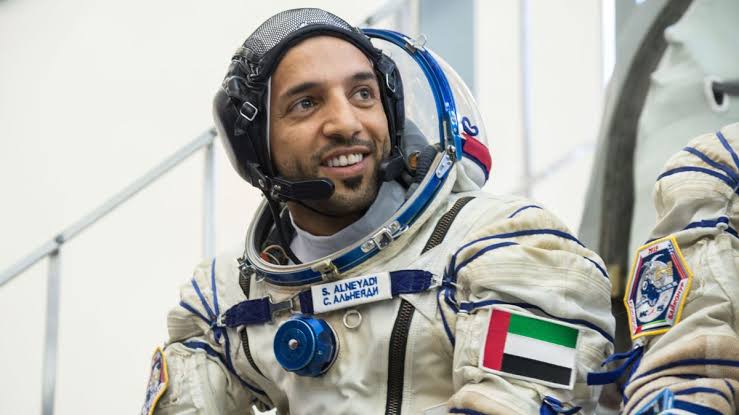
Sultan AlNeyadi spent approximately six months aboard the International Space Station as part of Expedition 69, becoming the first Arab astronaut to undertake a long-duration space mission. He also became the first Arab to conduct a spacewalk.
The UAE astronaut corps has since expanded to four members: AlMansoori, AlNeyadi, Nora AlMatrooshi, and Mohammad AlMulla. AlMatrooshi and AlMulla completed NASA astronaut candidate training in 2024, providing the UAE with additional astronauts qualified for future missions.
Human spaceflight has therefore become an institutional capability rather than a one-off national achievement.
From Mars to the Moon
The Moon represents another major component of the UAE’s next phase in space exploration.
The first Rashid Rover launched in December 2022 aboard Japan’s Hakuto-R Mission 1 lander. Although the lander ultimately failed during its attempted lunar landing, the Emirati rover reached lunar orbit as part of the mission.
The UAE quickly moved forward with a successor.
Rashid Rover 2 has been developed for a substantially more ambitious destination: the far side of the Moon.
The rover is scheduled to travel aboard Firefly Aerospace’s Blue Ghost Mission 2, alongside other international payloads. MBRSC says Rashid Rover 2 will study the lunar plasma environment, geology, thermal conditions, soil characteristics, and other properties that could assist future lunar exploration.
The mission reflects another characteristic of the UAE’s strategy: setbacks have generally been treated as opportunities to acquire experience rather than reasons to abandon programs.
The UAE Is Becoming Part of the Lunar Infrastructure
Perhaps even more strategically significant than an individual lunar rover is the UAE’s involvement in NASA’s Gateway program.
The UAE is responsible for developing the Emirates Airlock for Gateway, the planned space station that will operate around the Moon.
The module will enable astronauts to conduct spacewalks, transfer scientific equipment, and support spacecraft docking. MBRSC will also operate the airlock after its deployment.
Participation gives the UAE a role in infrastructure expected to support future human exploration of the Moon and, eventually, more distant destinations.
It also demonstrates how the UAE uses international partnerships differently from its earliest space programs. Instead of participating primarily to acquire basic knowledge, the country is increasingly expected to contribute critical hardware and operational capabilities to multinational missions.
The Next Leap: A Five-Billion-Kilometer Asteroid Mission
The Emirates’ most technically ambitious robotic mission is still ahead.
The Emirates Mission to the Asteroid Belt, or EMA, plans to send the MBR Explorer spacecraft on a journey of roughly 5 billion kilometers through the solar system.
The mission is expected to conduct flybys of seven asteroids before eventually studying its final target in greater detail. The UAE Space Agency currently plans to launch the spacecraft in 2028.
By April 2026, MBR Explorer had completed its Critical Design Review and entered the assembly, integration, and testing phase. The UAE Space Agency described the mission as significantly more complex than the Hope Probe, with a longer operational duration and a substantially larger spacecraft.
The asteroid program also serves an economic objective.
The UAE Space Agency says 50 percent of the mission’s work has been allocated to UAE-based private-sector companies, allowing a flagship science mission to function simultaneously as an industrial-development program.
That represents an important shift in how the country approaches space.
From Government Program to Space Economy
The UAE increasingly wants its achievements in exploration to generate commercial capabilities on Earth.
The government has created an AED 3 billion National Space Fund to support engineering, scientific research, infrastructure, startups, and cooperation between Emirati and international companies.
Space Economic Zones have also been introduced to give startups and established companies access to workspaces, laboratories, licensing services, incubation programs, and potential funding.
By 2025, UAE officials said around AED 44 billion ($12 billion) had been invested in the national space sector. Earlier UAE Space Agency figures indicated that national companies were contributing more than AED 10.9 billion, representing 40.7 percent of the sector’s output.
The emergence of Space42 is another example of this commercial transformation.
Created through the merger of Yahsat and Bayanat in 2024, Space42 combines satellite communications, geospatial intelligence, Earth observation, and artificial intelligence. The company says its satellite network covers more than 150 countries and reaches more than 80 percent of the world’s population.
Space is therefore increasingly linked with the UAE’s wider ambitions in AI, telecommunications, geospatial intelligence, autonomous systems, climate monitoring, and advanced manufacturing.
Why Can the UAE Be Considered a Regional Space Power?
The UAE’s rise does not mean it possesses every component of an independent space ecosystem.
Its major missions still rely heavily on international cooperation and foreign launch services. Hope launched from Japan, MBZ-SAT and Etihad-SAT used SpaceX rockets from the United States, and Rashid Rover 2 is being integrated with an American commercial lunar mission.
But complete technological independence is not the only measure of space power.
The UAE has built capabilities across nearly every major layer of the modern space ecosystem: satellite development, Earth observation, telecommunications, planetary science, astronauts, mission control, lunar exploration, deep-space mission design, scientific research, geospatial intelligence, AI-enabled space services, commercial investment, and international space diplomacy.
Its strategy has effectively been to use international partnerships to accelerate domestic capability, while gradually increasing the amount of engineering, manufacturing, science, and mission responsibility performed inside the country.
That approach has allowed a relatively young space program to compress decades of capability development into a much shorter period.
What Comes Next for the UAE Space Program?
The next several years could determine whether the UAE’s achievements become a permanently sustainable space industry.
In December 2025, the UAE also launched Arab Satellite 813, developed as a regional project involving Arab engineers and researchers and equipped with hyperspectral Earth-observation capabilities. The program reflects the Emirates’ effort to position itself not only as a national space actor but also as a center for broader Arab space cooperation.
In 2026, attention is centered on preparations for Rashid Rover 2 and continued development of MBR Explorer.
Beyond individual missions, however, the more consequential objective may be economic.
Under the National Space Strategy 2031, the UAE plans to double space-economy revenues, national companies, export markets, infrastructure investments, and domestic space startups while seeking a position among the world’s top 10 space economies.
If those targets are achieved, the UAE’s next phase will be defined less by individual headline missions and more by whether the country can turn exploration experience into a durable commercial, scientific, and industrial ecosystem.
The Bigger Picture
The UAE became a regional space power through a deliberate progression.
Satellite communications created the commercial foundations. Earth-observation programs developed engineering expertise. KhalifaSat demonstrated domestic satellite manufacturing. The Hope Probe established interplanetary credentials. Astronaut missions created human-spaceflight experience. Lunar exploration expanded the country’s scientific ambitions, while Gateway placed Emirati engineers inside one of the world’s most important future exploration programs.
The Emirates Mission to the Asteroid Belt now represents the next technological test.
But perhaps the biggest change is happening closer to Earth.
The UAE increasingly treats space technology as part of its economic diversification strategy—connecting satellites with AI, telecommunications, climate monitoring, advanced manufacturing, research, and commercial services.
That shift from conducting space missions to building a space economy is ultimately what could transform the UAE’s recent achievements into lasting regional and global influence.



Leave a Reply