

Saudi Arabia’s aviation hub strategy has moved from ambition to large-scale implementation. The Kingdom is building new airport capacity, expanding its airline sector, opening new international routes and developing cargo, maintenance and aviation-service businesses as part of a broader effort to position itself between the world’s major air-travel markets.
At the center of the plan is the Saudi Aviation Strategy, which aims to handle 330 million passengers annually by 2030, connect the Kingdom with more than 250 destinations, and raise annual air-cargo capacity to 4.5 million tonnes. The strategy is closely tied to Saudi Vision 2030, which views aviation not simply as a transport industry but as infrastructure for tourism, trade, investment and economic diversification.
The scale of the challenge is considerable. Saudi airports handled more than 140 million passengers in 2025, up around 9 percent year on year, while international connectivity increased to 176 destinations. Reaching the 330 million target by 2030 would therefore require another major expansion in traffic, infrastructure and airline capacity during the second half of the decade.
Saudi Aviation Strategy 2030: The Numbers
| Indicator | Current / Latest Position | 2030 Target |
|---|---|---|
| Annual airport passengers | More than 140 million in 2025 | 330 million |
| International destinations | 176 in 2025 | More than 250 |
| Air cargo capacity | Expanding | 4.5 million tonnes |
| Main global hubs | Riyadh and Jeddah | Two long-haul connecting hubs |
| Riyadh Air network | Rapidly expanding | 100+ destinations |
GACA’s aviation strategy envisions a network extending across 29 airports, led by Riyadh and Jeddah as the Kingdom’s two principal global passenger and cargo hubs. Saudi authorities have said the transformation is intended to make the country one of the world’s largest passenger-connecting centers and the leading regional air-cargo hub.
Why Saudi Arabia Wants a Global Aviation Hub
The aviation push cannot be separated from Saudi Arabia’s wider economic transformation.
For decades, the Kingdom’s aviation market was primarily shaped by domestic travel, business traffic, pilgrimage and passengers traveling to or from Saudi Arabia. The emerging strategy adds another objective: making Saudi airports competitive locations for passengers and cargo connecting through the Kingdom.
That model has already been demonstrated successfully elsewhere in the Gulf. Dubai, Doha and Abu Dhabi have used geographic location, large airlines and highly efficient airports to connect Europe, Asia, Africa and the Americas.
Saudi Arabia now wants a larger share of those flows.
But unlike a purely transit-focused model, Saudi Arabia also has substantial domestic demand. Riyadh is developing as a regional corporate center, Jeddah remains the main air gateway for millions of pilgrims and visitors to western Saudi Arabia, and the Kingdom is investing heavily in tourism, entertainment, sports and major international events.
This gives Saudi aviation planners the opportunity to combine origin-and-destination traffic with international connecting traffic.
Riyadh and Jeddah: A Two-Hub Strategy
One of the most important features of Saudi Arabia’s aviation plan is that it is not based on a single airport.
GACA’s strategy identifies Riyadh and Jeddah as two global long-haul connecting hubs.
In practical terms, the two cities can perform complementary roles.
Riyadh is being developed around business, government, investment, tourism and international connecting traffic. It is also the home base of Riyadh Air and the location of the future King Salman International Airport.
Jeddah, meanwhile, already serves as a major international gateway and has a structural advantage because of its proximity to Makkah and Madinah. It is central to Hajj and Umrah traffic and remains an important base for Saudia.
This dual-hub structure could allow Saudi Arabia to capture different passenger segments instead of forcing all international traffic through a single airport.
King Salman International Airport: Building Riyadh for Scale
The most visible infrastructure project behind the aviation strategy is King Salman International Airport in Riyadh.
The airport is planned across approximately 57 square kilometers and will eventually incorporate six parallel runways alongside commercial, logistics, residential and recreational facilities. PIF describes the project as a major gateway connecting Asia, Africa and Europe.
Its long-term ambition is particularly significant: the airport is planned to handle as many as 185 million passengers annually by 2050, alongside up to 3.5 million tonnes of cargo.
There is a small difference between published PIF figures for the 2030 phase. The original masterplan cited capacity of up to 120 million passengers by 2030, while PIF’s current portfolio page cites up to 100 million. The 185 million-passenger target for 2050 remains the longer-term benchmark in PIF material.
The project is therefore more than a larger terminal. It is being designed as an aerotropolis—an airport-centered economic zone where passenger aviation, logistics, retail, hospitality and commercial development reinforce one another.
PIF originally estimated that the airport could eventually contribute around SAR27 billion annually to non-oil GDP and support approximately 103,000 direct and indirect jobs.
Riyadh Air Is the Airline Engine of the Strategy
Infrastructure alone cannot create a global aviation hub. A successful hub also requires an airline capable of feeding passengers from dozens of markets into a coordinated connecting network.
That is the strategic role of Riyadh Air.
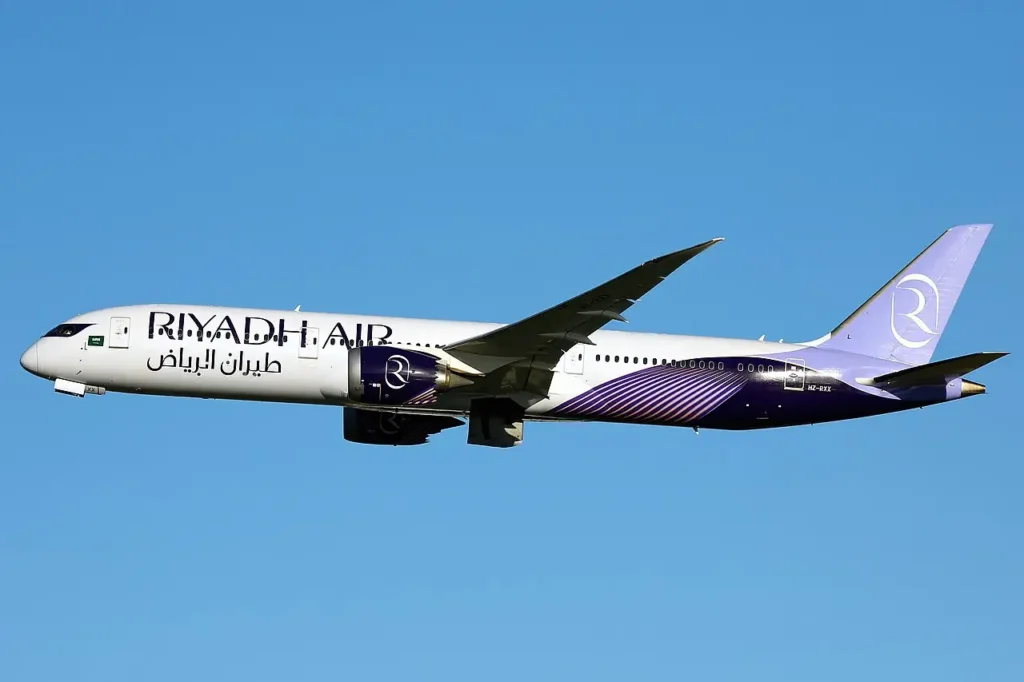
Established by the Public Investment Fund, the airline has been tasked with connecting Riyadh to more than 100 destinations by 2030.
By 2026, Riyadh Air’s expansion had moved beyond planning. Public commercial services accelerated during the year, with the airline opening or announcing links including London, Jeddah, Dubai, Cairo, Madrid, Mumbai, Kuala Lumpur, Dhaka, Islamabad, Lahore, Bangkok and Manila, among other destinations.
Its fleet strategy is equally important.
Riyadh Air’s current fleet plans cover 182 aircraft, combining long-haul Boeing 787s with Airbus aircraft for different network requirements. The airline is using the Boeing 787-9 as an important part of its early international expansion while building toward a much larger global network.
At the 2026 Farnborough Airshow, the airline further expanded its widebody plans with additional Boeing 787 and Airbus A350 commitments, reinforcing its intention to compete for long-haul traffic rather than remain primarily a regional carrier.
For Riyadh to operate as a true hub, the airline will ultimately need not only large numbers of destinations but also carefully synchronized schedules that allow passengers arriving from one region to connect efficiently to flights departing for another.
That network effect is what has made the established Gulf hubs so powerful.
Saudi Arabia Is Also Expanding Air Cargo
Passenger aviation is only one part of the strategy.
Saudi Arabia wants annual air-cargo capacity to reach 4.5 million tonnes by 2030, with both Riyadh and Jeddah playing international logistics roles.
Riyadh Air has already established Riyadh Cargo, using belly-hold capacity aboard its passenger aircraft as its international network expands. The cargo business is designed to grow alongside the carrier’s fleet and route network, connecting Saudi Arabia with international trade flows.
This matters because aviation hubs generate greater economic value when passenger operations are integrated with cargo, warehousing, freight forwarding, e-commerce and time-sensitive supply chains.
Saudi Arabia’s geographic location is particularly useful in this regard. Riyadh sits within flying distance of major markets across Europe, Africa and Asia, while Jeddah provides access to Red Sea trade routes and western Saudi Arabia.
Building an Aviation Industry, Not Just Bigger Airports
Saudi Arabia’s strategy also extends beyond airlines and terminals.
GACA has identified maintenance, repair and overhaul facilities, aviation manufacturing, supply chains, human-capital development and private investment as important elements of the aviation transformation.
PIF investments include companies and initiatives across aircraft leasing, helicopter services and maintenance. Its investment in Saudia Technic, for example, is intended to expand domestic MRO capability and localize aviation expertise.
This is strategically significant.
A global aviation hub that relies almost entirely on imported maintenance, technical services and expertise captures less economic value than one that develops those capabilities domestically. Saudi Arabia therefore appears to be pursuing an aviation ecosystem, rather than simply increasing passenger numbers.
Tourism Is Creating the Demand
The aviation strategy and Saudi tourism policy are mutually dependent.
New hotels, entertainment districts, Red Sea resorts, heritage destinations and business developments need reliable international air access. Airlines, in turn, need sufficient passenger demand to sustain new routes.
Saudi Arabia’s tourism transformation provides that demand base.
Pilgrimage already generates large-scale international aviation flows. During the 2025 Hajj operational period alone, Saudi aviation authorities handled more than 19 million passengers and pilgrims across more than 128,000 flights, with 116 airlines participating in the wider operation.
The Kingdom is now attempting to add leisure tourism, major sporting events, international conferences and corporate travel to that established religious-travel market.
Riyadh’s Expo 2030 and Saudi Arabia’s hosting of the 2034 FIFA World Cup will further increase the importance of airport capacity and international connectivity.
Saudi Arabia’s Geographic Advantage
Geography is one of the strongest arguments behind the strategy.
Saudi Arabia lies between Europe, Africa and Asia, placing Riyadh and Jeddah within practical long-haul range of many of the world’s largest population and economic centers.
But geography alone does not create a hub.
Dubai and Doha succeeded because geographic position was combined with strong airlines, large fleets, efficient airports, competitive transfer times, attractive fares and extensive international networks.
Saudi Arabia is therefore investing in all of these elements simultaneously: aircraft, airports, digital systems, cargo, regulation, route development and supporting industries.
Can Saudi Arabia Challenge Dubai and Doha?
Saudi Arabia has the capital, market size and geographic position to become a much more important aviation center. But becoming a global connecting hub will be more difficult than simply expanding airport capacity.
Emirates, Qatar Airways and Etihad have spent decades building brand recognition, corporate accounts, loyalty programs, route networks and highly optimized connecting operations. Dubai International also remains one of the world’s most important international aviation hubs.
Saudi Arabia is entering an already competitive market, and established Gulf carriers are continuing to expand rather than standing still. Recent regional instability has also highlighted another vulnerability shared by Gulf aviation hubs: geopolitical disruption can rapidly affect airspace, schedules and passenger confidence.
There is, however, an important difference in the Saudi model.
Riyadh does not have to depend entirely on passengers changing aircraft on their way somewhere else. The Kingdom has a large domestic economy, substantial religious travel, growing tourism and increasing corporate traffic.
That combination could give Saudi Arabia a more diversified passenger base than a transit-only strategy.
The Bigger Picture
Saudi Arabia’s plan to become a global aviation hub is ultimately about more than aircraft and airports.
It is part of a broader attempt to change the Kingdom’s position within international commerce.
If the strategy succeeds, a passenger traveling from Asia to Europe could increasingly connect through Riyadh. International businesses could move time-sensitive cargo through Saudi logistics centers. More airlines could establish services to Saudi cities, while a domestic aviation-services industry handles maintenance, leasing, training and technology.
The physical infrastructure is already being developed, passenger traffic is growing and Riyadh Air is now building the international network required to support the hub model.
The difficult phase will be scale.
Moving from more than 140 million annual passengers in 2025 to a target of 330 million by 2030 requires sustained double-digit growth, major fleet deliveries, airport expansion and significantly more connecting traffic.
Saudi Arabia therefore does not simply need to build one of the world’s biggest aviation systems. It needs to make that system efficient enough that international passengers and airlines actively choose to use it.
That will determine whether the Kingdom becomes not only a major destination, but one of the principal crossroads of global aviation.




Leave a Reply