
1.0 Introduction
China’s expanding role in the Middle East reflects a broader shift in global geopolitics, where economic power is increasingly translating into strategic influence. Historically, Beijing maintained a limited presence in the region, focusing primarily on trade and energy imports. However, over the past decade, China has evolved into a key external actor shaping economic, technological, and diplomatic dynamics across the Middle East.
At the center of this transformation is China’s long-term objective of securing energy supplies, expanding trade connectivity, and positioning itself as a reliable partner to regional states. Unlike traditional Western actors, China emphasizes economic cooperation and non-interference, enabling it to engage simultaneously with competing regional powers.
2.0 Strategic Drivers of China’s Middle East Engagement
2.1 Energy Security
Energy security remains the cornerstone of China’s Middle East strategy. As the world’s largest importer of crude oil, China sources approximately 45–50% of its oil imports from the Middle East, with major suppliers including Saudi Arabia, Iraq, and the United Arab Emirates.
In addition to oil, China has expanded its involvement in liquefied natural gas (LNG) projects, particularly in Qatar. Long-term supply agreements and investments in upstream energy infrastructure reinforce Beijing’s objective of ensuring stable and diversified energy flows.
2.2 Trade and Connectivity
The Middle East’s geographic position makes it a critical hub linking Asia, Europe, and Africa. China views the region as an essential component of its global trade network, aiming to enhance connectivity through ports, railways, and logistics corridors.
By integrating Middle Eastern infrastructure into its broader connectivity framework, China is reducing reliance on traditional maritime routes while strengthening its global supply chain resilience.
2.3 Strategic Balancing
China’s approach to the Middle East is defined by strategic neutrality. Beijing maintains strong relations with rival regional actors, including Iran, Saudi Arabia, and Israel, without aligning itself exclusively with any bloc.
This multi-vector diplomacy allows China to maximize economic opportunities while minimizing political risk, positioning itself as a pragmatic and reliable partner.
3.0 Belt and Road Initiative (BRI) in the Middle East
3.1 Overview
The Belt and Road Initiative (BRI), launched in 2013, serves as the primary framework for China’s engagement in the Middle East. The initiative focuses on infrastructure development, trade facilitation, and economic integration.
3.2 Scale of Investment
China’s global BRI engagement has surpassed $1 trillion, with the Middle East emerging as one of its most significant destinations. In recent years, the region has attracted tens of billions of dollars annually in Chinese investments and construction contracts.
This scale of financial commitment underscores the strategic importance of the Middle East within China’s global economic vision.
4.0 Key BRI Projects and Infrastructure Footprint
4.1 Energy Sector
China has invested heavily in energy infrastructure across the region, including:
- Oil refineries and petrochemical complexes in Saudi Arabia and Iraq
- Renewable energy projects, particularly solar power initiatives in the UAE
- Long-term energy partnerships across Gulf states
4.2 Transport and Logistics
China’s infrastructure projects aim to enhance regional connectivity:
- Development of port facilities in Oman, the UAE, and Djibouti
- Expansion of industrial zones along the Suez Canal in Egypt
- Investments in rail and logistics corridors linking regional trade hubs
4.3 Industrial Zones
China is establishing industrial parks and economic zones across the Middle East to support manufacturing and trade. These zones serve as nodes connecting regional economies with global markets, reinforcing economic interdependence.
5.0 Country-Level Engagement
5.1 Gulf States
The Gulf region is central to China’s Middle East strategy:
- Saudi Arabia is a leading partner in energy and infrastructure cooperation
- The United Arab Emirates serves as a commercial and logistics hub for Chinese enterprises
- Qatar and Oman play key roles in energy and maritime connectivity
5.2 Iran
Iran occupies a strategic position in China’s westward expansion, serving as a bridge between Central Asia and the Middle East. Long-term agreements between Beijing and Tehran encompass energy, infrastructure, and strategic cooperation.
5.3 Levant and North Africa
- Egypt is critical due to its control of the Suez Canal and its role in global trade
- Iraq remains a major energy partner with significant Chinese investment
- Israel represents a unique case of technological and infrastructure collaboration
6.0 China’s Expanding Diplomatic Role
China is increasingly transitioning from an economic partner to a diplomatic actor in the Middle East.
6.1 Mediation Efforts
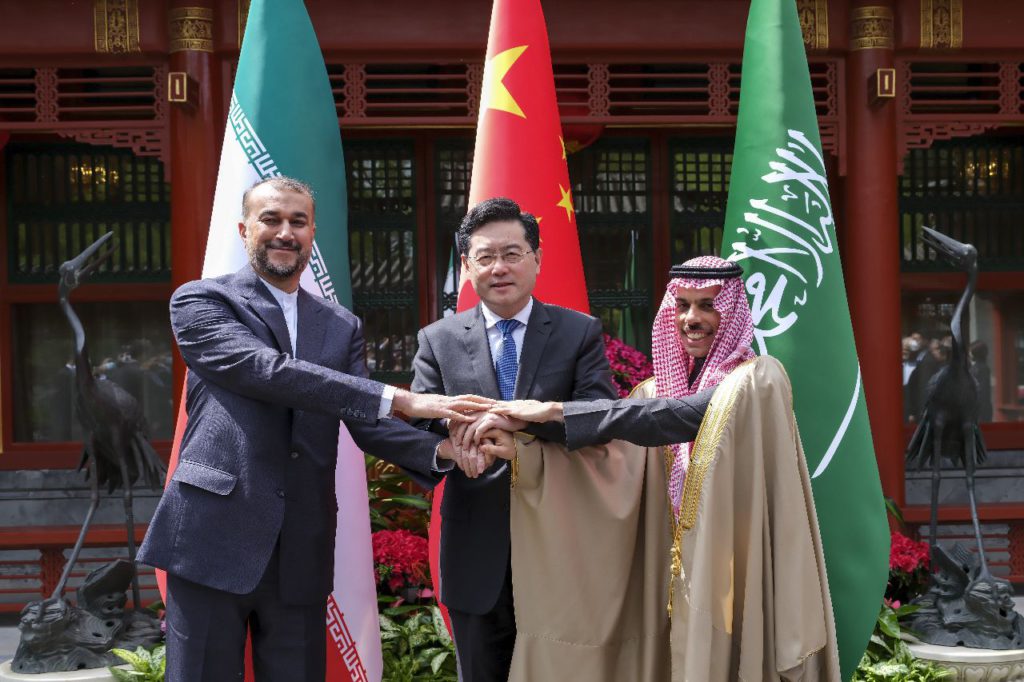
China has demonstrated its ability to facilitate dialogue between rival states, most notably contributing to the normalization of relations between Saudi Arabia and Iran. This reflects Beijing’s growing diplomatic credibility.
6.2 Non-Intervention Approach
China’s emphasis on sovereignty and non-interference resonates with regional governments, distinguishing it from Western interventionist policies and enhancing its attractiveness as a partner.
7.0 Digital Silk Road and Technological Expansion
China’s influence extends beyond traditional infrastructure through the Digital Silk Road, focusing on telecommunications and advanced technologies.
7.1 Key Areas
- Deployment of 5G networks across Gulf states
- Development of smart city infrastructure
- Expansion of AI-driven surveillance and urban systems
Chinese technology firms are increasingly embedded in the region’s digital infrastructure, raising both opportunities and strategic concerns.
8.0 Strategic Implications
8.1 Opportunities
- Accelerated infrastructure development
- Diversification of economic partnerships
- Enhanced regional connectivity
8.2 Challenges
- Risk of economic dependency on Chinese financing
- Strategic concerns related to technology integration
- Intensifying geopolitical competition with the United States
9.0 Conclusion
China’s expanding role in the Middle East reflects a long-term strategic shift rather than a temporary engagement. Through sustained investments, infrastructure development, and diplomatic outreach, Beijing is positioning itself as a central actor in the region.
As regional states continue to diversify their partnerships, China’s influence is expected to deepen further, reshaping the Middle East’s economic and geopolitical landscape in the years ahead.



Leave a Reply