

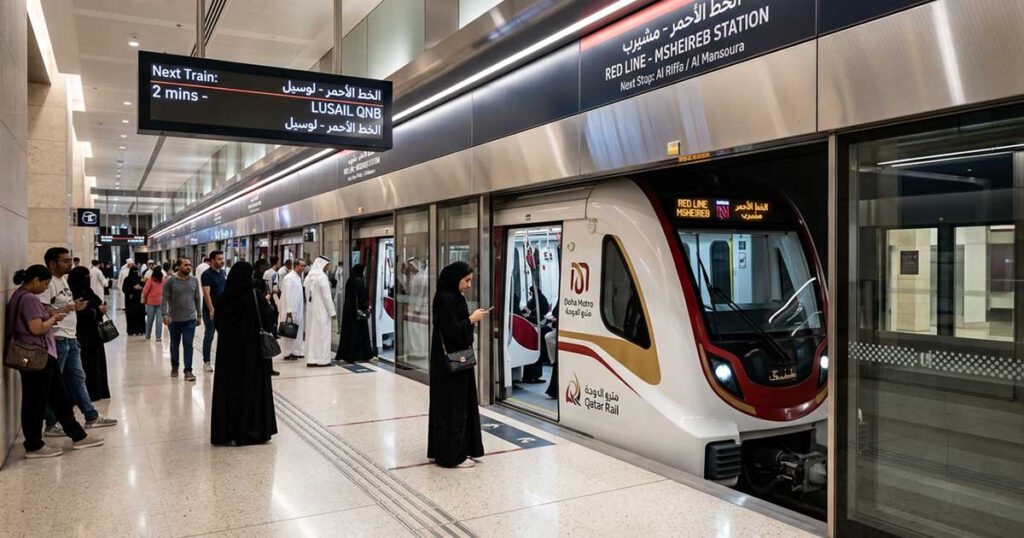
Doha Metro has become one of the most important infrastructure projects in Qatar’s modern history. More than a public transport network, it represents a wider urban transformation strategy aimed at reducing road congestion, improving connectivity, supporting tourism, and reshaping how residents and visitors move across the capital.
For decades, Doha’s urban growth was largely shaped around private cars, highways, and rapid real estate expansion. However, as Qatar developed into a global business, aviation, sports, and diplomatic hub, the need for a reliable mass transit system became increasingly important. Doha Metro was designed to answer that challenge.
Today, the metro connects major residential areas, commercial districts, cultural landmarks, stadium zones, and transport hubs. It has also played a central role in Qatar’s broader vision of building a more sustainable, connected, and internationally competitive urban environment.
What Is Doha Metro?
Doha Metro is a rapid transit system developed by Qatar Rail to serve Doha and its surrounding areas. The network consists of three main lines: the Red Line, Green Line, and Gold Line. These lines connect key parts of the city, including Hamad International Airport, West Bay, Msheireb, Education City, Lusail, and other major destinations.
The system is known for its modern stations, driverless trains, air-conditioned platforms, and high level of passenger comfort. Its central interchange, Msheireb Station, is one of the key transport hubs in the network and links all three metro lines.
The metro was also a major part of Qatar’s preparation for the FIFA World Cup 2022. During the tournament, it helped move large numbers of fans between stadiums, hotels, airports, and entertainment zones, proving the value of mass transit in a country historically dependent on cars.
Why Doha Metro Matters
Doha Metro matters because it is not just a transport project. It is part of Qatar’s long-term plan to modernize the capital, improve quality of life, and support economic diversification.
The metro helps address several urban challenges at once. It reduces pressure on roads, offers an alternative to private vehicles, improves access to major districts, and supports more efficient movement across the city. It also strengthens Doha’s position as a regional hub for business, tourism, education, and international events.
For Qatar, public transport is also linked to national branding. A modern metro system gives Doha the image of a global city with advanced infrastructure, similar to other major urban centers in Asia, Europe, and the Gulf.
Urban Transformation Through Transit
Doha’s transformation is visible in how transport infrastructure is being connected with real estate, business districts, and public spaces. Areas around metro stations are becoming more important for commercial activity, tourism, and residential development.
This is part of a wider concept known as transit-oriented development. Instead of building cities only around highways and parking spaces, transit-oriented planning encourages people to live, work, shop, and socialize near public transport links.
In Doha, this shift can be seen in areas such as Msheireb Downtown Doha, West Bay, Education City, and Lusail. These districts are increasingly connected through metro and tram systems, making them more accessible and reducing dependence on private vehicles.
Supporting Qatar National Vision 2030
Doha Metro is closely aligned with Qatar National Vision 2030, which aims to build a more sustainable, diversified, and knowledge-based economy. The vision emphasizes environmental development, human development, economic growth, and modern infrastructure.
By promoting public transport, Doha Metro supports the environmental goals of reducing emissions and improving urban sustainability. It also supports economic goals by improving mobility for workers, students, tourists, and business travelers.
A strong public transport system also makes the city more attractive for foreign investors, multinational companies, and international institutions. Efficient mobility is a key feature of competitive global cities, and Qatar has used Doha Metro as part of its wider urban modernization agenda.
Impact on Tourism and Major Events
Tourism is one of the main sectors benefiting from Doha Metro. Visitors can use the metro to access the airport, hotels, museums, shopping districts, stadiums, and cultural sites. This improves the overall visitor experience and makes Doha easier to navigate.
During the FIFA World Cup 2022, the metro demonstrated its importance as a large-scale event transport system. It allowed Qatar to manage high passenger movement during one of the world’s biggest sporting events. That experience has strengthened Doha’s ability to host future exhibitions, conferences, tournaments, and diplomatic gatherings.
As Qatar continues to promote itself as a destination for tourism, sports, culture, and business events, the metro will remain a central part of its mobility strategy.
Connection With Hamad International Airport
One of the most important features of Doha Metro is its link to Hamad International Airport. This connection allows travelers to move from the airport to central Doha without depending entirely on taxis or private vehicles.
For a country where aviation plays a major role in national strategy, this connection is highly valuable. Qatar Airways has helped turn Doha into a global aviation hub, and the metro strengthens the link between air travel and urban mobility.
This kind of airport-city rail connection is a key feature of many major global cities. For Doha, it supports both tourism and business travel while improving the image of the city as modern, efficient, and globally connected.
Reducing Car Dependence
Like many Gulf cities, Doha has traditionally been car-dependent. Wide roads, highways, and low fuel costs made private vehicles the dominant mode of transport. However, rapid population growth and urban expansion created rising congestion and environmental pressure.
Doha Metro offers an alternative. While changing travel habits takes time, the metro gives residents and visitors a reliable option for daily movement. It is especially useful for commuters, students, airport passengers, and people traveling to major business or entertainment districts.
The long-term success of the metro will depend on how well it is integrated with buses, taxis, walking routes, cycling paths, parking facilities, and last-mile transport services. The more connected the system becomes, the more likely people are to use it regularly.
Role of Msheireb and Lusail
Msheireb and Lusail are two important examples of Qatar’s urban transformation.
Msheireb Downtown Doha is one of the region’s most prominent smart and sustainable urban redevelopment projects. Its integration with Doha Metro makes it a key model for compact, walkable, and transit-connected development.
Lusail, meanwhile, represents Qatar’s future urban expansion. Designed as a planned city with residential, commercial, entertainment, and waterfront districts, Lusail is connected through transport infrastructure including metro links and the Lusail Tram. This strengthens the idea of a more connected metropolitan region rather than a car-only capital.
Together, Msheireb and Lusail show how Qatar is using transport infrastructure to guide urban development.
Sustainability and Smart Mobility
Doha Metro also supports Qatar’s sustainability goals. Public transport can help reduce traffic congestion, lower emissions, and create more efficient patterns of urban movement. While Qatar’s climate and urban design still create challenges for walking and outdoor mobility, the metro provides a foundation for a more sustainable transport system.
The network also reflects the rise of smart mobility in the Gulf. Automated trains, digital ticketing, integrated route planning, and modern station design all contribute to a more efficient passenger experience.
For Qatar, the metro is part of a broader shift toward smarter infrastructure, cleaner cities, and better urban management.
Challenges Ahead
Despite its progress, Doha Metro still faces challenges. Car dependence remains strong, especially among residents who are used to private vehicles. Last-mile connectivity is also important, as passengers need easy ways to reach metro stations from homes, offices, and public venues.
Another challenge is maintaining high ridership outside major events. The World Cup showed the metro’s capacity, but long-term success depends on daily use by residents, workers, students, and tourists.
To fully realize its potential, Doha Metro must continue to be integrated with urban planning, bus networks, pedestrian-friendly streets, and mixed-use development around stations.
Conclusion
Doha Metro is one of the clearest symbols of Qatar’s urban transformation. It has changed how people move across the capital, supported major international events, improved airport connectivity, and strengthened Doha’s image as a modern global city.
Its importance goes beyond transport. The metro is part of Qatar’s broader effort to diversify its economy, improve quality of life, promote sustainability, and build an urban environment suited for the future.
As Doha continues to grow, the metro will remain central to the city’s development. Its success will depend not only on trains and stations, but on how effectively Qatar builds a more connected, walkable, and transit-oriented capital around it.


Leave a Reply