

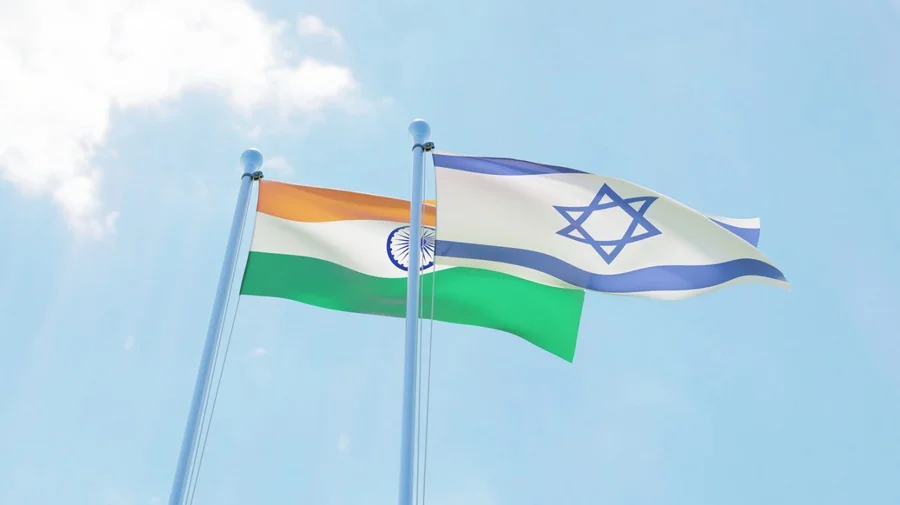
The deepening strategic partnership between India and Israel over the past decade has added a new dimension to the evolving regional security landscape, especially as the conflict between Iran, USA and Israel unfolds in West Asia. As regional tensions fluctuate and great-power competition intensifies, the strengthening of military, intelligence, and technological cooperation between New Delhi and Tel Aviv may create complex security challenges for Pakistan, Iran, and Gulf states in the coming months.
The trajectory of India–Israel relations has evolved dramatically since diplomatic ties were first established in 1992. It has emerged from modest cooperation into a strategic partnership that now comprehends defence procurement, co-production, and technology collaboration. Under Prime Minister Narendra Modi’s leadership, especially culminating in his 2026 visit to Israel, this relationship has taken a new strategic depth, spanning arms deals, joint production initiatives, and cutting-edge technology cooperation.
India became one of Israel’s most important defense partners in the 21st century, particularly after 2014. Over the past decade, data shows that Israel’s defense exports to India have grown more than 30-fold, making India one of its largest arms customers. Cooperative projects expanded beyond weapons to include joint ventures and production in India under the “Make in India” initiative.
Some Israeli-origin Indian weapon systems include the Barak-8 / MR-SAM air defence systems, co-developed by Israel Aerospace Industries (IAI) and India’s Defence Research and Development Organisation (DRDO). These systems form a core part of India’s layered air defence. Phalcon AWACS airborne radar, where India’s first airborne early warning platform was equipped with Israeli-supplied radar systems, is another example. Indo-Israel cooperation is increasing in the domain of Unmanned Aerial Vehicles (UAVs) as well . Heron, Herop, and Searcher surveillance drones from Israel have boosted India’s reconnaissance and surveillance capability, especially along its border areas. Notably, Israeli drones were India’s mainstay weapons in operations against Pakistan.
The Indo-Israel upgradation of ties has a special focus on defence production and tech sharing. Elbit Systems entered a joint venture with India’s Adani Group to assemble Hermes UAVs in Hyderabad, strengthening domestic production capability. Israeli firms have collaborated with Indian companies on electronic warfare systems and strategic electronics, often with technology transfer components. These arrangements laid the groundwork for deeper strategic alignment by the mid-2020s.
In early 2026, reports confirmed a major arms procurement package between India and Israel valued at about $8.6 billion — one of the largest single defence deals in their history. These constitute SPICE 1000 precision-guided bombs, Rampage air-to-surface missiles with a range of 250 km, Air LORA air-launched ballistic missiles, and Ice Breaker missiles.
These systems are designed to give India long-range, precision strike and integrated strike capability, which India has judiciously focused on improving its non-contact warfare abilities after facing a setback in engagement with Pakistan in May 2025. Its Russian and domestic weapon systems proved to be underwhelming against Pakistan’s air force network centric operational strategy. However, in parallel, Israeli weapons have demonstrated much more lethality in the Middle East conflicts in the last two years. Israeli precision munitions in the 12-day war with Iran, strikes on Qatar, and the ongoing Iran war showcased their ability to be launched at long standoff ranges, be precise in strikes, and inflict lethal costs on their targets.
Additionally, in late 2025, India approved other major procurements from Israeli partners involving MR-SAM missiles and associated systems worth several billions under the “Make in India” framework, often with local production requirements.
Modi’s two-day visit to Israel in February 2026 marked a strategic leap beyond transactional arms sales. Leaders from both countries elevated bilateral ties into a Special Strategic Partnership, institutionalizing cooperation in defence, technology, innovation, and critical emerging sectors. Agreements and memoranda of understanding signed during and shortly before the visit initiated frameworks for: Potential technology transfers for advanced missile defence include discussions around Israel’s famous Iron Dome and Iron Beam air and laser defence technologies, aimed at bolstering India’s multi-layer air defence network. Rather than merely importing hardware, India is increasingly seeking indigenous manufacturing, technology sharing, and co-innovation, reflecting both strategic autonomy goals and closer security ties with Israel. The partnership has also expanded into civilian technology spheres, reflecting broader innovation linkages. Israel’s semiconductor and digital payment expertise has found new markets in India — highlighted by the launch of India’s Unified Payments Interface (UPI) in Israel, a major step in cross-border technology integration. Private sector deals, like a $150 million co-development agreement on edge-AI chips, tie Israeli tech firms with Indian semiconductor ambitions.
Indo-Israel cooperation, along with unveiling of the Hexagon axis that apparently is a counter to another West Asian alliance ( although unofficial) between Pakistan. Turkiye, Egypt, Iran Saudi Arabia and Azerbaijan . This adds a whole new strategic dimension if we analyze the emerging postures of UAE, Greece in consequence with both India and Israel. The whole regional security complex that is emerging would recalibrate positoniong of these countries. India-Israel strategic congruence right before Israel’s attack on Iran and India’s exit from Chababahr , in addition to the events in May last year and a comprehensive strategic partnership deal with UAE hints at emerging regional fissures.
India and Israel have also agreed to collaborate on cyber security, startup innovation, and med-tech sectors, expanding the partnership beyond traditional defence domains. The shift in India–Israel cooperation from buyer–seller relationships to co-developers of high-end military technology signals growing strategic depth. While arms procurement continues, the emphasis on joint R&D, technology transfer, and co-production reflects India’s larger aim of defence self-reliance and increased indigenous capability. For regional actors, this deepening partnership underscores India’s pivot toward advanced defence ecosystems that blend Western and Israeli technologies — a factor that will shape West Asian security dynamics in the coming decade.

Hammad Waleed
Hammad Waleed is a Research Associate at Strategic Vision Institute, Islamabad. He graduated with distinction from National Defence University, Islamabad. He writes on issues pertaining National Security, Conflict analysis, Emerging Technology, Strategic forecast and public policy. He can be reached at hammadwaleed82@gmail.com.



Leave a Reply