

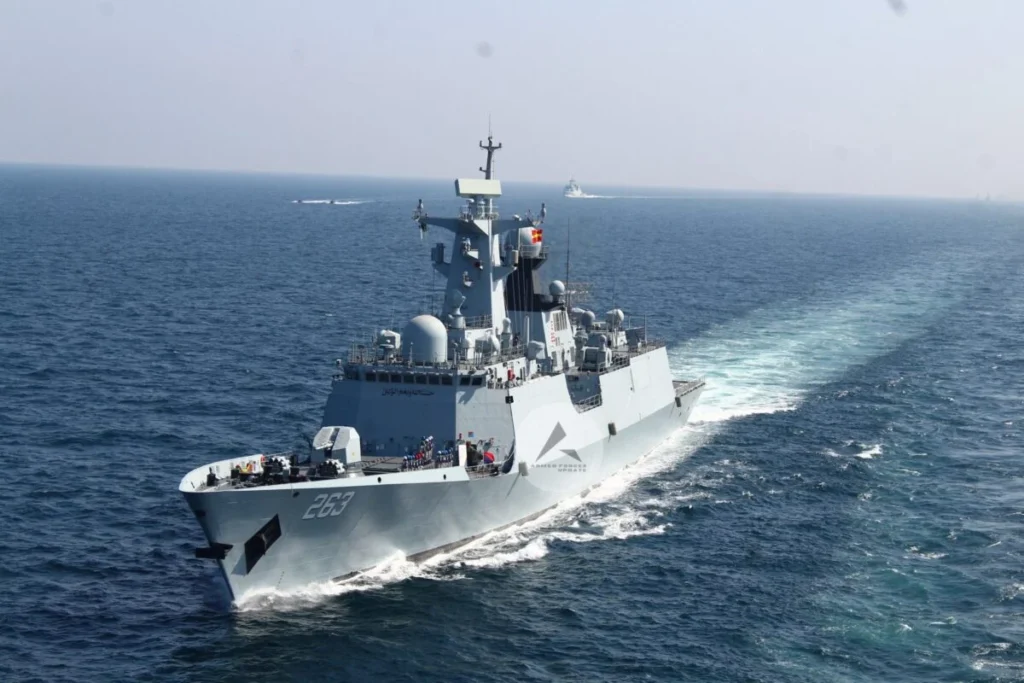
The frantic America-Israel-Iran conflict in the Middle East is a sign of a shift in the world order, which has changed the dynamics of maritime and regional security. The joint decapitation operations against Iran present a challenge to US power since Iran is fighting for survival, even though a diffuse and competing multipolar structure determines the intensity and nature of the Gulf conflict. The relevance of China and resurgence of Russia has recalibrated in the contemporary geopolitics of Middle East and Europe showing relevance of hard power. In this context, the opening of Operation Muhafiz-ul-Bahr and closure of Hormuz cannot be viewed in an isolated event but rather to secure its maritime interest. Gwadar due to its close proximity to the Western Asia has gained significance in the ongoing blockade of Hormuz, as safe passage and docking for merchant vessels. In such a hostile environment, the Gulf conflict along with Pakistan’s role as mediator where strategic stability and global balance are intricately linked. Pakistan Navy in this fragile security environment played a critical role in ensuring seamless transition of oil and trade across the strait of Hormuz. However, breakthrough diplomacy in Islamabad between the US-Iran in its second phase further intensify the role of Pakistan as a peace-maker in the region.
The Middle East is a Regional Security Complex
However, Maritime realm has always been contested concept, as the global economy, connectivity, and strategic competition takes a crucial stage at times of war. The conclusion of Hormuz affirms Barry Buzan’s observation that security is clustered in a geographical proximate region, as the developing dynamics demonstrate the practical logic of the regional security complex. The Gulf conflict’s sleek nature makes regional security harder still, since new technology like autonomous maritime platforms, unmanned aerial vehicles, and satellite-based monitoring is used to improve surveillance. States intentions to switch from traditional naval confrontations to hybrid threats have molded modern warfare amid emerging technological landscape. Controlling the sea lines of communication now requires flexibility, technology integration, and a constant eye rather than physical presence.
Shuttle diplomacy by Pakistan
To prevent a worldwide economic downturn, Pakistan, along with Turkey, Egypt, Saudi Arabia, and China, mediates between the countries involved in the Gulf crisis owing to its strategic importance and physical proximity to Iran. The Britton Wood systeml was put to the test during the 1973 global oil crisis and the Arab-Israeli war, but Iran’s challenge to the petrodollar in 2026 dealt a devastating blow to US dominance in global economic markets. This shift in protecting maritime interests, maintaining open sea lanes, protecting merchant vessels, and promoting peace in the North Arabian Sea is reflected from its efforts to deploy warships across the contested area.
Pakistan’s standing in the international system is on the rise, as it plays a mediating role among the conflicting parties of the Middle-East along with Turkey, Saudi Arabia and Egypt. Pakistan’s foreign minister Mr Dar visited China and met Chinese counterpart Wang Yi to finalize five points peace plans, towards cessation of the hostilities. Pakistan adept to more proactive diplomacy in contrast to India which adopt passive approach towards strategic autonomy. Pakistan is any conflict is always ready to jump-in whether it may be US-led coalition against former USSR, Sino-US rapprochement, the war on terror, and now the Iran-US-Israel conflict
Pakistan has recently signed Mutual Defense Agreement with Saudi Arabia, in which attack on one state would be consider an attack on the other. The joining of Trump Board of Peace on Gaza earlier this year, as the US and Pakistan relations is revived with no further clarity of what would be next if Trump promises is not fulfilled. Pakistan is finding itself in a flux, if Saudi were to invoke Defense Pact, Pakistan would be compelled to respond to the attack on KSA. In such a scenario, Pakistan and Tehran are good neighbors, but if the war turns out not in favor of Iran then the situation would worse since the former is trying to avoid direct involvement because of its Southern border.
Operation Muhafiz-ul-Bahr and stability at West Asia
The Pakistan Navy’s involvement in the contested Arabian Sea waters entails a change from deterrence and combat to cooperation and unconventional security roles. When considering Pakistan’s position in the intersection of the Gulf War, where the lines between combat and stability are blurred, Geoffrey Till noted that the Navy’s function is not only a weapon of war but also an instrument of order. The presence of the Pakistan Navy fosters the idea of open and secure sea routes, helps to foster confidence, and reduces the possibility of escalation.
A balance between neutrality and strategic readiness is required for operational readiness in the contested regional environment. Pakistan’s strategy in the face of economic limitations emphasizes both protecting national interests and promoting regional security. Pakistan Navy jointly conducted “Sea Guardian exercise” in a bid to strengthen its interoperability and maritime cooperation with PLA (N). As the war in Iran loom and amid the closure of Hormuz, Iran has given Pakistan a way for its oil supply. President Trump in his remarks to media, President Trump quoted eight ships to be reportedly passed through Hormuz with Pakistan flag. Pakistan is a neighbor to Iran, Pakistan is trying to prevent full-scale conflict and mediate between Iran-US-Israel war along with Turkey, Egypt, and Saudi Arabia.
Gwadar port is in close proximity to Strait of Hormuz, which might operate as an alternate route and an economic hub for oil shipments, economic channels, and connecting sea flows with land connectivity corridors such as CPEC. From a theoretical standpoint, this is strategic redundancy where states adopt to limit their weakness innate in the chokepoint. Pakistan in this scenario, is seeking resilience and enhances maritime security into infrastructure and economic integration to support Pakistan Navy. In this scenario, Pakistan is trying hard to find a hedge and balance amid the prolong conflict between Iran-US-Israel, being a cautious and pragmatic neighbor.
Conclusion
Regional security is imperiled amid Iran-US-Israel war, as highlighted by the Regional Security Complex that patterns of competitiveness, interdependence, and alliances ensure that security one state is insecurity to others. Pakistan’s strategic interests, economic stakes, and diplomatic maneuver to mediate between the US-Iran-Israel conflict. Pakistan strengthens its position in the international community to broker peace deal along with brotherly Muslim countries Turkey, Saudi Arabia, and Egypt. States in this anarchical world, comprehensive security is the essential component to secure national interest. The intensity of the conflict shapes regional security dynamics in the West Asia, and its spillover has already been felt in the increasing price of oil thus disturbing strategic calculus. The initiation of Operation Muhafiz-ul-Bahr highlights how critical the national interest when the war looms at your shores. Pakistan finds its South border in the intensity of the Gulf war, and asymmetric warfare, the strait of Hormuz causes heavy oil prices, soaring inflation, and disturb trade balance. Conflict in this globalized world, particularly the asymmetric Iran-Israel-US is emerging to be a test case for Military Industrial Complex to prevent worldwide recession and challen the dollar hegemony.

Basit Ali
Basit Ali is currently serving as a Research Associate at Maritime Centre of Excellence (MCE) PNWC. He is engaged in research focused on national security and maritime affairs. His work primarily explores the geopolitics of the Indian Ocean, maritime security challenges, and Pakistan's strategic interests in the broader South Asia, and Indo-Pacific region. He is contributing to policy-oriented studies, analytical papers, and institutional research projects that aim to enhance maritime awareness and strategic thinking within the naval and academic communities.

Leave a Reply