

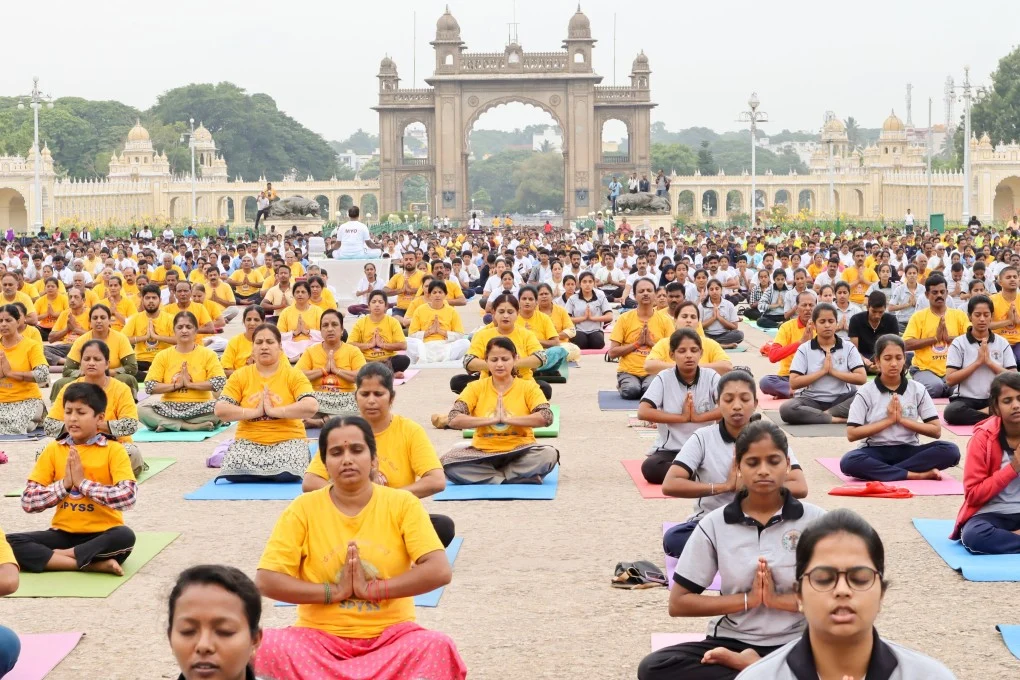
On June 21, 2025, Narendra Modi spoke to hundreds of thousands of people in Visakhapatnam, holding a mass yoga session to mark the International Day of Yoga.
Spreading across the globe, there was a very clear message of the spectacle: India is not a state but a civilization with spiritual teachings to the world.
This scene is the epitome of the changing foreign policy approach of India. India has resorted to soft power in an era when power is beyond the military and economic strengths to wield culture as a diplomatic tool especially yoga. Yoga has over the last ten years transformed into a political instrument across the world as opposed to being a traditional spiritual practice.
Yet, there is something more beyond the beauty of the coordinated motions and universal messages. Even though yoga diplomacy has provided India with a broader audience in the world, how far its cultural appeal is transformed into tangible geopolitical strength is a contentious topic. In this paper, it is argued that the diplomacy of yoga is not a power instrument, but rather a symbolic projecting and image control in India.
The Emergence of Yoga as Soft Power
Promotion of yoga by India is one of the best examples of cultural branding in modern-day culture and diplomacy. The International Day of Yoga was globally recognized making yoga an integral part of the international systems and engraving it in the minds of people in the world.
This plan is based on three pillars:
1. Globalization by international organizations such as the UN.
2. Free access to courses and programs by embassies.
3. Being synonymous with other concepts like wellness, sustainability and world peace.
The results cannot be disputed. Yoga is now practiced in almost all countries and India is well known as the source of yoga. It is also economical, yet with a wide reach as compared to conventional diplomacy, it generates a lot of goodwill at the international level. But visibility does not equate to influence. To the conceptualization of soft power by Joseph Nye, it is based on attraction and credibility. It is here that yoga diplomacy begins to falter.
Strategic Performance or Public Diplomacy?
The application of yoga by India falls in the larger context of public diplomacy, which is one that seeks to impact the people of a foreign country, and not simply the governments. With the help of enormous yoga festivals, cultural festivals and wellness campaigns, it is possible to create the sense of unity between India and the rest of the world.
But an important question with this strategy is:
“Does culture admiration play a role in political affiliation?”
The facts indicate the contrary. Despite the millions of individuals practicing yoga and being fond of the Indian culture, it does not necessarily imply that they promote the Indian geopolitical interests. It is not on the basis of cultural affinity that countries change the position of foreign policy. In this respect, yoga diplomacy is more like strategic performance, highly visible, emotive, limited in its capacity to manifest itself in concrete results.
The Overrating of Cultural Power
The fact that cultural power can substitute material power is among the key weaknesses that the Indian approach possesses. Cultural diplomacy can best be used as a complement to economic power, technological advancements and political stability.
The excessive dependence on yoga in India is dangerous as it may lead to the formation of a perception-reality gap:
- An international picture of peace and harmony.
- An external and internal competitive and internal challenge strategic environment.
Unless the economic and political sectors evolve simultaneously, yoga diplomacy will not be able to bear the burden of global aspirations of India. It enhances goodwill without having to fundamentally alter power coalitions.
Home Gaffes and Believability Loopholes
The success of soft power is based on the correspondence of the external message and internal realities. Here India has many problems.
Critics point to:
- Backsliding and press censorship of democracy.
- Social and religious war.
The consequences of these issues are a discrepancy in credibility. It is difficult not to see the contradiction when a state promotes yoga as the philosophy of harmony and faces criticism at home. This type of inconsistencies contributes to turning yoga into a sort of a soft power shield a weapon that wraps the inner issues rather than addressing them, instead of enhancing the moral authority of India.
South Asian Frontier: South Asian Strategic Reality
Particularly, in South Asia, the negative aspects of yoga diplomacy can be observed. Although India and the neighbors share a common cultural background, issues of security, past resentment and political rivalry remain the character of the Indian relationship with its neighbors.
In this context:
- The yoga programs do not make much difference in resolving conflicts.
- Geopolitical tensions prevail over cultural outreach.
- The attempts of India will be seen as a cultural domination instead of cooperation by smaller states.
This leads to the realization of a fundamental fact that does not imply political agreement that the common culture does not necessarily imply. Hard strategic realities cannot be subordinated to soft power.
International Success, Diffuse Influence
Yoga has been much more successful internationally. It is directly linked to the current day problems such as mental health, sustainability and living a whole life, and therefore is a generally accepted system in many societies.
This, however, is much non-political. Countries embrace yoga without necessarily augmenting the degree of strategic engagement with India. What is happening is some sort of influence which is broad and shallow high in visibility and narrow in influence. This reinforces one of the restrictions: global fame may not always be associated with
political influence.
Ownership, Authenticity and Politics of Culture
Question of ownership is another challenge that is emerging. The attempts of India to safeguard yoga as cultural heritage, by documenting and regulating it, is comprehensible. But any effort to regulate or standardize its practice throughout the world runs the danger of backfire.
Openness and adaptability have been the ingredients of the world-renowned success of yoga. Over-regulation or claims of exclusivity may:
- Alienate international practitioners
- undermine the universality of yoga
- change attitude towards cultural generosity to cultural control
- Influence is fostered in diplomacy by inclusion and not by restriction.
Conclusion
The application of yoga by India in public diplomacy is innovative and powerful. It has transformed the way the world is perceived, has placed India among the leaders of cultures, and has shown that soft power can be very powerful in international relations. Nonetheless, it has a minimal strategic impact. In its present manifestation, yoga diplomacy is rather an image building than an image projecting instrument. It is limited to the contradictions within the domestic sphere, the local conditions and the imperatives of the cultural influence. Culture can be an open door in a more competitive world but not a determinant by itself. In the case of India, the question is not to drop yoga diplomacy but base it on its credibility, consistency, and overall strategy. The pose may be worshipped by the world. However, what is below is what endures

Ayesha Noor
Ayesha Noor is currently pursuing her bachelor's in international relations from Fatima Jinnah Women's University. Her areas of interest are diplomacy, global affairs, and foreign affairs.



Leave a Reply