

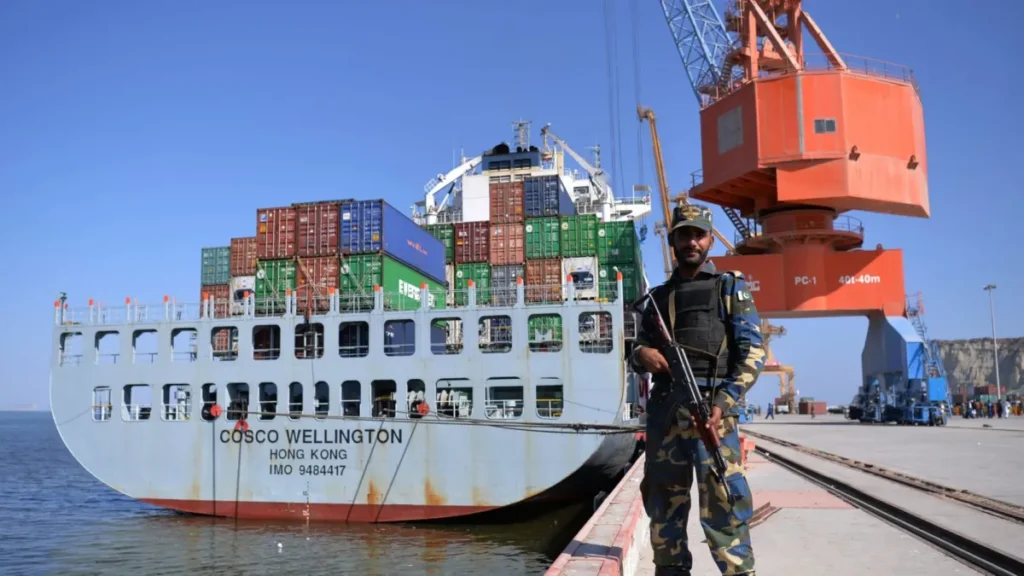
Pakistan is blessed with a highly valuable maritime domain, including a continental shelf of approximately 50,000 square kilometers, the deep seaport of Gwadar, rich natural resources, a 200-nautical-mile Exclusive Economic Zone (EEZ), and warm waters year-round. In this strategic environment, the Pakistan Navy plays a pivotal role not only in securing Pakistan’s sea boundaries but also in contributing significantly to regional and international maritime security. As a committed member of the Combined Task Force 150 (CTF-150) under the Combined Maritime Forces (CMF), the Pakistan Navy has demonstrated its operatonal effectiveness through joint efforts. For instance, Pakistan Navy Ship Yarmook, in collaboration with the Saudi Navy, successfully conducted a maritime operation in the Arabian Sea that resulted in the seizure of narcotics worth approximately $972 million. Similarly, the Aman Exercises, initiated by the Pakistan Navy in 2007 and now regularly attended by around 50 countries, have become a prominent platform for enhancing marritime security cooperation. These multinational drills focus on countering piracy, smuggling, human trafficking, and ensuring the safety and security of international sea lanes. Complementing the Pakistan Navy’s efforts is the Pakistan Maritime Security Agency (PMSA), established on 1 January 1987. The PMSA is mandated to enforce national and international maritime laws, policies, and conventions within Pakistan’s waters. Its responsibilities include the protection of Pakistani and international shipping, countering terrorism and smuggling, and conducting search and rescue operations at sea. Notable recent examples of PMSA’s humanitration role include the joint operation with the Pakistan Navy on 4 February 2024 to rescue the immobilized SAS-5 Ocean tug near the Indian coast, approximately 167 nautical miles southeastt of Karachi. In December 2024, the PMSA also responded swiftly to an urgent request from the Maritime Rescue Coordination Center (MRCC) Mumbai and successfully rescued 12 crew members from the Indian cargo ship MSV Al Piranipir, which had encountered an emergency in Pakistani waters. The historical evolution of Pakistan’s maritime strategyy reflects a journey from modest beginnings to a more robustt and forward-looking posture. At the time of Partition in 1947, the Pakistan Navy was a small force under the command of Commodore James Wilfred Jefford. It inherited limited assets, including two anti-submarine frigates/slops, eight fleet minesweepers, a few trawlers, four harbor defense launches, and basic shore establishments such as a gunnery school, radar school, and training facilities. During the 1960s and early 1970s, the Navy prioritized operational learning and the acquisition of submarines to enhance deterrence in the Indian Ocean. The induction of PNS Ghazi in 1964, followed by three Daphne-class submarines from France in 1969–70, marked important milestones. After the loss of PNS Ghazi during the 1971 war, Pakistan acquired another Daphne-class submarine from Portugal in 1975. In the post-1971 period, modernization of frigates, submarines, missiles, and other weapon systems became a core focus. A significant leap forward came with the launch of Agosta 90-B submarine in 2002, which added advanced capabilities in anti-submarine warfare, limited land-attack roles, and intelligence gathering. Pakistan’s joining of CTF-150 and CTF-151 in 2004 further highlighted its commitment to global maritime security, particularly in countering terrorism, human trafficking, and drug smuggling while safeguarding sea lanes of communication. The most transformative phase in Pakistan’s maritime strategy emerged with the China-Pakistan Economic Corridor (CPEC) and the development of Gwadar Port. This shift has placed greater emphasis on addressing security challenges alongside harnessing the potential of the blue economy, including deep-sea mining, fisheries, and coastal tourism. Since 2015, naval cooperation with China has deepened significantly, focusing on technology transfer and capacity building. A landmark development occurred in March 2024 when Pakistan launched the second Hangor-class submarine in China as part of an agreement with China Shipbuilding & Offshore International Company Ltd (CSOC). Under this program, four submarines will be acquired from China while the remaining four will be constructed at the Karachi Shipyard through a technology exchange initiative.
From its humble beginnings in 1947 to its current role as a capable maritime power, Pakistan has steadily transformed its naval posture to meet national and international responsibilities. Today, through active participation in CTF-150 and CTF-151, successful counternarcotics and humanitarian operations, and the successful conduct of the multinational Aman Exercises, the Pakistan Navy and PMSA have firmly established Pakistan as a responsible stakeholder in regional and global maritime security.
The development of Gwadar Port under CPEC, coupled with the ongoing modernization program particularly the Hangor-class submarines mark a new era in which Pakistan is well-positioned to protect its maritime interests while contributing meaningfully to the safety of international sea lanes. As Pakistan continues to harness the vast potential of its blue economy, sustained investment in naval capabilities and deeper iinternational cooperation will remain essential. In an increasingly interconnected maritime domain, Pakistan stands ready to play a constructive role in promoting peace, stability, and prosperity across the Indian Ocean and beyond.

Muhammad Nafees Khan
Muhammad Nafees Khan is a graduate in International Relations and a contributing writer on global politics, with a focus on maritime security, U.S. foreign policy, and Middle Eastern affairs.


Leave a Reply