

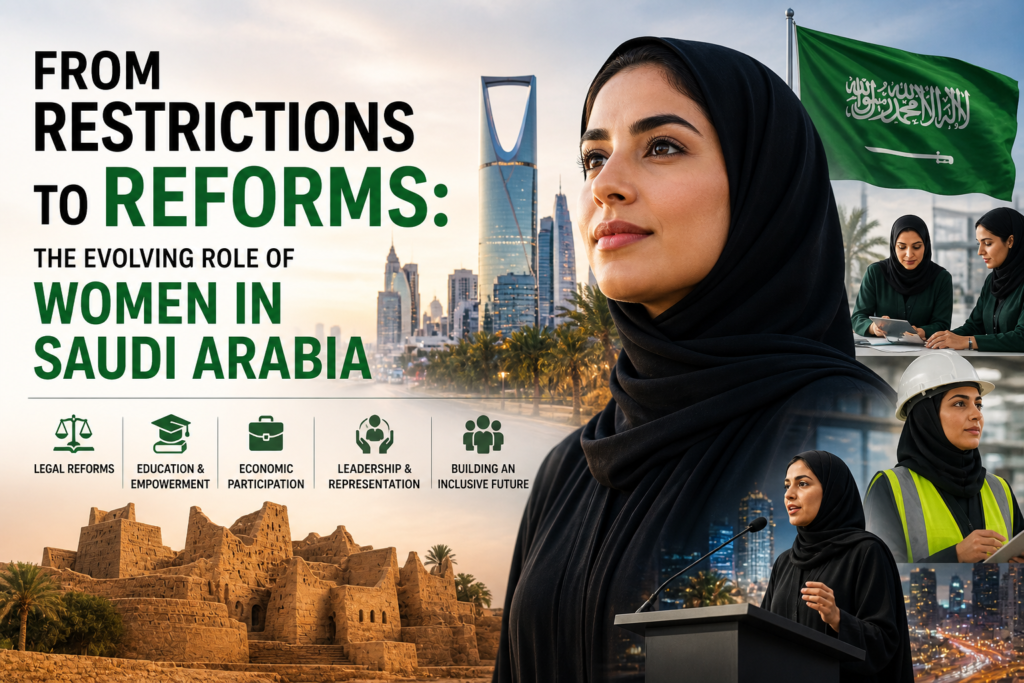
In the modern world, women’s empowerment has become crucial for societal development. In the 21st century, it has become an important social issue. In Saudi Arabia, less than a decade ago women were not independent enough to travel alone or drive without male permission. The gradual shift holds remarkable value. To empower women is not just about justice and gender equality but also a dire need for economic growth, social and cultural transformation. In the contemporary era, Saudi Arabia has made a series of successful reforms focused on women’s rights. It has taken significant steps to improve the living conditions of women. However, these reforms, while significant, are still a work in progress. Saudi Arabia is working towards a social, cultural and legal transformation.
Traditionally, Saudi Arabia was recognized for having strict gender stereotypes, a patriarchal system and limited women’s participation. Restrictions were imposed on women’s employment, mobility and legal affairs. All the matters such as education and career choices required approval from a male guardian. Such a suffocating environment severely damaged and restricted women to actively play their role in society. However, the country recognized the importance of women in the recent decade and embraced the change. One of the most impactful measures was lifting the driving ban in 2018. This reform allowed women to travel freely without relying on any male family member.
For a country to prosper, economic growth is a crucial aspect. Hence, economic empowerment is a critical aspect of women’s empowerment. Saudi Arabia has taken an important step of Vision 2030. Under this Vision, the Technical and Vocational Education and Training sector has been aligned with key sectors such as industry, healthcare and technology where women are increasingly being trained and employed. It is a national strategy for economic transformation through acknowledging the importance of women in workforce. Many domestic policies have been introduced to encourage women’s participation in male-dominated career paths. Women are encouraged to participate in fields like engineering, science and technology, finance and economics. The Ministry of Tourism has invested an amount of 375 million riyals towards the women’s training programs. These training programs helped women to acquire professional skills. In the business realm, women are empowered through training programs, financial initiatives and aid system. These steps have proven significant as those who have financial control are more independent and socially protected. Hence economic improvement can lead to social transformation. It can play an important role in dissolving the rigid and pre-established societal norms. Moreover, women can play their role in economic prosperity which benefits the society as a whole.
Social reforms have also played a crucial role in gender inclusion in Saudi Arabia. By removing the concept of guardianship, women are now more independent in decision making. They are confidently making important decisions regarding their education, career and work life. Access to higher education resulted in more women’s enrollment than men which has led to the perception of women being more career-oriented and have perspectives that are vital for national progress. Moreover, women having active participation in leadership roles challenged the pre-established norms. The National Observatory for Women has reported that there is a gradual increase in women’s employment in senior management positions. When women succeed in a particular position, it conveys a strong message that gender should not specify one’s potential.
These changes sound convincing in theory, but when it comes to practice there are some challenges. Cultural attitudes regarding gender roles influence women in Saudi Arabia. Legal reforms do provide a solid framework for equality and justice but on the other hand social and cultural norms hinder progress. Women do have access to the workplace but they still face resistance, limitations in career progression and pressure to fulfill traditional gender roles. There is a huge gap between formal reformations and lived experiences.
However, the step forward is to bring cultural transformation. Female participation is not just a legal or economic matter it is also impacted by cultural gender stereotypes. Awareness programs, educational initiatives can help reshape the social norms and perspectives. Engaging in active communication between communities and policymakers ensures that reforms are not just superficial but they hold a deeper impact. When the cultural and legal practices align with each other only then the women in Saudi Arabia can enjoy full rights and independence.
But the overall progress seen in Saudi Arabia is to an extent convincing that further developments can be achieved. Reforms are an inspiration that the country is moving in the right direction. It is building a foundation including educational access, employment and mobility. Through which women can thrive. The journey is ongoing but the country needs to address its sociocultural barriers in order to make a true impact. A sustainable empowerment is achieved through the combination of education, political and cultural transformation and Saudi Arabia is gradually acknowledging it.
To conclude Saudi Arabia is showing remarkable progress. Recent reforms show the country’s commitment to improving women’s living conditions. These policies have created new opportunities for women. However, this empowerment program requires more than laws and regulations it also demands a cultural transformation that is to build a society that values women as equal individuals. However, the progress achieved so far should be appreciated and the remaining gaps serve as milestones yet to be achieved. Women’s empowerment is not just about equality and fairness but it is an important investment in the future generations and national progress. The true success of these policies will be measured by the lived realities of women across Saudi society.

Ayla Maryam
Ayla Maryam is an undergraduate student of International Relations with a keen interest in gender studies and socio-political transformation. This article reflects her interest in examining Saudi Arabia’s ongoing women empowerment reforms under Vision 2030 and their social impact particularly contemporary policy development.



Leave a Reply