

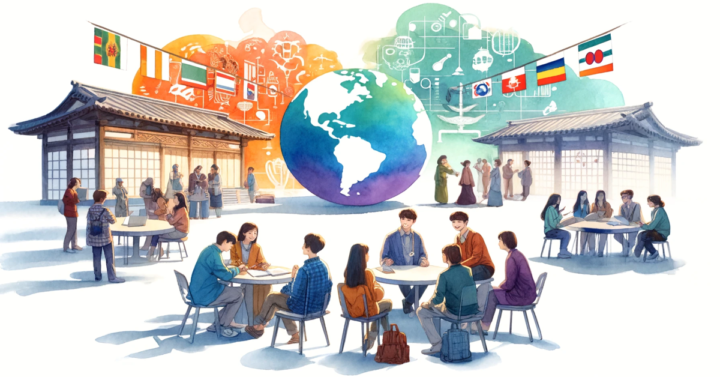
In an era where military alliances fracture and economic leverage breeds resentment, the nations that will shape the next century are those investing not in weapons, but in people. Soft power is transmitted through media relations and embassy functions. The most effective public diplomacy today is the influence achieved through people by education, experience, and understanding. This fact has dawned sooner on Turkey than on most other countries. Thanks to its deep and rich historical and cultural heritage from the Ottoman Empire to Anatolian culture—Turkey has a powerful source for soft power. Through cultural exchange programs, Turkey has harnessed this legacy to develop one of the most successful and often under-recognized public diplomacy strategies for the 21st century: a strategy that does not exploit military might, but leverages humans as an active tool of diplomacy.
It is critical to consider what Turkey is in order to understand why its strategy of soft diplomacy is effective. Turkey is a bridge between East and West, with a history of thousands of years of civilization — from the Byzantine and Ottoman empires to the Silk Road civilizations that served as arteries of global commerce and cultural exchange. It is a country with buildings, food, books, music, and traditions that attract millions of people from different regions and continents because of its cultural diversity. This rich history lends Turkey something which is in short supply on the international stage: a culture of its own, and a story worth telling.
It is only since the rise of the Justice and Development Party (JDP) in 2002 that this realization took shape in Turkish foreign policy. Turkey began to promote itself not solely through economic and political engagements, but also through cultural and educational diplomacy. Institutions were created to achieve this vision. The Yunus Emre Institute was established in 2007 and now has 93 cultural centers in 69 countries, providing Turkish language education to tens of thousands of people each year. The Türkiye Scholarships program offers full scholarships to students from more than 180 countries. Fully-funded summer schools on Turkish archaeology, food culture, art, and history immerse students in Turkish culture. This state-funded arrangement is a coherent part of a broader effort at public diplomacy that is unique to few countries.
What makes this strategy work so well, and noble, is that it is genuine. Turkey has historical monuments, food, language, and culture. When a student from Pakistan or Uganda attends a Turkish summer program and walks the streets of ancient Anatolia, they are encountering something of historic and cultural value. In this way, education and cultural exchanges become a two-way dialogue rather than a monologue between worlds. This is precisely what distinguishes the Turkish model: it engages rather than coerces, and fosters understanding rather than dependence.
Turkey’s educational programs are also future-oriented. The Türkiye Scholarship students spend four to six years studying and return home well-versed in Turkey’s society and institutions. Many become university professors, bureaucrats, journalists, and policymakers. Turkey is making a long-term investment in the future of young people from regions where it would like to establish lasting partnerships with South Asia, Sub-Saharan Africa, Central Asia, and the Middle East. Rather than “outcomes diplomacy,” it is creating decade-long relationships with future leaders at a time when their countries will have a genuine need for these relationships. In my view, this is the most visionary aspect of Turkey’s public diplomacy and one that sets it apart from more arms-length models of international relations.
It is also important to note that such programs carry significant benefits for recipient countries. A fully funded scholarship to study abroad represents a transformative opportunity for many students from the developing world — granting them access to high-quality education, a global outlook, and a deeper cultural understanding. Turkey is bringing something of value to regions that are commonly neglected by developed nations. As the Yunus Emre Institute’s cooperation agreements with universities in Pakistan, Uganda, and Indonesia demonstrate, Turkey recognizes the worth of partnerships that other nations often overlook. In that regard, Turkey’s soft power in education is not merely a self-serving endeavor — it is an approach to the Global South that deserves broader recognition.
The Turkish programs are designed and directed by the state, meaning the cultural message communicated has been state-approved. Some scholars and institutions have expressed concern about the political nature of these activities, and there are grounds for such concerns. But having a political purpose does not necessarily compromise the value of the program. Some of the most successful and prestigious cultural institutions in the world—the British Council, the Goethe-Institute, and the Alliance Française—are government-funded and carry national interests alongside a genuine commitment to education. Turkey is participating in a long-standing tradition of state-backed cultural diplomacy that has existed for centuries; holding it to a different standard than others would be inconsistent.
If there is a lesson to be learned from the Turkish approach, it is this: in an age where hard power is becoming more expensive and political trust more tenuous, those countries that invest in human relationships will go further than those that rely on raw power or economic leverage. The next force in shaping the world does not need to be a superpower. It needs a culture, a long view, and a welcoming attitude. The leaders of tomorrow are in the classrooms of Turkey today touring historical sites in Anatolia and meeting people they would have otherwise never crossed paths with. When they return home and assume their positions, Turkey will have their ear. The question for the rest of the world is not what it can learn from Turkey ,it is why so many countries haven’t done the same.



Leave a Reply