

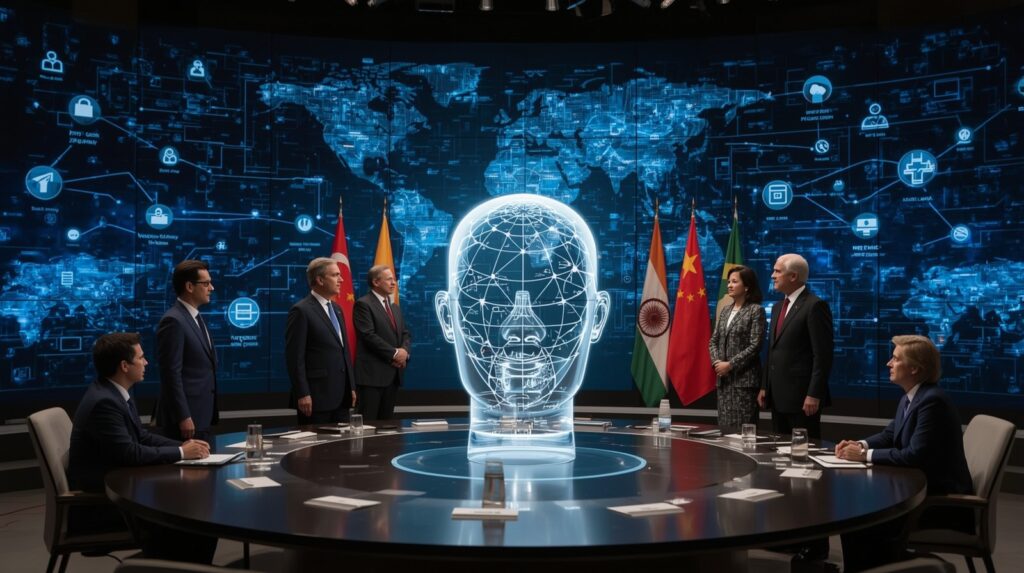
In this increasingly multipolar world, Brazil clearly demonstrates that influence can be built by leveraging soft power tools rather than relying on military capabilities. Brazil enhanced its international image through the BRICS forum by articulating a narrative centered on inclusive governance and environmental responsibility. However, an increasing gap exists between its climate commitments and oil expansion which risks its credibility as a responsible climate leader and a voice for the Global South. The gap is shaped due to the contradiction between its aspirational global image and domestic economic imperatives.
The BRICS (Brazil, Russia, India, China and South Africa) bloc along with recent expansion (e.g. Egypt, United Arab Emirates, Ethiopia etc) reinforces the challenge to the Western-dominated system of governance. Although constrained in hard power, Brazil positioned itself as a proactive middle power strategically utilizing the BRICS platform to build international influence by leveraging the narrative of South-South cooperation to develop partnerships rather than relying on coercive means. Brazil’s 2025 BRICS presidency is a prime example of this approach. By hosting the United Nations Conference (COP30) in Belem, Brazil demonstrated its commitment to positioning itself as a sustainability leader, seeking influence in a multipolar order where global governance is shaped by an emphasis on environmental responsibility.
Brazil’s public diplomacy vision involves rebranding itself as the leader of the Global South. It brought emerging economies together with the intent to endorse fairer systems in health and finance during its 2025 BRICS presidency. It also encouraged trade in local currencies as an approach to reduce dollar dependence and foster economic cooperation among the BRICS bloc. Moreover, Brazil criticized the disproportionate empowerment of the Global North and the underrepresentation of developing economies in global institutions such as the IMF and the World Bank, hence calling for reforms to provide greater representation for the Global South.
Brazil’s strategy involves a mix of cultural outreach, educational programs, scholarships and climate diplomacy to enhance its ties in BRICS. For instance, Brazil hosted cultural events such as the tenth year of Bloco Bollywood in São Paulo which was organized by the local Indian community that mixed Brazilian carnival, Russian dance, Indian tunes and South African rhythms; not only promoted cultural convergence in BRICS but overall enhanced its cooperative and influential image building efforts.
In addition, Brazil focused on educational cooperation by offering scholarships and exchange programs targeting BRICS youth with the intent of building long-term partnerships. Although the BRICS-NU (BRICS- Network University) was launched collectively in 2015, Brazil chaired its 10th anniversary council meeting and expanded its twenty domestic institutions for collaborative research and academic exchanges in 2025. Furthermore, regional virtual Youth seminars have contributed to cultivating people-to-people networks and connected Brazilian youth with counterparts from different states.
Moreover, Brazil’s effort to reduce deforestation allowed it to frame itself as a responsible climate leader with an ambition to lead the Global South regarding climate issues. Hence, advocating for global action on climate change.
However, a discrepancy exists and results fall short of pledges, with a need for the Brazilian government to move beyond broad commitments and deliver clear results. In the context of Brazil’s climate leadership, it portrayed the Amazon as a global symbol of environmental responsibility and successfully reduced the deforestation rates in the Amazon under President Luiz Inacio Lula da Silva . This signals that through political will, dedication and regulatory enforcement, substantive progress can be achieved. However, credibility gaps exist due to the discrepancy between discourse and practice. Brazil’s credibility has been scrutinized for wildfires, violence against environmental advocates and a lack of resources for the regulatory bodies. But most importantly, Brazil’s expanding oil production undermines its international image as a responsible climate leader while Petrobras oil and gas expansion is under scrutiny. Petrobras confirming new hydrocarbon discovery in pre-salt layer in the Compos Basin highlights Brazil’s fossil fuel expansion strategy which is central to revenue generation. It poses risks to the global climate goals, especially the targets set by the Paris Agreement while also threatening COP30 climate commitments. Hence, demonstrate a gap between Brazil’s international commitments and domestic realities.
At the same time, Brazil’s energy profile portrays a complex picture. Approximately 87% power generation is derived from renewable sources. As a result, a smaller share of emissions originates from electricity production and more from the expansion of fossil fuel production thereby, complicating its claim of comprehensive environmental leadership.
Moreover, Brazil’s government is drafting a national Fossil-fuel transition plan focusing on a ‘just and orderly’ energy transition towards renewables. Although the comprehensive roadmap documentation of the plan was due by February 2026, the draft is still in progress.
The delay has prompted concerns regarding the implementation capacity also raising questions whether the government can translate ambitious commitments into concrete outcomes.
Despite these challenges, Brazil’s diplomatic engagement remains significant. Through its cultural projection, climate leadership, and South-South cooperation narrative, Brazil positioned itself as a middle power capable of exerting influence and shaping global debates without dependence on military dominance. Its 2025 BRICS presidency and hosting COP30 were the major achievements in diplomatic progress and provided it with forums to push for an inclusive governance narrative and a greater voice for the Global South. Yet, the dual reality of Brazil’s energy profile cannot be overlooked. While the energy sector is largely renewable, the broader political economy partially depends on fossil fuel extraction, thus creating a tension between climate leadership and development imperatives.
Brazil now stands at a critical juncture where its future influence in BRICS and beyond depends on the successful alignment of domestic policies with environmental commitments. Failure to achieve this risks its climate leadership being perceived as aspirational rather than substantive.

Minahil Durrani
Minahil Durrani is pursuing a Bachelor's in International Relations from Fatima Jinnah Women University. Interested in global sustainability, climate change, and foreign policy analysis.


Leave a Reply