

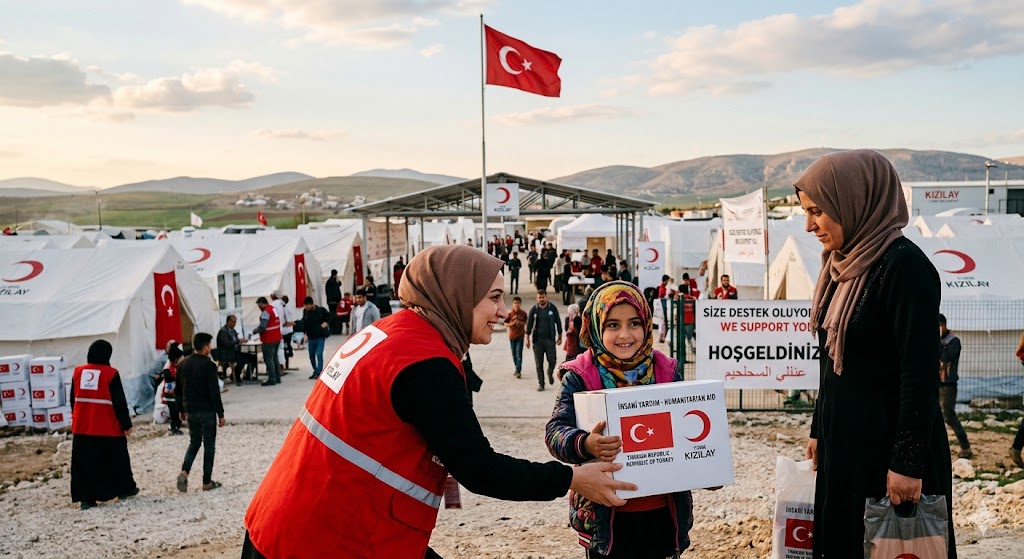
In 2026, Türkiye remains at the center of one of the most significant debates in international relations: the relationship between humanitarian responsibility and diplomatic strategy. Hosting more than 3.6 million foreign nationals, including approximately 2.35 million Syrians under temporary protection, Türkiye’s refugee policy has become a defining part of its international image. What initially emerged as an emergency response to the Syrian conflict has gradually evolved into broader mechanism of public diplomacy, combining humanitarian assistance with national interest and international image building.[1]
Türkiye’s refugee policy is often presented as an example of humanitarian leadership, and this recognition is not without justification. For more than a decade, the country has provided shelter, healthcare access, education and social services to millions displaced by war and instability. At a time when many countries have tightened migration policies and limited refugee intake, Türkiye has continued to carry a major humanitarian responsibility. This long term engagement has strengthened its reputation as an active humanitarian actor both regionally and globally.
At the same time, Türkiye’s refugee policy is not only about humanitarian assistance. Over time, it has also become closely connected to the country’s international identity and diplomatic messaging. Refugee management is communicated externally as evidence of Türkiye’s moral responsibility and regional leadership. Through this narrative, Türkiye positions itself as a capable, Muslim–majority power willing to act in situation where others hesitate. This framing enhances its visibility and influence across the Middle East, Africa and parts of Asia, demonstrating how humanitarian policy can function as a form of soft power in modern diplomacy.
The refugee issue has created important domestic challenges inside Türkiye. As the Syrian conflict continued for years, economic pressures, housing concerns, and employment competition have intensified public debate within Türkiye. Many Turkish citizens increasingly questioned the long term sustainability of refugee hosting, especially during periods of economic difficulty and inflation. As a result, refugee policy gradually shifted from being viewed mainly as a humanitarian issue to becoming a politically sensitive domestic matter as well. This reflects the complex reality of migration politics, where humanitarian ideals often interact with economic and political limitations.
This complexity lies at the heart of the debate surrounding Türkiye’s humanitarian diplomacy. Is Türkiye acting primarily out of moral responsibility, or is it using humanitarian policy to expand its international influence? In reality both elements exist simultaneously. Türkiye has undeniably provided real humanitarian support to displaced population, but these actions have also contributed to diplomatic visibility and geopolitical influence. In contemporary international relations, morality and strategic interest are rarely completely separate. Instead, humanitarian action often becomes part of broader foreign policy objectives.
Türkiye’s disaster relief operations further reinforce this dynamic. Institutions such as AFAD and the Turkish Red Crescent, the country has developed a reputation for rapid and visible humanitarian response both domestically and internationally. Whether responding to earthquakes, regional conflicts, or humanitarian emergencies abroad, Turkish aid agencies have become increasingly visible in global crisis zones. These relief operations are not only humanitarian efforts; they also serve as demonstrations of state capacity, organizations, and international engagement.
The devastating earthquakes that struck southern Türkiye and northern Syria in 2023 especially highlighted this aspect of Turkish humanitarian diplomacy. The crisis attracted international attention and demonstrated the scale of Türkiye’s disaster response infrastructure. At the same time, Turkish humanitarian organization expanded their operations abroad, strengthening the countries in international humanitarian profile. In 2026 official statements by Foreign Minister Hakan Fidan continue to emphasize Türkiye’s commitment to peace, stability and humanitarian responsibility showing how closely aid and diplomacy are connected in Turkish foreign policy discourse.
Foreign Aid strengthens this global image. According to the Organization for Economic Cooperation and Development, Türkiye has consistently ranked among key leading humanitarian donors relative to its economic capacity. Its assistance spans disaster relief, infrastructure, education, and health projects across Africa, the Balkans and part of Asia. These initiatives strengthen Türkiye’s diplomatic presence in recipient countries while also reinforcing its image as a humanitarian partner.
Nevertheless, critics argue that humanitarian diplomacy can also function as a strategic political instrument. The relationship between the European Union and Türkiye regarding migration management has frequently involved negotiation, policy bargaining, and security concerns. Critique claim that refugee policy has occasionally been used as leverage in diplomatic discussions with Europe. While such agreements do not erase the humanitarian value of Turkish assistance, they do demonstrate how closely humanitarian action geopolitical interests can overlap in modern international politics.
Historical examples show that this combination of morality and strategy is not unique to Türkiye. The Marshall Plan, for instance, provided significant economic assistance post war Europe while also advancing American geopolitical interests during the Cold War. Similarly Türkiye humanitarian initiative generate both humanitarian outcomes and diplomatic advantages. This is not necessarily weaken be legitimacy of its efforts; rather it reflect the reality that humanitarian policy and national interest often coexist with within state behaviour.
Ultimately, the question is not whether Türkiye’s humanitarian policy is purely altruistic, but whether it produced meaningful human and political outcomes. On that measures Türkiye’s role has been significant. It has provided assistance to millions of displaced people, extended its international visibility, and positioned humanitarian engagement as a central feature of its foreign policy identity.
In an era increasingly shaped by displacement, climate crisis, armed conflict, and geopolitical instability, humanitarian diplomacy has become an important source of international influence. Türkiye’s approach demonstrates how states can use humanitarian action not only to respond crisis but also to strengthen their diplomatic legitimacy and global standing. Whether viewed as moral leadership, strategic communication, or a combination of both Türkiye’s humanitarian diplomacy remains one of the clearest contemporary examples of how compassion and statecraft can operate together in international relations.
[1] Türkiye — Overview of Migrant Situation – Annual Report (Jan-Dec 2025) – Türkiye | ReliefWeb



Leave a Reply