

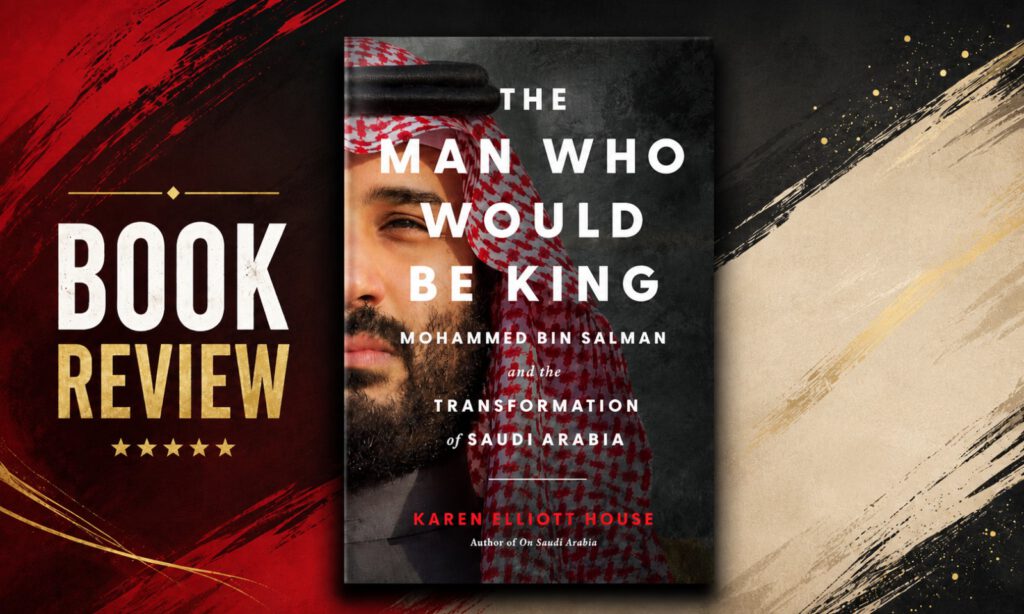
The Man Who Would be King is written by Karen Elliott House and was released less than a month before Israel went into a twelve-day war against Iran. The release of the book could not be more timely than this, because there was some school of thought that considered Hamas’ surprise attack on Israel to be part of Iran’s great plan to thwart Saudi Crown Prince Mohammed Bin Salman (MBS) from entering into a peace deal with Israel. Throughout this time period, MBS skillfully managed KSA’s position in this chaos and solidified his role as a regional statesman.
House is uniquely positioned to write this book due to winning the Pulitzer Prize as a journalist, being a former chairperson of the RAND Corporation, and her previous work on the book “On Saudi Arabia” (2012). She has covered the Kingdom for more than four decades. For this book, she has conducted exclusive interviews with the Crown Prince, members of the royal family, and the Crown Prince’s advisors. The book is structured as a series of thematic essays examining dimensions of MBS’s rule, ranging from his consolidation of power to his social and religious reforms, then Vision 2030, and finally the darker episodes from his rule that caused his rise.
Karen House opens by tracing MBS’s rise from an unknown prince as the sixth son of King Salman to the most powerful man in the kingdom. She recounts his accumulation of titles such as Minister of Defense, chair of the Council for Economic and Development Affairs, and finally crown prince in 2017 with the removal of his cousin Mohammed Bin Nayef. The author then treats the Ritz-Carlton Purge as a pathway for MBS’s future agendas. The purge was widely interpreted as a campaign that eliminated potential challenges to MBS’s authority in the Kingdom.
A substantial portion of the book is devoted to MBS’s campaign of curbing Saudi Arabia’s religious establishment authority. The very authority that was equal to the ruling family in terms of legitimacy. The author mentions the cessation of the religious police’s powers, lifting the ban on women driving in 2018, loosening the male guardianship restriction, and the introduction of public entertainment like cinemas, concerts, etc. MBS took these steps, which were once considered unthinkable. The author frames these changes as reshaping the Saudi national identity to be nationalist and youth-oriented, which was based on Wahhabi orthodoxy.
The author then gives extensive attention to MBS’s flagship program of Vision 2030, intended for diversification and reducing the Kingdom’s reliance on oil. She describes all the ambitious and controversial projects such as NEOM and the Line, as well as investments in tourism, green energy, and megacomplexes. This section is presented through the lens of Saudi ambitions and modernization rhetoric.
The book then examines the MBS’s assertiveness both regionally and internationally. This included the Kingdom’s use of oil production by leveraging its diplomatic relations with the West. Furthermore, the kingdom’s relationship with Washington across the Trump and Biden administrations and Riyadh’s careful engagement with the potential normalization framework with Israel were also examined. The author situates MBS as a pragmatic statesman who was balancing relationships with the United States, China, and Russia simultaneously while pursuing the kingdom’s strategic autonomy.
The author then mentions the murder of Jamal Khashoggi in the Saudi Consulate in Istanbul in October 2018. This event caused global condemnation, and US intelligence assessments were that MBS himself approved the killing. The author also mentioned some events of detained activists, jailed clerics, and imprisoned rival princes. This part occupies very little space in the book as compared to the social reforms and megaprojects.
Karen Elliot House’s book is a good piece due to her decades of experience covering Saudi Arabia, her access to Saudis, and interviews with MBS himself. Furthermore, she has also delivered detailed insights into Vision 2030 and the erosion of clerical power in the kingdom. The book is also valuable due to the author’s dual framing of MBS as Peter the Great and Ivan the Terrible. A modernizing autocrat ambitious to bring his country into a new era, yet on the other hand, eliminating his rivals and jailing dissenters. The book’s analytical balance is uneven because very little coverage is given to the Ritz-Carlton purge, the Yemen War, and human rights abuses. A further limitation is the sources’ transparency, as many of the sources are unnamed whose representativeness cannot be verified independently. House’s book is a good read as an informative primer on Vision 2030 and social reforms rather than MBS’s political biography that undertook the coercive dimension of MBS’s power consolidation.
The Man Who Would Be King can be considered well-informed regarding Saudi Arabia’s transformation under Mohammed Bin Salman. But it is less successful as a balanced biography due to less emphasis on the repression side and unnamed sources and testimonies. This book remains a useful resource for understanding Saudi statecraft and authoritarian instincts when read with other investigative accounts.

Zohaib Arif
The Author is scholar of Strategic Studies at National Defence University Islamabad, Pakistan. His area of interest are Indian Military Affairs, Strategic Stability in South Asia and Drone Warfare.
Leave a Reply