

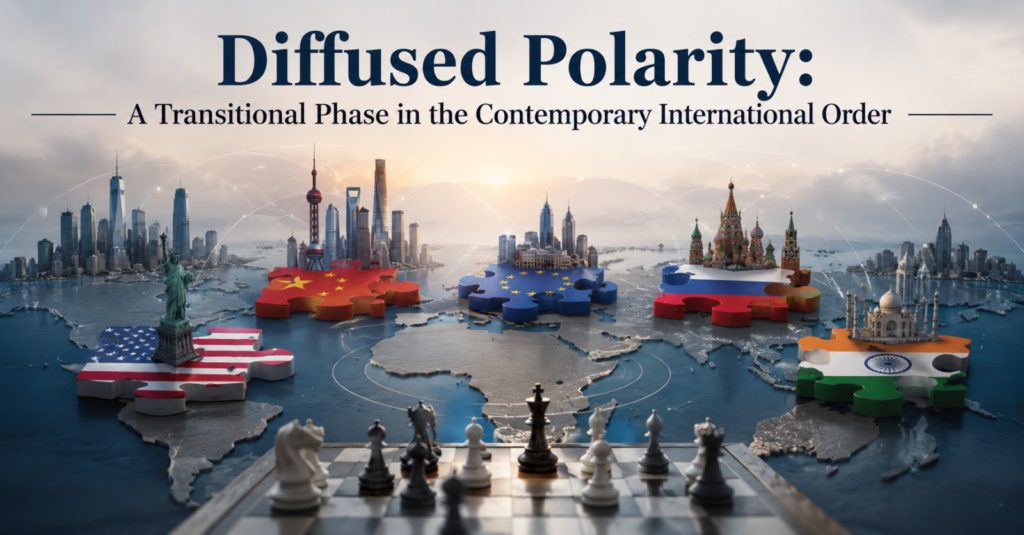
For much of the twentieth century and the early quarter of the twenty-first century, scholars of International Relations have understood global power distribution through the concept of polarity. In simple terms, a pole is developed when power concentrates at one region or within one state. While polarity, as defined by Goedele De Keersmaeker “is about the number of great powers or polar powers,” it has traditionally provided the foundation for categorizing international systems as unipolar, bipolar, or multipolar according to the pattern of power distribution among major states.
A system will be unipolar when a single state attains overwhelming power and influence and face no near-peer challenger in the international arena. According to William C. Wohlforth, “a unipolar system is one in which a counterbalance is impossible. When a counterbalance becomes possible, the system is not unipolar.” That single global power is also dubbed as a hegemon. Rise of United States as sole superpower in post-Cold War era is considered as an era of unipolarity. Similarly, when power is near-uniformly distributed across two opposing states, then it is termed as bipolarity. In terms of stability, bi-polarity is considered as most stable form of polarity. The Cold War, in which United States and Soviet Union were the only dominant competing power, is most eminent example in recent history. Then there is multi-polarity, which deals with formation of multiple poles around the globe, each competing for power and dominance. This form of polarity is regarded as most destabilizing by neorealists and examples of World Wars era are provided in this regard. Although classical realists, like Hans Morgenthau, have argued that multi-polar system offers more stability than bipolar one as great powers can gain power through alliances and petty wars that do not directly challenge other powers. But neorealists contradict this notion and suggest that multipolar systems are most unstable and thus more likely to trigger major conflicts due to “chain-ganging” (allies are pulled into conflict due to actions of their partners) and “buck-passing” (threatened state avoids confronting an aggressor, choosing instead to coerce or encourage another state to bear the costs and risks of countering the threat). Despite fundamental difference in structuring, there is one common feature of all types of polarity, i.e., power centers are clearly well defined.
The rapidly transforming global strategic environment appears to reflect a more dynamic and fluid distribution of power which tend to defy aforementioned rigid classifications of polarity. Rather it can be conceptualized as a transition phase, which can be termed as phase of “Diffused Polarity.” This concept can be elaborated as a transitional phase of international system in which power is more dispersed across multiple states, but no actor holds ample capability to establish a dedicated pole of its own. Unlike traditional approach in which poles are clearly distinguishable and possess a broad spectrum of national power, the concept of diffused polarity confronts this assumption by emphasizing that a system can exists, particularly in transitional phase, in which centers of power do exists but not influential enough to act as dedicated pole of their own due to shortcomings in one of more domains of power.
In the phase of diffused polarity, the power gets more distributed across multiple actors and each actor may not possess dominance in all domain of power. For example, United States still possess formidable military muscle, economic clout, technological superiority, and diplomatic clout, but its influence is on decline and Washington no longer retain the unchallenged dominance of post-Cold war era. China, the rising competitor, has undertaken remarkable development in the economic, technology, industrial, and military domains, but is yet to translate its growing potential into dominance at global scale. Russia still retains substantial military prowess, energy resources, and diplomatic leverage, but has persistent economic, industrial-productivity, and geographical limitations. Europe has significant economic, diplomatic, and technological base, but struggles with building military capable of power projection at global scale. Other mid-tier powers, like Japan, India, South Korea, Turkey, and Saudi Arabia etc. have regional influence, but lag in one or more domains of power by major margin. Together, these examples illustrate that in diffused polarity, all dimensions of power do not concentrate within one or two state, thus falling short of turning into hegemon(s) capable of independently shaping international order.
Another important feature of diffused polarity is the growing reliance on minilateral collaboration. The power circulates around the globe based on patterns of such cooperative initiatives. Based upon their interests, states keep combining and separating their military, economic, diplomatic, and technological capabilities through flexible, interest-oriented collaboration instead of following traditional approach of developing rigid alliances or global multilateral frameworks. This results into creation of a dynamic yet complex international system where exercising power unilaterally by any state yields grave political consequences.
Although aforementioned both characteristics tend to give impression that multi-polarity and diffused polarity are essentially synonymous to each other. They are not. And, it is important to differentiate both. The fundamental difference is that while multi-polarity is a system of clearly distinguishable great power poles, diffused polarity is system of fragmented and domain-specific power in which no clearly established poles have yet fully emerged. Additionally, unlike multi-polar world, states may not maintain mutually agreed position on global affairs for long, and keep switching their position more visibly and dynamically in a world shaped by diffusion of power.
Diffused polarity represents a transitional stage in the international system where an existing power structure is weakening while a new stable order has yet to emerge. Yes, Thucydides Trap provides an understanding to the pattern of power transition in global order which often results in heightened risk of major conflict between rising and declining powers. But diffused polarity can provide more comprehensive explanation. Instead of straight forward transition of dominance from one actor to another, multiple actors are concurrently amassing influence. While this condition can promote cooperation, and greater influence for smaller and middle powers, it can also increase instability, as the absence of clearly defined centers of authority may intensify the risk of miscalculation due to inherent complexity of the system. This may lead to frequent heightened tensions and multiple but relatively localized and somewhat isolated conflicts – as are happening today in Europe and Asia. In this sense, diffused polarity can be viewed as the wider systemic environment with Thucydides Trap as a potential subset, making the transition more fragmented, uncertain, and potentially more difficult to stabilize than previous great-power transitions.
In a nutshell, diffused polarity presents a credible conceptual framework for understanding the contemporary dynamic global order as a transitional phase characterized by power dispersion and overlapping centers of influence. In the absence of a dominant actor capable of establishing and running a stable order, competition among states intensifies across multiple domains. In parallel, mutual co-operation becomes a necessity to address shared challenges. As power becomes increasingly fragmented, distinction between major and middle powers becomes increasingly ambiguous, turning the world unto competing ground where the definitive future poles of the power have yet to emerge and fully consolidate.

Ahmad Ibrahim
Author is Research Associate at Maritime Centre of Excellence (MCE), Pakistan Navy War College (PNWC) Lahore.

Muhammad Mahad Samija
Muhammad Mahad Samija is a student at the Department of Political Science, Government College University Lahore (GCUL).


Leave a Reply