

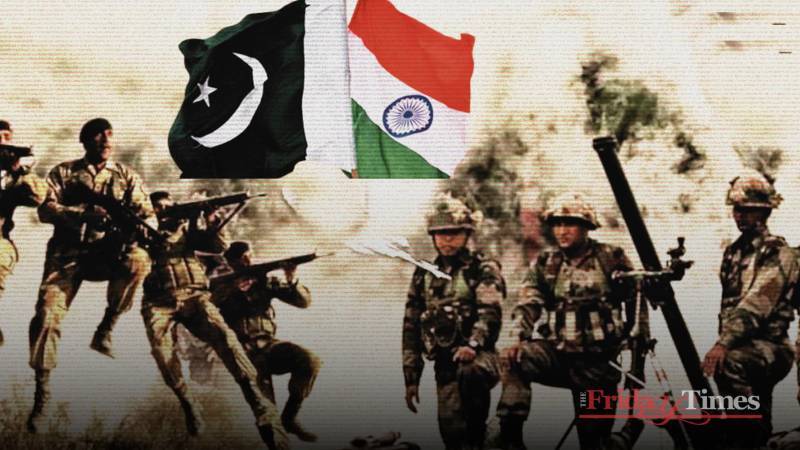
The rivalry of India and Pakistan in the evolving strategic environment of the south Asian region has been long framed in the melodramatic terms with which it has so often been cast: precision strikes which follow noisy and dramatic pronouncements, jets flying over borders and politicians making declarations: “decisive victories.” Behind this melodramatic scene, however, is a more important lesson in modern deterrence, that strategic rationality is better than more vocal signaling, qualitative advantage is superior to quantitative equality, and calculated response is to be preferred over media circus.
The latter has been in regular preference of India and more so, under the current BJP ruling government. In the wake of 2019 Pulwama terror attack, India tried to set a dangerous precedent: it launched airstrikes into Pakistani territory. New Delhi hailed it as decisive blow against “terrorist infrastructure.” What was to have been a strategic success was however soon to become a storyboard sink hole as the air force of Pakistan launched retaliatory strikes, downed 2 Indian planes. The pilot of a shot-down MiG-21 was then released as a peace overture. With the tensions continuing, the [Indian] side eventually launched public relations campaigns instead of acquiring a definite military advantage. The reactions of Pakistan blocked the efforts of India to create a “new normal” of cross-border attacks. It also contained the ladder of escalation at bay and compelled India to revert back to rhetoric signaling as opposed to military escalation. Notably, this was not accomplished through dramatic utterances and confusing media advertisements. Instead, it depended on situational awareness, coordination, and integration with more emphasis on qualitative edge over quantitative measures as it maintained surprise and deliberate ambiguity in escalatory intent.
The same tendency was observed in the 2025 crisis that had started following the notorious Pahalgam attack on April 22, 2022, in the Indian occupied Kashmir that took the lives of 26 people. What ensued was a common curve of denunciation and vengeance. An even more obvious and immediate reaction of India was the suspension of the Indus Waters Treaty and blatant accusation of Pakistan of being involved, which in its turn was a massive diplomatic escalation with the potential of ramifications of water security in the region. This rhetoric on May 7, 2025, was followed by Operation Sindoor, a concerted series of missile and drone attacks on Pakistan and Kashmir, controlled by Pakistan. New Delhi termed them as accurate attacks on “terrorist infrastructure.” The attacks led to the damaging of airfields and military installations on the Pakistani side of the border and were assessed by international analysts as being amongst the heaviest attacks on Pakistani military installations since 1971. In retaliation, 6 Indian planes were shot down in self-defense as per the official reports of Pakistan. Three [Indian] planes were destroyed in one of the largest beyond-visual-range (BVR) conflicts in history of the modern network-centric era, according to independent assessments. These figures are not the tactical value of the reaction of the Pakistani government, but its style and the impact of the reaction.
But what is most interesting about this confrontation is that the strategy, and communication between states took a down-turn towards the opposite direction. The publicity surrounding the strategy of India was attributional, expensive and a framework that was said to be premised on the media amplification to win the narrative rather than the strategic win. This was evident in the fashion in which New Delhi was quick to go on air to justify its reasons and to appeal to the masses both within the country and abroad often highlighting the size and precision of strikes, and with no clear evidence that Pakistan had been involved in the attacks. As an alternative, Pakistan answered in a functionally significant and rhetorically limited manner. Pakistan does not mirrored India’s theatrical signaling pattern. Rather it launched Operation Bunyan al-Marsoos, whereby it targeted the Indian military bases in various locations using the missiles and drones in a calculated response which was not boastfulness. These attacks were a calculated retaliation of Pakistan against the Indian drone and missile attacks on the Pakistani military infrastructure during the night of May 8–9, 2025. All this was done at a level whereby, Islamabad not only retained control on the escalation, but also thwarted the initiative of the Indians to institute a self-proclaimed “new normal” of cross border missile and drone attacks.
The analogy is didactic. The Indian domestic politics have often been employed to ruin the long-term policy of India: a very competitive media environment that favors quantity over subtlety and model of defense acquisition that emphasizes on the number of platforms and variety rather than on thorough integration. The outcome is an imposing force that, though impressive on the paper, experiences issues with coordination, patchwork of systems of different vendors that makes it a challenge to communicate, logistics, and long-term operations. The military of Pakistan, in its turn, has been paying an ever-growing attention to the acquisition of cost-effective, synchronized technologies, drones, missiles and aircraft, which can be networked into a consistent operational design, and the effects of which can be selectively unleashed without the automatic escalation into a full-scale destructive war. Islamabad too, has not been spared of challenges. It is financially limited and politically unstable making its calculations and viability of its asymmetrical strategies challenging. But, even with all the odds, it can still find a way to assemble an effective response to asymmetries.
In no way does this romanticize or understate the reality and costs of conflict. Civilians on both sides suffered, and the risks involved in nuclear deterrence looms large. But it does help to sensitize the fact that Pakistan never has been pursuing a parity narrative in which it could scream as loud as India about the number of platforms or its capacity to achieve “surgical success.” Rather, the position of Islamabad was to have a qualitative military edge (QME) that is a concept that emphasizes the decision loops, integration, and surprise over pure numbers. Regardless of how many platforms New Delhi purchases, numbers does not in itself equate to escalation dominance. What Islamabad needs is to maintain a QME in platform acquisition as compared to the crude missile-for-missile and aircraft-for-aircraft equivalence.
More to the point, the softer posture of Pakistan rescued strategic ambiguity, a form of deterrence that does not provide adversaries with clear signals about thresholds of responses and thus makes the aggression calculations more fraught and less predictable. Rather, India is publicly announcing its will to the world, be it by domesticating its deterrence logic, which limits its own plans or by declaring its own intentions to the world.
The international mediators during the aftermath of the clashes of May 2025 called on the two countries to hold back and especially the U.S. mediation dragged both the nations back from the brink of all-out war. But the more important lesson to the students of strategy, is that deterrence is best when it is coherent, calibrated, and unpredictable in their effects, but silent in their posturing. The approach of Pakistan, despite all its limitations, proved this by implementing major countermeasures which predetermined adversarial calculations without giving in to the spectacle of mass mobilization or rhetoric grandstanding.
Another alternative model is presented by Pakistan where in the world, military signaling is increasingly being played out in 24/7 news cycles, where each missile launch becomes a headline, and domestic audiences often demand theatrical displays of power. Give the effect an opportunity to be heard and not the sound of the announcement.

Suffian Zafar
Suffian Zafar is an MPhil scholar of International Relations at the University of Punjab, Lahore. He is currently working as a Junior Research Fellow at the Maritime Centre of Excellence MCE.

Muhammad Mahad Samija
Muhammad Mahad Samija is a student at the Department of Political Science, Government College University Lahore (GCUL).


Leave a Reply