
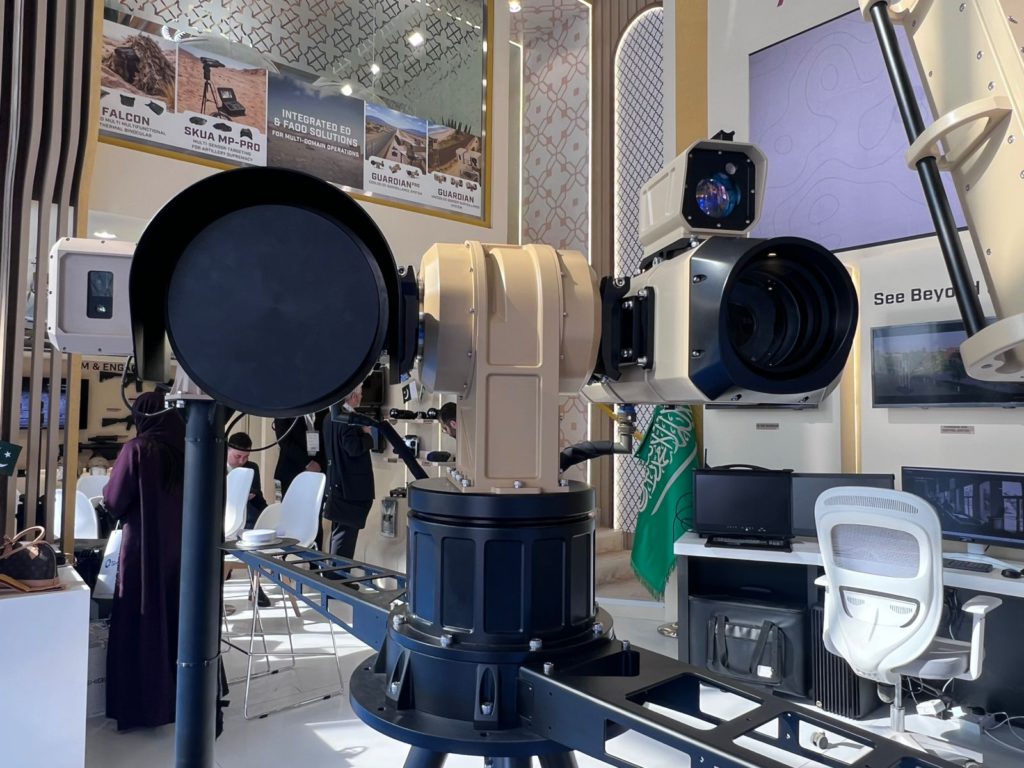
Defense surveillance solutions provider Shibli presented its latest electro-optical platform, the Guardian Pro Cooled EO Surveillance System, during World Defense Show 2026, highlighting a capability designed to support border security, critical infrastructure protection, and persistent situational awareness missions across complex operational environments.
The unveiling reflects increasing regional demand for advanced surveillance technologies capable of operating continuously in extreme climates and low-visibility conditions, particularly as governments across West Asia invest in layered monitoring systems for border management and strategic asset protection.
Advanced Multi-Sensor Surveillance Architecture
The Guardian Pro platform integrates a cooled mid-wave infrared (MWIR) thermal imaging sensor operating within the 3–5 μm spectral band, available in both 640×512 and 1280×1024 configurations. Cooled thermal technology significantly enhances sensitivity and detection range, enabling long-distance observation while maintaining image clarity in demanding atmospheric conditions.
Complementing the thermal channel is a Full HD electro-optical day camera equipped with 52× optical zoom and 16× digital zoom, allowing operators to conduct detailed visual monitoring at extended ranges. Image-processing functions such as automatic gain control, non-uniformity correction, defog capability, and heat-haze reduction ensure stable imagery in desert, maritime, and high-temperature environments.
Long-Range Detection Capabilities
Manufacturer performance data indicates that the system is capable of detecting human-sized targets at distances exceeding 17 kilometers, vehicles at more than 16 kilometers, and heavy trucks beyond 40 kilometers under daylight conditions. During nighttime operations, the thermal channel supports vehicle detection beyond 44 kilometers and large-vehicle detection exceeding 80 kilometers, illustrating the platform’s suitability for wide-area monitoring.
An optional laser rangefinder module operating at a wavelength of 1.54 μm provides accurate distance measurement between 100 meters and 15 kilometers, with a measurement accuracy of ±2 meters, supporting precision targeting and command decision support.
Precision Tracking and Mechanical Stability
The system is mounted on a stabilized pan-tilt platform offering continuous 360-degree rotation, an elevation range from −90° to +90°, and pointing accuracy of 0.001°. With slew speeds reaching 80 degrees per second, operators can rapidly acquire and track targets while maintaining image stability, a critical requirement for surveillance and reconnaissance missions.
Command-and-Control Integration
A defining characteristic of the Guardian Pro system is its open-architecture design, enabling seamless integration with existing command-and-control infrastructures. The interface supports real-time monitoring of thermal, daylight, and infrared feeds and incorporates advanced management tools including:
- AI-enabled detection and tracking
-
GIS mapping integration
-
Event and alert handling
-
Multi-camera networking
-
Automated video archiving
-
Device prioritization systems
Such interoperability allows security operators to deploy the platform within established surveillance frameworks without major modifications.
Flexible Deployment Configurations
Engineered for operational adaptability, Guardian Pro can be installed on fixed structures or mounted on vehicles, supporting applications ranging from border monitoring to base security. The system can operate through conventional power sources or autonomous solar and hybrid energy configurations, enabling deployment in remote or off-grid locations.
Weighing approximately 60 kilograms and designed to function in temperatures between −32°C and +45°C, the platform is optimized for extreme climate conditions typical of desert and high-altitude environments.
Regional Security Implications
Shibli’s presentation of the Guardian Pro system at World Defense Show 2026 underscores the broader shift toward intelligent, sensor-driven surveillance ecosystems across West Asia. Governments and security agencies are increasingly prioritizing integrated electro-optical solutions capable of delivering persistent monitoring, automated analytics, and real-time threat awareness.
As regional defense modernization programs accelerate, platforms combining cooled thermal imaging, artificial intelligence analytics, and interoperable architecture are expected to play a central role in future surveillance and reconnaissance networks.




Leave a Reply