
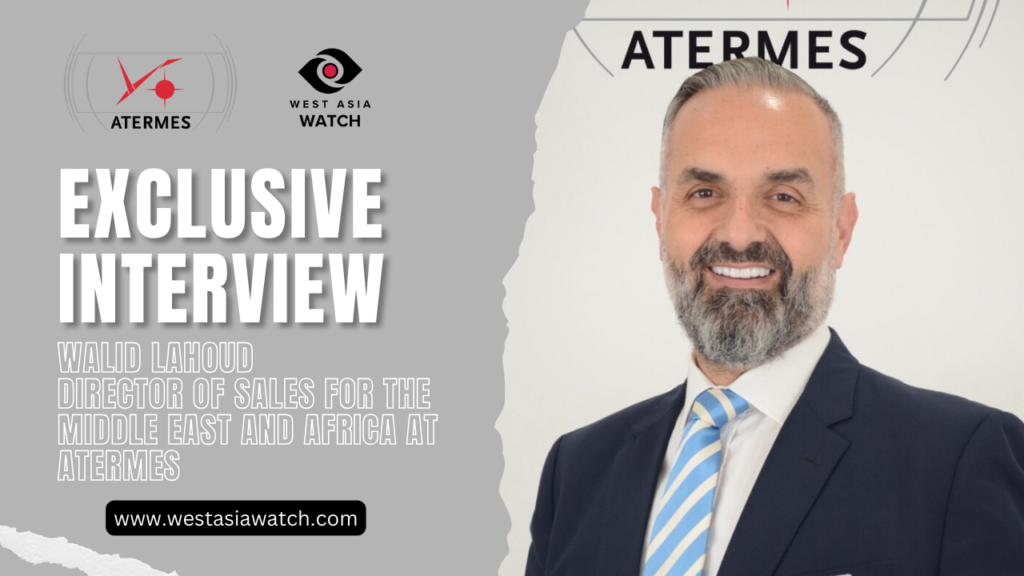
In an exclusive interview with West Asia Watch, Walid Lahoud, Director of Sales for the Middle East and Africa at ATERMES, shares insights into the rapidly evolving demand for advanced optronic and AI-enabled surveillance systems across the MENA region. As regional governments accelerate defense modernization and prioritize border security, counter-drone operations, and the protection of critical infrastructure, ATERMES is positioning itself at the forefront of intelligent, human-in-the-loop security solutions. Lahoud outlines how platforms such as SURICATE, supported by AI-driven analytics and non-lethal deterrence systems, are shaping the future of operational security while aligning with regional ambitions for localization, sovereign capability, and long-term resilience.
- How do you see demand for optronics evolving in the MENA region?
Demand for optronics across MENA is accelerating sharply, driven by large-scale defense modernization programs, heightened border security requirements, and the protection of critical national infrastructure. Governments are increasingly focused on countering emerging threats such as drones, unauthorized incursions, and asymmetric tactics. In this context, ATERMES solutions; such as the SURICATE platform, are gaining traction for their ability to deliver real-time, AI-driven threat detection and adaptive deterrence. Whether deployed at borders, military bases, or strategic facilities, the region’s emphasis on sovereign security and smart defense is fueling strong demand for integrated, high-precision optronic systems that combine automation with human oversight, ensuring both efficiency and operational flexibility.
- What differentiates ATERMES’ solutions in operational environments?
ATERMES’ solutions are distinguished by their dual-use design, proven across both military and civilian operational environments. Platforms such as SURICATE are engineered for reliability in extreme conditions, while AI-driven analytics assess threats based on size, quantity, trajectory, and behavior. Complementary systems; including the A-TOM 550 laser deterrent and acoustic repellers, enable precise, non-lethal responses, with full operator authority to override automated actions when required. This balance between autonomy and human control, combined with modularity and scalability, allows ATERMES’ systems to adapt seamlessly to MENA’s diverse security environments, from remote desert borders to dense urban and industrial sites.
- How central is AI to your surveillance and optronic systems?
AI sits at the core of our surveillance and optronic architecture. It enables real-time threat detection, classification, and predictive analytics, allowing systems to respond rapidly and accurately to evolving situations. Within SURICATE, AI processes multispectral data to identify and assess potential risks, activating deterrents such as laser or acoustic systems only when predefined conditions are met. Crucially, human operators retain full decision-making authority, ensuring that autonomous efficiency is always balanced with strategic judgment; an essential requirement in defense and high-security operations.
- How important is localization in ATERMES’ MENA strategy?
Localization is a cornerstone of our strategy in MENA. We work closely with regional partners to adapt our solutions to local threat profiles, regulatory frameworks, and environmental conditions. This approach enhances operational effectiveness while supporting knowledge transfer, local capacity building, and long-term sustainability. It also aligns closely with regional ambitions around sovereign security, industrial development, and technological independence.
- Which capability areas are top priorities for the region?
In MENA, priority capability areas center on border security, critical infrastructure protection, counter-drone operations, and long-term operational readiness. There is strong demand for AI-enabled optronic systems capable of long-range detection and rapid response to cross-border threats, as well as integrated surveillance and deterrence solutions to secure energy assets, ports, airports, and military installations. At the same time, the growing prevalence of drones has elevated counter-UAS detection and mitigation as a critical requirement. Equally important is investment in training and support, ensuring that local teams are empowered to operate, maintain, and adapt these systems independently, reinforcing resilience and operational sovereignty over the long term.
- How does ATERMES support border and critical infrastructure security?
ATERMES delivers end-to-end security solutions that integrate AI, advanced optronics, and multi-layered deterrence. Along borders, our systems provide continuous monitoring, automated classification of threats; such as vehicles, drones, or intruders, and real-time alerts to operators. For critical infrastructure, modular platforms like SURICATE are tailored to specific environments, including military bases, ports, and energy hubs. While capable of autonomous operation, these systems are designed to allow seamless human intervention, ensuring adaptability in fast-changing and complex threat landscapes.
- What is your long-term vision for ATERMES in the MENA market?
Our long-term vision is to be MENA’s trusted partner for intelligent defense and security solutions; recognized for innovation, reliability, and collaboration. We aim to deepen regional partnerships, invest in local R&D, and continuously expand our capabilities to address emerging challenges, from drone swarms to hybrid and asymmetric threats. By integrating AI, advanced optronics, and human expertise, ATERMES is committed to setting new standards for security, resilience, and operational excellence across the region’s most critical sectors.



Leave a Reply