

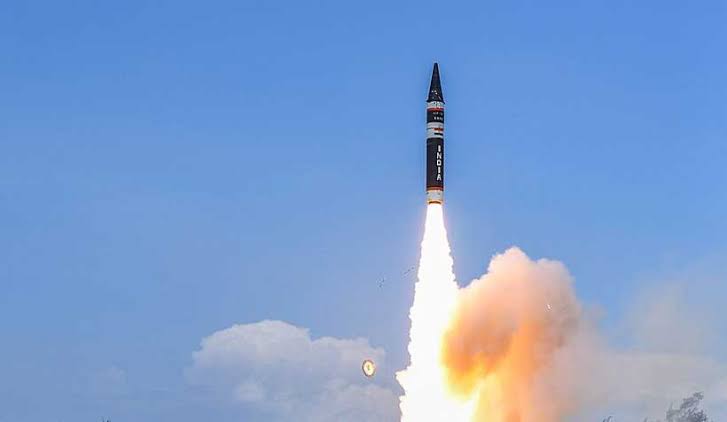
A single figure buried in SIPRI’s latest Yearbook warrants close attention: twelve nuclear warheads. For the first time since India’s nuclear tests, SIPRI has pointed out operational deployment of twelve nuclear warheads by India, meaning they are mated to delivery systems and assigned to operational forces rather than stored for later assembly. Although modest compared with major nuclear powers, this marks a significant shift. Compared with previous SIPRI assessments, it provides the clearest open-source indication yet that India’s nuclear posture is undergoing a structural transformation with implications beyond New Delhi’s own strategic calculations.
SIPRI’s world nuclear forces chapter is, by design, a conservative document. Its estimates are collected from multiple sources spanning from satellite imagery, fissile-material accounting and government statements, and the authors are careful to flag uncertainty where it exists. That caution makes the consistency of the recent trend line all the more notable. The SIPRI Yearbook 2024 edition placed India’s stockpile at 172 warheads as of January 2024, with none classified as deployed. This was consistent with New Delhi’s long-declared practice of storing warheads separately from launchers in peacetime. SIPRI’s 2025 edition recorded a further, modest rise to roughly 180 warheads as of January 2025, still with the entire stockpile assessed as stored rather than deployed. The 2026 SIPRI edition — covering the year that included the most serious India-Pakistan military crisis in over two decades now places India’s total inventory at approximately 190 warheads, of which twelve are, for the first time, assessed as “ deployed” with operational forces, alongside a maturing triad of aircraft, land-based missiles and a nuclear-powered ballistic missile submarine reported to be conducting deterrence patrols.
Three consecutive editions, in other words, describe not merely a numerical increase but a qualitative shift in how the nuclear warheads are held. SIPRI report frames this as a departure from an assumption that has anchored outside analysis of Indian nuclear policy for decades: that India stores its warheads separate from its delivery systems during peacetime, in line with its posture of recessed deterrence.
The technical driver of this shift is canisterization which is the practice of fitting a missile inside a sealed, climate-controlled tube that also functions as its launch container, with the warhead reportedly integrated before the canister is sealed. India’s Defence Research and Development Organisation has itself described canisterized variants of the Agni family as launch able “from anywhere, at any time,” a formulation that subject analysts have noted, is difficult to reconcile with a genuinely de-mated, disassembled force. At sea, the logic is even less avoidable because a ballistic missile submarine’s entire value proposition rests on its ability to remain hidden and ready, which makes genuine warhead-launcher separation on patrol close to a practical impossibility.
Most probably, the figure of 12 comes from the Indian nuclear submarine’s fleet’s ability to carry 12 K-15 Sagarika Nuclear armed missiles while on patrol or four K-4 Long range missiles. In any case, either one submarine on patrol carries 12 Sagarika’s or three nuclear submarines carry K-4 missiles. India’s current three nuclear submarines Arihant, Arighat and Aridhaman add to the Continuous at Sea Deterrence, as explained priorly. The third Indian SSBN can carry more missiles than the older two. With 8 launch tubes it can carry double the number of both K-15s and K-4s. A fourth vessel, currently named S4, will have a newer reactor and missiles with even more longer ranges,
Layered onto canisterization is a parallel investment in accuracy and multiple-warhead delivery. In March 2024, India tested the Agni-V under Mission Divyastra with a Multiple Independently Targetable Re-entry Vehicle payload, joining a small club of states capable of delivering several warheads from a single missile. The shorter-range, rail-mobile Agni-P has drawn particular scrutiny from strategic analysts for combining canisterization with the kind of accuracy more commonly associated with counterforce (strikes intended to destroy an adversary’s retaliatory capability rather than its cities or population centers) raising the question of whether India’s declared doctrine of “credible minimum deterrence” is being outpaced by the capabilities it is acquiring.
The context in which this shift has become visible is not incidental. SIPRI’s own account of 2025 Indo-Pak conflict notes that the brief but intense armed conflict between the two states in May last year. Conventional exchange between two nuclear-armed neighbors occurred in the same year that one of them began, for the first time, keeping a portion of its arsenal in a rapid-response configuration.
The distinction between “deployed” and “stored” warheads carries strategic significance far beyond the twelve-warhead increase within a global arsenal exceeding twelve thousand. Crisis stability in South Asia has partly depended on the assumption that neither side could launch nuclear weapons within minutes, as assembly and mating requirements provided days or hours for diplomacy, correcting misperceptions, or restraint. Canisterization reduces this buffer at a time when conventional escalation, including drone attacks, air-base strikes, and the first overt use of cyber operations in the rivalry, is already compressing decision timelines. As some Indian strategic commentators acknowledge, a doctrine developed for the security environment of 2003 now operates in an era of AI-assisted targeting, hypersonic weapons, and warning times measured in minutes, challenges it has yet to fully address.
For Pakistan, the SIPRI data provides little reassurance and strong incentives to respond. Pakistani analysts view India’s canisterization and MIRV programs as evidence of an emerging counterforce posture that could threaten Pakistan’s smaller nuclear arsenal despite India’s stated intentions. Under the logic of nuclear deterrence, even the possibility of a disarming strike compels Pakistan to adopt more survivable deployment practices, including higher readiness measures similar to those emerging in India. Concerns are further heightened by projections of significant growth in India’s fissile-material production capacity as new breeder reactors become operational. Academic studies have consistently argued that a counterforce strategy is unlikely to neutralize Pakistan’s existing force structure and instead risks creating “use it or lose it” pressures that can make crises more difficult to manage.
SIPRI data also shows that both states exercised restraint during their most serious crisis in decades. However, three consecutive years of rising arsenals and increased readiness point to a South Asian nuclear environment with shrinking margins for error. The most effective safeguard remains sustained restraint through transparency measures, crisis communication channels, and mutual signaling to prevent operational postures from outpacing declared doctrines.

Hammad Waleed
Hammad Waleed is a Research Associate at Strategic Vision Institute, Islamabad. He graduated with distinction from National Defence University, Islamabad. He writes on issues pertaining National Security, Conflict analysis, Emerging Technology, Strategic forecast and public policy. He can be reached at hammadwaleed82@gmail.com.


Leave a Reply