

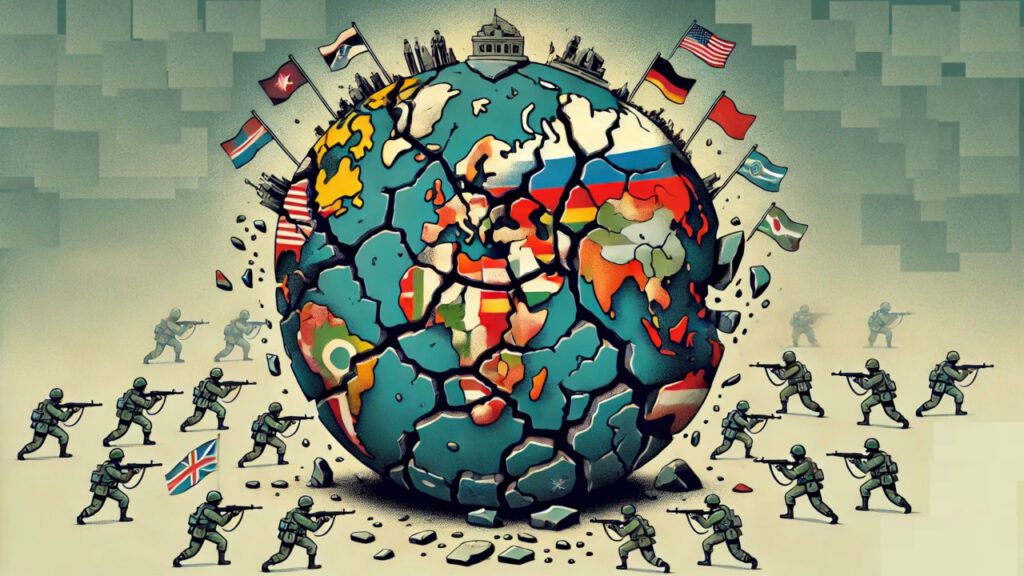
After the Second World War, the global powers took a daring step when they gathered at the Veterans Memorial Hall at San Francisco and came up with a liberal international order founded on cooperation, treaty law, collective security, and international institutions including the United Nations, the World Trade Organization, and NATO. This order did not grow out of moral idealism itself. It was a reaction to material facts, ruined economies, war weary societies, the understanding that unchecked politics of power had created a disaster. At this point, cooperation was not just a good idea, but it was a necessity. This system dictated the interactions between states in decades. Multilateral institutions turned out to be the major locations of diplomacy, economic interaction, and conflict resolving. However, there is a new trend being determined against the assumption that cooperation was the natural or permanent condition of international politics. By 2026, the world system seems to be less defined by the rules and much more by the calculation of the strategy, the unilateral action, and conflicting interests of the national levels.This change must not be interpreted as some rapid disintegration of liberalism, or, as the evidence that realism has somehow prevailed in some sort of theoretical battle. Instead, it is a transformation of what becomes useful to the global power. The international liberal culture worked best when it would meet the interests of the strongest supporters. When these interests change so does the commitment to rules.
The withdrawal of the United States, which occurred recently, in dozens of international bodies and treaties is one of the most obvious indicators of such a change. Leaving institutions dealing with climate management, development, human rights, and scientific relations, Washington has provided an indication that the multilateral structures are no longer perceived as a pillar in the promotion of national interests. This is not just a retrenchment at the administrative level; it is a strategic re-tuning. Organizations that were once viewed as a source of stability in the world are being redefined as a limitation to sovereignty and elasticity. Meanwhile, U.S. foreign policy has been taking an ever-stronger course of direct pressure, coercion, and acting unilaterally. The U.S. military action in Venezuela in early 2026, which led to the arrest of President Nicolas Maduro and his extradition to the United States to stand trial on criminal charges, caused a lot of controversy. Whether it be seen as law enforcement, regime intervention or violation of sovereignty, the episode shows how the exercise of power is gaining momentum outside institutional agreement. This was met with international protests and legal objections, but the operation went on regardless putting into focus how rules are important when they are not enforced by those who are ready to go around them. The same logic is evident in policy of the U.S. towards Iran. This tendency to use coercion rather than negotiated compromise, is representative of a larger tendency that is diplomacy is a useful tool; however, it should not water down leverage. These are not the only trends in the United States. States are reevaluating old notions of restraint and cooperation world-wide. The move by Japan to vastly expand its defence expenditure is a break with decades of post-war pacifism as the country perceives itself as a target in the region and uncertain of its security assurances. In South Asia, the relationship between India and Pakistan is not under institutional confidence-buildings but rather deterrence and strategic mistrusts. The arguments on strategic autonomy in Europe exude apprehension on the dependence on other powers in an even more uncertain world.
What becomes apparent is not the lack of cooperation but rather, it is conditional. States will collaborate in areas where there is commonality of interests and defect where there is non-cooperation. This fact reveals one of the major flaws of liberal internationalism: it relied on long-term involvement of the big states that would be ready to devote more importance to the system stability than to the immediate benefit. That willingness is fading.
Another question that would cross the mind is whether the liberal order was as neutral or inclusive as it is usually depicted. In the Global South, it was perceived in many states as discriminatory, unequal, and sometimes forceful.
What seemed universal was always conditional; the promises of equality and fairness were only as strong as the powers that enforced them.
Some individuals were advantaged over others by economic guidelines; some security standards were not equally applied. The order was supposed to be universal, but in many cases, it was conducted in a hierarchy. On that note, the current change is not a betrayal of morals, but a truthful revelation of the way the system operated behind the scenes.In this respect, realism is no recent ideology that takes the place of liberalism; it is a restatement of an ancient fact of international politics. Power matters. Interests matter. The norms can only survive when they are in harmony with both. The distinction now is that there is more decentralization of power, more intense competition, and less reward given to the cooperative compromise by domestic politics to visible power. It does not imply that the cooperation globally is outdated. Unilateralism simply does not stand structurally on matters like climate change, pandemics and economic instability. But the present trend is that collaboration will be instrumental and not ideological to be applied sparingly, discarded when inconvenient, and remodelled to benefit the national cause.
The liberal international order, in turn, was not a lasting cure and an ethical destination. It was a historical order which was fit to a certain time, supported by certain structures of power and common interests. With the change of such conditions, the order changes as well. Whether liberalism is dying or not is not a question the world needs to ask in 2026, but rather whether a system of fragmentation and interests can address issues in the world and preventing the world to fall into permanent instability. The lesson of the past, as far as I can make out, is that world orders are not destroyed by an inability to respond ideologically, but by the fact that they no longer serve the interests of these people who sustain them. Instead of being cleaner, fairer and more peaceful, the thing that takes the place of the existing order might be honest about the realities that fuel it.

Afifa Kamran
Afifa Kamran is a student of BS International Relations at the University of Central Punjab. Her work examines foreign affairs, civil–military relations, governance, and democratic institutions.afifakamran772@gmail.com



Leave a Reply