

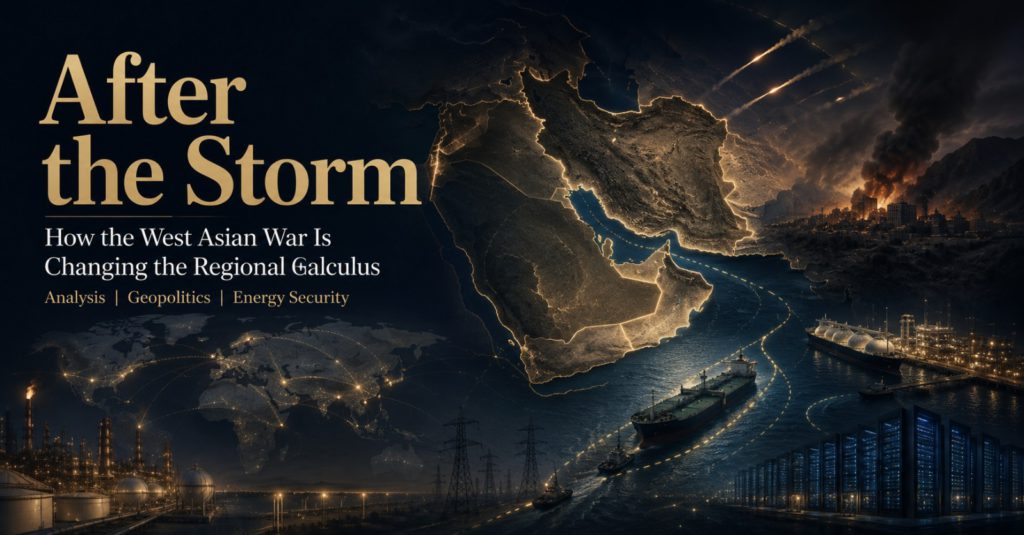
When the United States and Israel launched strikes on Iran in early 2026, the reverberations extended far beyond the immediate military theatre. The conflict has been the most significant conventional confrontation in the Middle East since Iraq’s invasion of Kuwait in 1990. It has altered the region’s economic outlook, shattered whatever residual trust that existed between Iran and Arab Gulf states, and thrust the Strait of Hormuz into the centre of global energy anxiety. Yet as the dust begins to settle, a critical question hangs in the air: how much has the war truly, durably transformed the region, and what forces of continuity remain stubbornly intact?
The last major conventional war in the Gulf — Saddam Hussein’s invasion of Kuwait in 1990–1991 — predated the internet. Today’s Gulf is rapidly becoming home to an emergent AI infrastructure, with at least three to four data centres reported as targets during the current conflict, alongside subsea cables placed at acute risk. The potential target list for critical infrastructure has expanded dramatically beyond the traditional focus on oil and gas facilities. This is a conflict fought in a landscape transformed by technology, capital flows, and new geopolitical alignments, factors that complicate any simple comparison to prior Gulf crises.
No single data point captures the war’s economic gravity more starkly than the paralysis of the Strait of Hormuz. The waterway, which carries roughly a quarter of global oil flows, has been effectively closed since March 2, 2026 when USA/ Israeli strikes on Iran began. On April 17, Iran’s foreign minister announced a reopening, triggering a rush of tankers toward the exit. AIS vessel-tracking data from Starboard Maritime Intelligence shows that many tankers quickly reversed course and remain stranded in the Persian Gulf. Only thirteen tankers successfully made it through in that brief window before the Islamic Revolutionary Guard Corps reversed course shut the strait again just one day later.
Of the 187 vessels that have successfully transited the strait since March 4, over half belong to shipping companies located in just four countries — with China prominently at the top of the list. This is consistent with reports that Beijing pressed Tehran to protect Chinese shipping interests, underscoring how great-power rivalries are woven into even the most tactical dimensions of this conflict. Increasingly, ships are also moving along preapproved routes closer to Iranian waters, with some reportedly coordinating through designated intermediaries and paying additional transit fees. Analysts have described this as Tehran operating a de facto “toll booth” system in contested waters.
Energy markets have responded predictably. Crude oil and fertilizer prices have risen sharply, reflecting the region’s central role in global supply chains. Natural gas prices in Europe and Asia have surged and remain elevated. The United States, buffered by abundant domestic production, is relatively insulated. This itself is a divergence that carries its own geopolitical implications for alliance management and burden-sharing. Grain prices have not yet experienced comparable spikes, though sustained increases in energy and fertilizer costs could ripple through global food production in coming weeks.
Perhaps the most enduring political consequence of the war is the increase is mistrust between Iran credibility among the Arab Gulf States. The 2023 Saudi-Iranian rapprochement, that was brokered by China with considerable fanfare , now appears fragile and functionally defunct. The conflict has forced Gulf States into an uncomfortable reckoning about their own strategic postures.
Vali Nasr, whose forthcoming analysis in Foreign Affairs examines whether Saudi Arabia can continue to hedge between Washington and Beijing, argued that the pressure on Riyadh is now acute. Gulf states had spent years cultivating economic diversification and strategic ambiguity, refusing to fully align with any single great power. The war has compressed that space considerably. They must now confront whether their security architecture — heavily dependent on U.S. military presence and hardware — is still fit for purpose, or whether a genuine diversification of security partnerships is both desirable and achievable.
Iran, for its part, has pursued a strategy of rapid horizontal and vertical escalation. Tehran pursued the conflict across the region and thereby,the global stakes, betting that it can outlast American political will in a war of endurance rather than firepower. The Strait of Hormuz is the centerpiece of this approach: less a conventional military weapon than a lever of global economic coercion.
The war has also created significant strategic openings for China and Russia, even as it imposes costs on both. Jon Alterman and Ali Vaez, writing in Foreign Affairs, argue that Beijing and Moscow can exploit the conflict by allowing the United States to bear the disproportionate military and reputational burden while they accumulate influence and advance their own strategic interests without direct involvement. China’s particular dilemma — its heavy dependence on Gulf energy, its commercial ties to Iran, and its desire to avoid overtly antagonizing either Washington or Tehran — has placed it in a delicate position that the Hormuz crisis has rendered visible.
A prospective U.S.-Iran diplomatic deal remains possible but deeply contingent. Gulf states and states beyond the region are watching the ongoing negotiations with acute attention, aware that any deal’s terms will define the new parameters of their security environment and Iran’s regional role.
What the war has unambiguously done is strip away the comfortable ambiguities that allowed multiple actors to defer hard choices. Saudi Arabia cannot indefinitely hedge between Washington and Beijing. Iran cannot sustain indefinite economic warfare without serious internal consequences. The United States cannot remain indifferent to the costs of a conflict that has rattled global energy and commodity markets, strained alliance relationships, and raised questions about the American strategic credibility that will outlast any ceasefire.
The West Asian region would certainly have a different outlook as an outcome of this conflict, but it will be a region where the margin for strategic error has narrowed considerably, where the infrastructure of order is visibly strained, and where the decisions made in the coming months will shape the region’s trajectory for a generation.

Hammad Waleed
Hammad Waleed is a Research Associate at Strategic Vision Institute, Islamabad. He graduated with distinction from National Defence University, Islamabad. He writes on issues pertaining National Security, Conflict analysis, Emerging Technology, Strategic forecast and public policy. He can be reached at hammadwaleed82@gmail.com.

Leave a Reply