

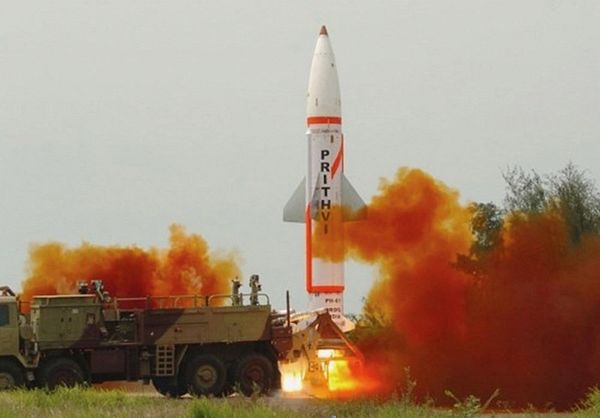
Recently, the Chairman of India’s Defence Research and Development Organisation (DRDO), which is India’s premier agency responsible for military research and development, stated that the agency is ready to proceed further on the Agni-VI missile, pending political approval from the government. The statement however did little to suggest the current progress on the project. Nonetheless, the Agni-VI missile is intended to be the latest variant from India’s nuclear-capable Agni Ballistic Missile series, which constitutes as the central pillar of India’s ballistic missile arsenal. The series fields solid-fuelled missiles ranging from short-ranges to inter-continental ranges. The Agni-VI missile is intended to be land-based as well as submarine launched. Claimed to be Manoeuvrable Reentry Vehicle (MaRV), equipped with Multiple Independently-targetable Re-entry Vehicle (MIRV)-capable, with the ability to carry up to six warheads, with an expected range of 8,000 to 10,000 kilometres. However, media reports claim that its range could be anywhere between 10,000 to 12,000 kms. This range places the missile in the category of intercontinental ballistic missiles (ICBMs) thereby allowing New Delhi to strike almost any target around the world. Nonetheless, rationale behind the development of Agni-VI. And the strategic gap that it would seek to plug-in remains questionable, given the fact that India’s existing missile arsenal is sufficient to address India’s perceived core strategic concerns i.e. Pakistan and China.
As evident from the Agni program, New Delhi’s development trajectory for nuclear-capable ballistic missile has been evolving, moving far beyond serving as a deterrent at a regional level, to a rather expansive capability with a global strike range. Developed under the aegis of the Integrated Guided Missile Development Program (which took off in 1983), the Agni program now fields intercontinental strike capability. The first three variants i.e. Agni-I, Agni-II, Agni-III, as well as the MIRV-capable and canisterised Agni Prime, are all primarily Pakistan-focused. Agni-I, which is the maiden missile of the Agni family, is a short-range ballistic missile with an approximate range of 700 to 1200 kms. The next variant; Agni-II is a medium-range missile. Whereas Agni III is an intermediate range ballistic missile (IRBM). Agni IV and Agni V are relatively advanced systems. While Agni-IV is an IRBM, it is capable of encompassing mainland China in its target envelop. However, it is the Agni-V missile that has significantly expanded India’s strategically targetable reach, and has marked India’s entry into the intercontinental ballistic missile (ICBM) category. The Agni-V brings almost all of Asia, parts of Europe, and Pakistan and China in its range.
Alongside this, the Agni series has also undergone technological transformation to improve mobility and launch readiness. Newer variants, particularly Agni-IV also incorporates canisterised launch systems, which enables quicker deployment through ready-to-launch posture. On the other hand, the fact that Agni-VI missile would also be designed for submarine launch capability, allows it to be launched from positions closer to distant targets, effectively extending its targetable reach to a “global range” even if its technical range is limited compared to land-based ICBMs.
While the current status of the development of Agni-VI missile remains murky, since in his recent statement, the DRDO chairman did not exactly specify whether the missile has been developed or not. However, it could be plausible that New Delhi has already completed its development and is currently awaiting political authorization to proceed with testing. This is because in 2016, when New Delhi announced the successful test launch of the Agni-V missile, at the same time, it also announced to having begun working on Agni-VI missile. Also, since the DRDO has been working on missile technologies, the technological gap between Agni-V and Agni-VI may not have been too sharp to bridge. In this case, New Delhi’s pursuit of extended-range systems reaching up to 8,000–10,000 km would significantly expand its strategic envelope well beyond its deterrence requirements vis-a-vis China and Pakistan. Insofar, the Agni-VI missile would be unlikely to generate any meaningful incremental deterrent value against these two adversaries. However, instead, the development of Agni-VI missile appears to be a function of New Delhi’s prestige-related aspirations, whereby it seeks to assert itself as a major global power, by gaining a status parity with established nuclear powers possessing intercontinental capabilities.
At the same time, it may also be noted that such advancements in its nuclear delivery systems can further generate an appetite for quantitative expansion in nuclear warheads and fissile material stockpiles. It is also to be noted that New Delhi has been working on advancing its nuclear reactors and expanding its fissile material production capabilities, as evident from the development of its first fast breeder nuclear reactor, and its aim to also develop Thorium-based reactors. Likewise, in doctrinal domain too, this trajectory does not sit with New Delhi’s stated commitment to CMD. As a central tenet of India’s 2003 Draft Nuclear Doctrine, CMD premises on maintaining a force posture sufficient for assured retaliation, but not geared toward expansive weapons build-up and reach. However, the induction of intercontinental missile contravenes this posture, signalling a stark gap in its doctrinal commitments.
Hence, it can be ascertained that the Agni-VI missile program is not driven by any urgent deterrence requirements, but instead by the symbolic value attached to achieving intercontinental reach. The prioritisation for developing prestige-driven systems, rather than strengthening nuclear deterrence, instead risks exacerbating security dilemmas, and may also invite scepticism over India’s long-term strategic intent.




Leave a Reply