

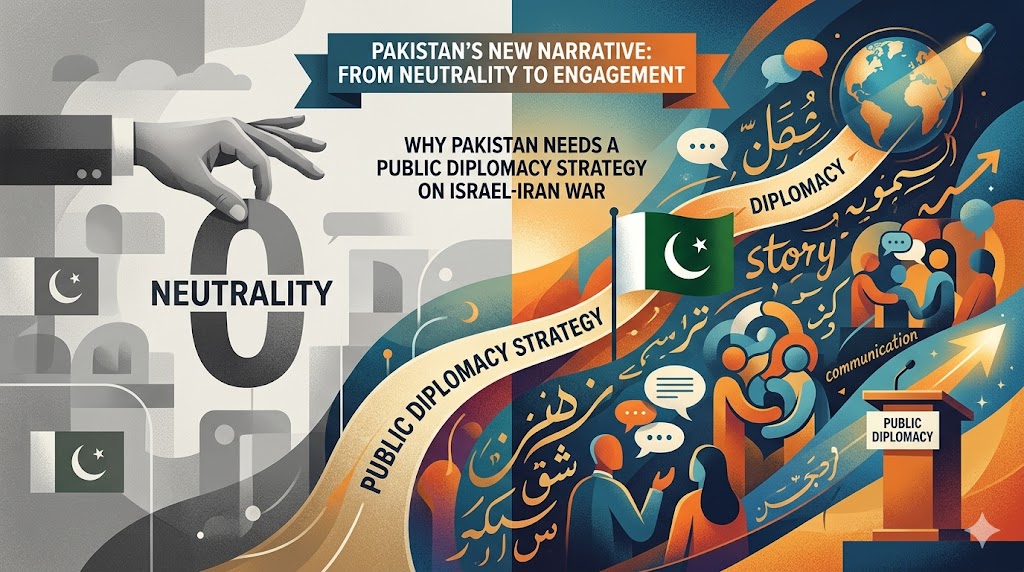
For many years, Pakistan has followed a single rule when it comes to Middle East conflicts, remain neutral and safe. Pakistan has a border with Iran, brotherly relations with Saudi Arabia and complicated relations with the United States. Siding with anyone can have its price economically and politically for Pakistan. So Pakistan remained careful and balanced. But this old approach is not working anymore. The Israel–Iran conflict is not just another regional tension. Instead, it is a rapidly evolving potential confrontation with a high risk of escalation being waged on two fronts, on the ground and in cyberspace. Weapons and drones are just one facet of the conflict. The other component is narrative, who is perceived to be right, who is wrong, and who is given a voice. And on this second front, Pakistan is virtually invisible. This is the problem. Not that we are neutral but that we are silent. Pakistan has in fact played subtle but important role in trying to defuse the tension. There have been backchannel talks reported between the Gulf states and Pakistan as well as coordination with major powers. It is not a small feat. This shows that Pakistan has not lost its diplomatic importance. But here’s the contradiction, if nobody is aware of it, then does it really count? In modern society, diplomacy that is not communicated can be said not to exist. Other countries are not keeping quiet. Iran presents its actions as a resistance to aggression. Israel frames itself as defending survival. Gulf states position themselves as stabilizing forces. Smaller countries as well take active roles in shaping perceptions about themselves. That story at times is shaped by international media which only highlights Pakistan’s crises. Sometimes that story is written by regional rivals that present Pakistan as a confused or irrelevant country. And increasingly, that story comes from the social media, where half-baked narratives become the norm much faster than the facts. This is where staying neutral becomes fatal. Not because it is unethical, but because it leaves a vacuum. And vacuums never remain empty. The Real Risk, Confusion at Home Most policy discussions end at externalities, security, oil prices, alliances. But that neglects a more profound and immediate factor. The Israel–Iran conflict is not just geopolitics. It is shaping the way Pakistanis perceive their fellow citizens. Finally, if you ask the people across Pakistan what the country should do, you will not get one answer. Answers will be many. Some will say Pakistan must support Iran because of religion and resistance. Others will argue that Pakistan must maintain its alignment with Gulf states and not provoke the West. Some quietly argue that Iran itself is a threat. Many simply have emotional anger and no policy sense. This is not just disagreement. It is fragmentation. And here is the one part that research has barely ever seriously looked at how foreign wars such as Israel-Iran are changing domestic identity and sectarian outlook and trust in Pakistan. We study missiles. We study alliances. But we do not study how international narratives shape Pakistan and influence domestic action. We have no large-scale data on how the Pakistani Shia and Sunni understand this war. There is no monitoring of how social media narratives impact public opinion. There is no concerted focus on whether people believe the state or even know what it believes. This is a dangerous gap. Because if society doesn’t get it from the state, it will make its own narrative and it may not match up. Public Diplomacy Is Essential now. This is where public diplomacy is needed. Not as propaganda. Not as slogans. But as clear, consistent communication to the world and to our own people. There’s only three things Pakistan must explain, and explain well. First, what it stands for. Not just non-alignment, but a principle: Pakistan is for de-escalation, negotiation and saving lives anywhere. Second, what it won’t do. Its land, sky or divisions to be fought over. Third, why its stance is important. Because Pakistan is one of the few nations that can engage with multiple players without being too close to them. At the moment, this is not being said in a coordinated fashion. Official statements are few, official and reactive. They are not reaching audiences around the world, and they don’t inform the public. At the same time, young Pakistanis are getting their information from Tiktok videos, YouTube commentaries and overseas narratives. Learning from Others But Wisely Other countries, such as Turkey and South Korea, have leveraged culture and media to gain influence. But this is not what Pakistan should do. Pakistan has its own strength. It is not pop culture dominance. It is a reputation for being able to manage conflict, to live with it, and to try to create peace. It is a compelling narrative if well told. But this is not happening now. From Silence to Strategy, the goal is not to throw away neutrality. That would be reckless.The goal is to make neutrality visible, understood and respected. Pakistan should not be silent. It should be seen as deliberate. That means messaging from embassies. Working with the international media, not shunning them. Engaging with social media where people are talking. Working with researchers, journalists and even the public. It means being honest at home. Explaining risks. Acknowledging divisions. Creating a common ground before the crisis. Because if not, it will be built in a crisis, and pressure does not promote understanding. The Bottom Line Pakistan is weak because it is neutral. It is weak because it doesn’t control its neutrality. In a world where reality is what you believe, quiet is not secure. It is loss of narrative space. The Israel-Iran war is not just a test case of military capabilities in the Middle East. It is testing the ability of nations like Pakistan to keep up with a new international politics one in which power is about what you do, but also what you are perceived to do. If Pakistan is to play a role in the next crisis, it needs to do something easy, but not easy, Speak clearly,Speak early. And most of all, tell its own story.

Leave a Reply