

India’s defence ties with Israel and reliance on Israeli weapons creates a commitment trap where, if not for strategic congruence, an operational linkage is indeed taking place may raise concerns with regional countries including Pakistan that may feel threatened by Israel. Simply said, Israeli weapon systems and manufacturing base come with trainers, advisors, and joint operators who actively participate in real-time employment of these systems. India’s reliance on Israeli systems during Operation Sindoor in May 2025 is a prime example. India claims to have utilized Israeli-origin stand-off munitions (Rampage and Spice-2000) to target the Pakistani mainland. In addition, India majorly used Israeli-origin drones (Herop and Heron) in ISR missions against Pakistani military installations. Pakistan shot down one of India’s Israeli-origin ISR drones on May 7.
From an Israeli perspective, it would prefer to diversify and offshore critical defence industrial base, especially in the context of its geographical vulnerabilities that have been exposed during the war with Iran. Israel has a small landmass. Most of its industries are located in close proximity, which makes them lucrative target for stand-off attacks. Even with error probability of missiles, that its industrial base is quite exposed. Therefore, Israel not only seeks to secure its industrial base but also needs to scale it up, and to use it to foment defence sales abroad. It is already selling state-of-the-art weapons to countries in Europe and Asia. India, being its largest customer and one with a political elite resonating with the Israeli right wing, would be seen by Tel Aviv as a safer destination to offshore its defence industrial base.
India is seeking to diversify its defence arsenal, especially in stand-off precision strike capability, along with unmanned AI-driven systems. In both domains, Israel has a qualitative edge in comparison to Russian and indigenous systems. Israel’s war machinery currently employed against Iran is also using assets developed in India, especially drones with BEL.
The Israeli technological contribution to India’s Ballistic Missile Defence (BMD) programme is more foundational than is commonly considered and predates most of the headline acquisitions of the Sindoor era by over two decades. India acquired and deployed two EL/M-2080 Green Pine radars — produced by Elta Systems, a subsidiary of Israel Aerospace Industries, and originally developed as the backbone sensor of Israel’s Arrow theatre missile defence system — around July 2002, with a third unit delivered in August 2005. The Green Pine operates with a detection range of approximately 500 kilometres and is capable of simultaneously tracking more than 30 targets at speeds exceeding 3,000 metres per second — specifications that made it the only radar available to India at the time capable of providing meaningful ballistic missile early warning at the strategic level. Two of these units were procured directly from Israel and deployed at Konark in Odisha and at a DRDO facility in Bangalore; two more units were subsequently built in India under licence, with one deployed near Delhi as part of the BMD Phase 1 shield and the other held in storage at DRDO radar testing facility in Bangalore. The Green Pine’s influence did not end with direct procurement. India’s indigenously developed Swordfish Long Range Tracking Radar — the primary sensor of DRDO domestic BMD programme — is an acknowledged derivative of the original Green Pine design, meaning Israeli radar architecture is embedded not only in the imported systems but also in the indigenous BMD sensor layer itself. India’s BMD Mission Control Centre was additionally built on Israeli technology acquired from IAI and Tadiran Communications — now part of Elbit Systems — the same company that developed the Command, Control, Communications and Intelligence modules for the Arrow system, making the C3I architecture of India’s BMD network a direct conceptual and technological descendant of Israel’s Arrow. At the medium-range layer, the Barak-8 MRSAM system incorporates the EL/M-2248 MF-STAR AESA multi-function surveillance, tracking, and guidance radar produced by IAI’s Elta Systems, providing 360-degree coverage and simultaneous multi-target engagement capability across the naval and land-based variants deployed with all three Indian services. The depth of this dependency means that any assessment of India’s BMD architecture that treats it as a domestically developed system significantly understates the Israeli technological inheritance running through its sensors, its command network, and the design philosophy of its intercept chain. With Israel now also exporting its Arrow interceptor systems, India will very likely also consider them as part of its BMD chain with localization.
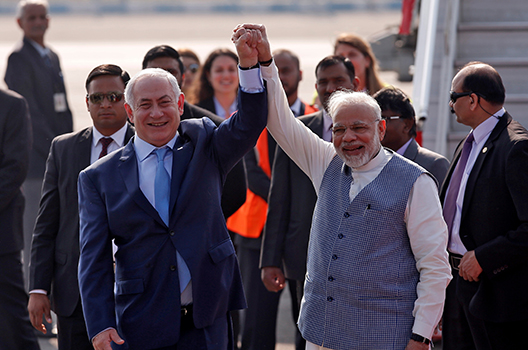
India-Israel defence relationship, already the most fruitful bilateral arms partnership for Israel, entered an accelerated phase following two convergent shocks: the operational validation of Israeli air defence systems during the 2023–2025 Middle East wars, and the exposure of India’s own vulnerabilities in drone, missile, and cyber warfare during Operation Sindoor in May 2025. According to SIPRI data, India accounted for 34 percent of Israel’s total defence sales between 2020 and 2024, with Israel’s SIBAT directorate reporting total arms sales to India in this period worth approximately $20.5 billion — a baseline that the post-Sindoor period appears set to substantially exceed. In November 2025, India and Israel signed a new Memorandum of Understanding to expand defence cooperation through joint production of military equipment and collaboration in artificial intelligence and cybersecurity, emphasizing shared access to Israeli advanced sensors, electronic warfare systems, and air defence technologies developed through operational combat experience. This was followed in January 2026 by India’s Ministry of Defence signing a contract with BDL for the supply of over 70 MRSAM missiles for the Indian Navy at a cost of approximately ₹2,960 crore ($350 million) — a continuation of the deep Barak-8 co-production architecture. The centrepiece of the emerging acquisition surge, however, was Prime Minister Modi’s landmark state visit to Jerusalem in February 2026, during which India approved an $8.7 billion precision-strike weapon package from Israel, including SPICE-1000 guidance kits and long-range missiles, representing one of India’s largest single foreign arms acquisitions in recent years. Alongside offensive systems, potential deals were reported for all four major elements of Israel’s multilayered missile defence architecture — the IAI Arrow system, Rafael’s David’s Sling and Iron Dome, and the Iron Beam laser weapon — though none of these companies confirmed finalized agreements at the time of writing. Taken together, the trajectory suggests that India is no longer approaching Israel purely as a procurement source but increasingly as a co-production partner whose battle-tested technologies offer the fastest route to bridging capability gaps that Operation Sindoor rendered impossible to defer.
From a geopolitical purview, this strategic defence coupling reorients regional dynamics in the coming period. Indo-Israeli defence industrial cooperation will become a symbiotic relationship, where both will utilize each other’s capabilities (initially for R&D and advisory in the case of Israel and scaled-up equipment production for India), which will eventually lead to more strategic coupling in security pursuits. India would seek to utilize more and more Israeli weapons against Pakistan, especially after drawing lessons from their usage in Iran. Israel would want a reliable defence partner that would secure its investment and also ensure a robust supply chain for Israeli defence needs, with the add-on of the cash flow that would come from the biggest buyer of its equipment. How India in that case would chart its foreign policy with Iran and especially Gulf countries (Saudi Arabia, Qatar, Egypt etc) would be very complex as performative neutraility would become questionable. India has tactfully used its economic prowess to balance its relations with Iran and Saudi-led Gulf order. Israel would be a whole new case. With Pakistan emerging as a security partner in Gulf, along with its increasing role as a mediator for during the US-Iran talks , the Indo-Israeli dyad will pose a complex challenge to West Asian security, especially as Israel’s intentions for the region become clear, so does India’s increasingly aggressive posturing towards Pakistan.

Hammad Waleed
Hammad Waleed is a Research Associate at Strategic Vision Institute, Islamabad. He graduated with distinction from National Defence University, Islamabad. He writes on issues pertaining National Security, Conflict analysis, Emerging Technology, Strategic forecast and public policy. He can be reached at hammadwaleed82@gmail.com.



Leave a Reply