

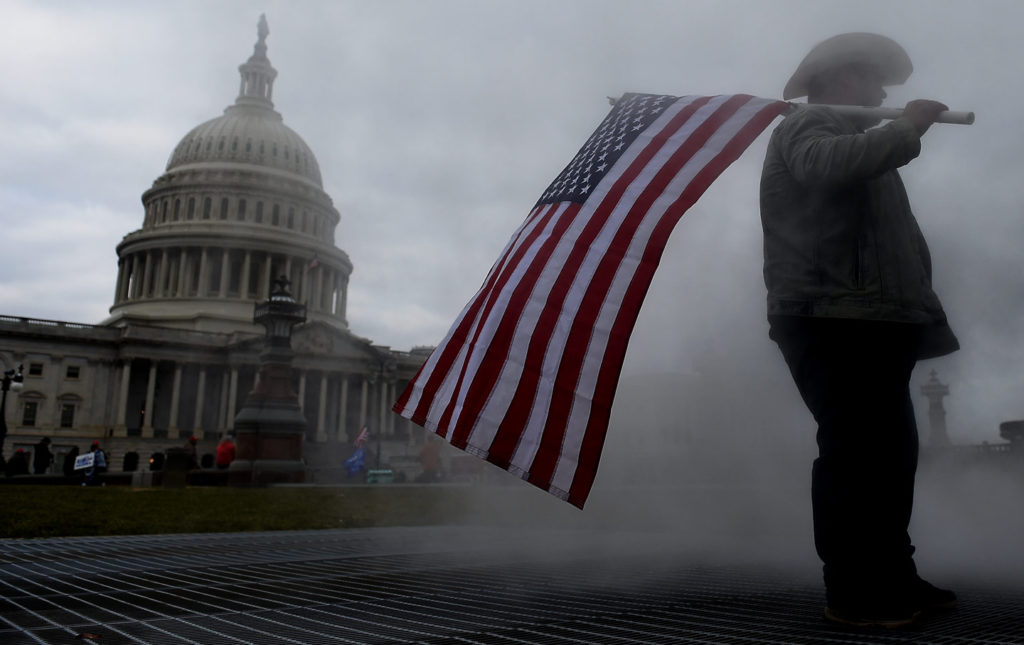
The United States of America, the sworn beacon of democracy and the champion of human rights has served as the world’s hegemon for the better part of three decades. But the cracks in that hegemony are no longer hairline fractures; they are becoming structural faults. As the United States waged yet another war in the Middle East, this time against Iran, the familiar playbook of moral justification is being met not with deference but with defiance. Iran has refused to negotiate on American terms and is determined to secure a result to its liking in the “Islamabad Talks.”
For decades, the United States justified its military interventions under the banner of human rights and counterterrorism. Iraq in 2003 was about weapons of mass destruction. Libya in 2011 was about protecting civilians. Afghanistan was the war on terror. However, the 2026 Iran war has raised serious questions about the credibility of this long-standing framework. On 8 April, Israel reportedly launched 100 missiles in 10 minutes on Lebanon shortly after a two-week ceasefire was announced between the United States and Iran, brokered by Pakistan. Later, POTUS said, “Lebanon was not part of the ceasefire plan”, a position that has been widely questioned given the timing of the strikes. Launching a military strike during active diplomacy does not merely undermine one negotiation; it eviscerates the very concept of diplomatic credibility.
Perhaps the most explosive revelation has been the growing visibility of Israeli influence over American war-making. On 17 March 2026, Kent, an eleven-tour combat veteran appointed by Trump himself, drew a direct line between the Iraq and Iran wars, calling it “the same tactic the Israelis used to draw us into the disastrous Iraq war.” Former Israeli PM Naftali Bennett reinforced this reading, telling European media: “We are fighting your war. We expect your backing.” The language positions Israel not as a beneficiary of American protection, but as the driving force. The question the Global South has long asked is: Who is really driving American foreign policy? Now has answers coming from inside the house.
If these revelations represent an internal fracture, the European response represents an external one. Never since the Second World War have so many Western allies simultaneously refused to back a US military campaign. EU Foreign Affairs Commissioner Kaja Kallas declared: “This is not our war.” Germany’s Chancellor stated: “We will not participate.” Spain condemned the strikes as violations of international law. When Trump demanded NATO allies send warships to the Strait of Hormuz, he was met with refusal and declared the United States “does not need the help of anyone.”
The military and diplomatic fractures are compounded by economic erosion. The US national debt crossed $39 trillion in March 2026, with interest payments projected to exceed $1 trillion this fiscal year, surpassing the entire defence budget. Meanwhile, de-dollarisation is accelerating: the dollar’s share of global reserves has fallen from 73 percent in 2001 to approximately 57 percent. After Western sanctions froze Russian assets in 2022, over 95 percent of Russia-Iran trade shifted to rubles and riyals; China and Russia now conduct most bilateral trade without the dollar. BRICS, representing nearly 40 percent of global GDP, is developing alternative payment systems, while central banks worldwide have been purchasing over 1,000 tonnes of gold annually since 2022. The economic architecture that sustained American hegemony is quietly being bypassed.
The rise of China and Russia further reshapes the equation. China became the top trading partner for over 120 countries after the Saudi-Iran rapprochement broke down in 2023. Russia, despite Western sanctions, has deepened energy partnerships with China and India, rerouting oil exports eastward and demonstrating that sanctions can accelerate alternative economic blocs rather than prevent them. The Trump administration’s tariff wars against BRICS nations have arguably pushed these countries into their most intense cooperation yet.
While stating these facts, one cannot overlook the demise of US moral authority at home. The Cambridge Analytica scandal, the January 6 Capitol attack, the resignation of Joe Kent, declaring that the war was launched not because of an imminent threat, but “due to pressure from Israel and its powerful American lobby,” and the Epstein files each exposed elite misconduct, damaging America’s image as a moral leader and preacher of democracy. This shift is also reinforced by a generational change: Gen Z, from Rawalpindi to Rotterdam, has grown up with unfiltered information that bypasses traditional gatekeepers, dismantling the colonial assumption that Western powers hold a monopoly on moral authority.
The convergence of these forces- military overreach, alliance fracture, democratic erosion, debt, de-dollarisation, and the rise of competing powers-points toward a single trajectory: the unipolar moment is fading. Research in Frontiers in Political Science projects turning points in American global primacy between 2032 and 2067. Yet it would be premature to write the obituary of American hegemony. The United States still commands the world’s most powerful military, leads in technological innovation, and maintains a financial system that, for all its vulnerabilities, remains the deepest and most liquid on earth. No single currency is positioned to replace the dollar. History warns that hegemonic transitions are measured in decades, not years, and that the incumbent often retains decisive advantages long after decline becomes visible.
But if the trajectory holds, if the nation that wrote the rules continues to break them while the rest of the world builds alternatives, then the question is no longer whether American hegemony is fading. It is whether it will fade into a stable multipolar order or into something far more volatile. And if so, who will write the next rules, and for whom?

Alina Ijaz
The writer is pursuing her degree in Peace and Conflict Studies from National Defence University, Islamabad. She can be reached at alinaijaz071@gmail.com



Leave a Reply