

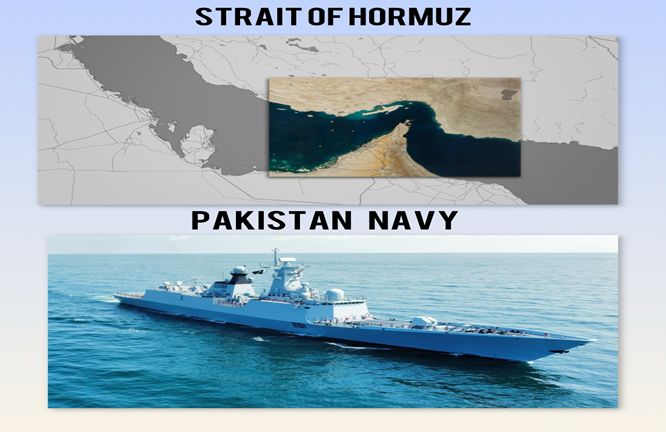
Iran is countering the US-Israel mutual aggression by counter-force posturing at the strait of Hormuz. The strategic objective is to mount the pressure of disrupted global economy on United States with Maritime deterrence and Area Denial Strategy. Initially, Iran Revolutionary Guard Corps (IRGC) declared the condition-based closure of the strait to dis-engage the navigational maritime trade and then restricted naval maneuverability in the respective region. Since millions of oil barrels and tankers pass through this critical water-way, strategic disruption shall inflict heavy costs for global war situation. Iran staged multi-layered positioning of its naval fleet to influence the war dynamics in the region.
As part of operational planning, Iran remained consistent in deploying fast flexible force at sea to emerge against the technologically superior aircraft carriers and amphibious assault carriers of United States. At core, the doctrinal motivation purely vested in countering heavy armored warships with the high-speed offensive force. It remained effective in damaging and displacing humongous aircraft carriers, Abraham Lincoln and Gerald Ford, away from the strait. It revealed that the edge of situational awareness regarding shallow based basin of the strait favored Iranian navy to counter warships.
Iran led the tactical featuring of swarm tactics by the use of high-speed crafts of Seraj-1 and Azarakhsh to employ explosives laden boats and torpedoes against the hull of aircraft carriers. Additionally, it engaged Shahed-129 and Shahed-136 drones as loitering munitions against any non-compliant warship crossing the strait. To amplify the offensive countermeasures and to narrow down the navigational leakage of maritime traffic, Iran substantiated the settling of sea-based mines as part Area Denial strategy. It remained effective in surmounting the risk for the safe passage of naval vessels. Meanwhile, it ensured deployment of attrition-based machine guns of CM-302 surmounted on destroyers and stationed heavy fire power along its coastline to induce strategic depth.
In this way, Iran managed to posit asymmetric warfare strategy and successfully maintained its maritime writ in the strait of Hormuz. The United States Nimitz class aircraft carriers with the capacity to displace 100,000 tons of water mounting disruptive firepower which once defeated Japan in World War II now facing severe repatriation. Iran not only denied hegemonic interests through pro-active naval strategy but also set the new normal of countering high end technological warships with the efficient use of low-cost weaponry.
The aforementioned naval contingencies suggest Counter Active posture for Pakistan Naval force. Because its coastal line lies in close proximity with strait of Hormuz. Anything happens there shall have direct impact on the maritime and land-based interests of Pakistan in Indian ocean. In comparative analysis, Pakistan naval force does settles on asymmetrical warfare strategy just like Iran with defensive posturing. But it requires to ensure the survivability of its strategic depth along the coastline due to vulnerable geographical landmass. It shall put maritime deterrence of Pakistan at stake and endanger land bound political upheaval.
Pakistan navy has quite recently inducted PNS Khaibar MILGEM Class Corvette to avert the shortcomings of strategic reach. In order to contain the strategic threat at a distance and to target adversary’s critical infrastructure in no time, the respective warship has been made part of Pakistan navy. Since the stealth and speed oriented technological sophistication is the new trend, it turns out vital equipment for modern naval task force to get equipped with no delays. Iran’s navy has provided real time example that how effectively these technologies can enhance the strategic leverage at sea against one of the formidable warships of United States.
The naval force is in dire need of introducing low end kamikaze drone technology on board for the strategic advantage it provides for the operational leverage. This unmanned technology boasts the offensive applicability of tactical targeting of massive vessels with minimum stake. Pakistan naval task force is advancing its options to improve the maneuverability of its fleet against the maritime threats through layered defense and network centric warfare. Since the coastline lacks strategic depth so high-speed corvettes, destroyers and aerial impact of drones are considered to provide formidable defense line.
Lessons from Iran war is applicable for Pakistan navy since the hegemonic interests of United States and Israel are widening beyond strait of Hormuz. It is high time for the political and military leadership to secure its coastline in best possible ways beforehand. Since Arabian Sea stands in between the passage of trade flow from middle to pacific, the strategic alignment of Pakistan in future shall dictate the fate of this maritime trade route considerably. Meanwhile geo-political scenarios of extended adversaries can ploy and challenge the second-strike capability of Pakistan naval force. So, it is inevitable for Pakistan to put its naval force in offensive posture to out-stand as effective counter measure against the naval threat from countries surrounding it. Pakistan shall priorities integrated warfare strategy at high seas to ensure fortification at coastal areas.

Seerat Fatima
Seerat Fatima is a graduate of Defence and Strategic Studies from the National Defence University, Islamabad. She is the author of the article titled “Analysing Russian Cyber-Warfare and Legal Frameworks in the Context of United States Elections 2016,” published in the CEIL Journal of International Law at ISSRA.

Leave a Reply