

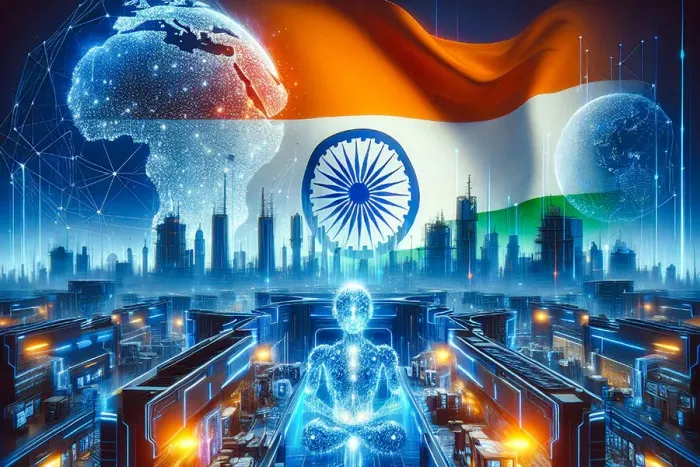
India hosted an AI summit in the Global South from 16 to 20 February, organized by the Ministry of Electronics and Information Technology. India holds ambitions to expand AI’s accessibility, equity, healthcare, and education. Modi inaugurated the New Delhi Declaration, with 88 nations signing and 2,50,000 registered attendees, 20 heads of state and prominent figures including Sundar Pichai of Google, Sam Altman of OpenAI, and Dario Amodei of Anthropic, India demonstrating a new kind of power. However, Summit faced criticism over the jam and mismanagement at the venue, Galgotias University presented China’s robodog Orion as an Indian product. Misrepresentation compromises the credibility of the summit.
In recent years, New Delhi has prioritized technology and increased investments in both traditional strategic and emerging technologies. By hosting the summit it wants to be seen as an emerging global tech leader. The AI summit was quite successful in shaping public diplomacy. New Delhi joined the Pax Silica initiative and attracted foreign investment from tech companies like Google, OpenAI, and Anthropic. Despite this, a serious question arises Is this true leadership or brand management?
New Delhi faced a setback in a highly competitive global landscape. Policymakers have paid limited attention to its hardware gaps. The future of AI depends more on hardware and infrastructure. India is strategically weak in hardware manufacturing and strong in software emphasizing software and public services, which potentially risks India’s advantage.
India’s Digital Public Infrastructure including models such as Aadhaar, UPI, and India Stack, forms the foundation of New Delhi’s digital governance. They are designed to be low-cost, open source, and scalable for biometric verification, payment transactions, and open APIs. India uses DPI as soft power with India Stack adopted across Asia and Africa. The Modular Open Source Identity Platform (MOSIP) is operating in more than twenty countries. New Delhi positions itself as a provider for the Global South.
The Summit remains a successful diplomatic platform. India announced $250 billion in infrastructure investment pledges. Moreover, it generated real investment commitments, such as $20 billion in deep technology. OpenAI-Tata and Anthropic-Infosys partnerships were also announced at the summit.
India also has strategic bilateral tech pacts with global powers, and has signed an Initiative on Critical and Emerging Technologies (ICET) with the US. India formally joined the US-led framework Pax Silica to secure semiconductor and critical minerals supply chains, a direct outcome of the 2026 AI summit. MoUs with Japan and the European Union were signed before the summit and are part of ongoing diplomacy. Through broader tech diplomacy India is positioning itself as a strategic technology partner.
Digital Public Infrastructure is not a neutral technical toolkit. It reflects built-in beliefs about how governments ought to operate. When India Stack or MOSIP reaches other countries, it brings an institutional template around identity, data, and state authority. This led to a question of whether India is providing genuine assistance to the Global South or exporting its governance model under the banner of development?
New Delhi claims digital sovereignty. However, it depends on foreign companies such as Microsoft, Google, Amazon, and Nvidia for cloud services, advanced chipsets, and proprietary models. As a result, India’s digital diplomacy projects influence abroad while continuing to rely on Western corporate infrastructure. This dependence undermines India’s credibility when it positions itself as an independent tech leader for the Global South.
India’s digital platforms involve a tension between inclusion and control. India is exporting the Aadhaar-based biometric system to other countries through MOSIP but in India Aadhaar has excluded vulnerable populations due to biometric mismatches, denying their access to welfare and essential services. While UPI is enabling a payment revolution, it operates within an environment of data collection and indirect persuasion. When these systems are used abroad they carry the risk of transferring the same exclusions and surveillance architecture to host countries. New Delhi cannot credibly position itself as a champion of the Global South while these contradictions remain unresolved at home.
India stands between two giants, American Silicon Valley’s corporate-led model and China’s surveillance and control-oriented Digital Silk Road. This position gives India genuine space to define a third way for the Global South one that is open, sovereign, and democratically accountable. However, to ensure credibility New Delhi must first resolve the contradictions within the country such as biometric exclusions, surveillance risks, and infrastructural dependency. It should export not just technology but the values behind its open standards and democratic accountability. Whether it becomes a footnote or a foundation will India lead with ambition alone or with fairness and equity?

Shanza Butt
Shanza Butt is an undergraduate student of International Relations at Fatima Jinnah Women University, Rawalpindi. Her research interests include South Asian geopolitics, regional security, and technology policy.



Leave a Reply