
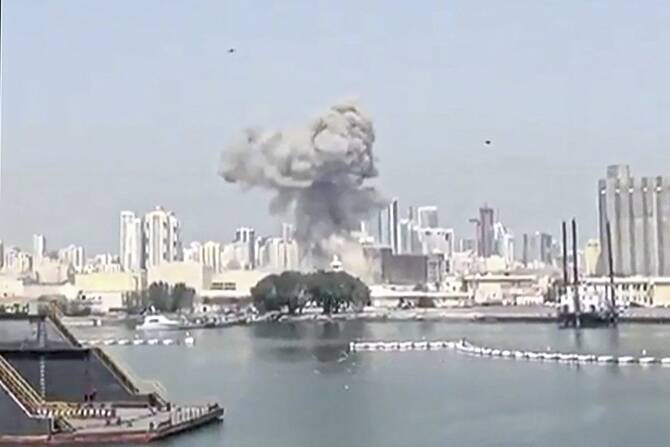
The missile attacks against the American military bases in the UAE, Qatar and Bahrain are indicative of Tehran trying to support its deterrence concept, however, it brings new anxieties to Strategic stability in the Middle East. The size of these regional tensions has been widened when Iran targeted U.S. military bases in the Gulf, using missiles to attack the facilities in the United Arab Emirates, Qatar and Bahrain as a direct retaliation to the recent military actions against the country. The attacks are one of the most severe increases in the region over the years and highlight the changing policy of deterrence by Tehran. It was reported that the Al Dhafra Air Base in the United Arab Emirates, the Al Udeid Air Base in Qatar, and the headquarters of the Fifth Fleet of the United States were under attack by missiles.
They are the bases of U.S. air and naval activity throughout the Middle East and have long served as a symbol of Washington security presence in the Gulf. The officials of Iran asserted that the attacks were a retaliatory measure in a similar manner to the combined military measures undertaken by the United States and Israel on targets within Iran.
Tehran insists that any assault on its territory will be answered through open and frontal retaliation against American military installations in the area, which may be anywhere. Supreme Leader Ali Khamenei called on TV accused Iran would not tolerate what he referred to as aggression. Islamic Revolutionary Guard Corps took ownership of the missile launches saying this was part of a defensive doctrine to restore equilibrium.
Security experts indicate that the attacks are indicative of the fact that Iran has always depended on deterrence as a means of strategy. Instead of direct large-scale war, Tehran seems to be indicating that, the costs of attacking Iran will not solely be confined to Iran. Iran is trying to increase the stakes of Washington and its allies by attacking the high-value U.S. bases, which are hosted by the Gulf states in effect expanding the space of confrontation.
The deterrence in this regard does not simply mean retaliation but it means establishing expectations. The message that Tehran sends is that, further military pressure will cause repercussions that would affect American operations, partners in the region as well as the global energy markets. By so doing, the Iran will be seeking to enhance what strategists refer to as strategic stability a state where those who oppose it will not escalate further due to the fact that the costs of doing so are more than the benefits.
Nonetheless, this policy involves some risks. The Gulf states that currently host U.S forces are left on the frontline of a conflict that is not necessarily their fault. These nations have also been keen to maintain economic and diplomatic contacts with Tehran although they are in defense alliances with Washington. Any missile attacks on their land would put a strain on that equilibrium and increase the issue of domestic security.
Analysts in the region fear that the repetition of such actions and counteractions may destroy the delicate balance that has kept the open war at bay over the past decades. The efforts by both opposing parties to build up deterrence can, ironically, heighten the chances of miscalculation. The war can be used to attack military deployments as a way of reassuring allies, and retaliatory strikes as a way of restoring the equilibrium but they will only serve to further escalate the war.
In the meantime, diplomatic relations are not yet closed, but the tension is very high. The fact that U.S. bases in the Gulf are being targeted is an indication that Iran is planning to move beyond rhetoric to confrontation and entrench its doctrine of deterrence in actual military intervention. It will be determined whether this tactic can stabilize the situation strategically or bring the region nearer to a larger conflict by how Washington, its Gulf allies and Israel will react in the future.

Hamna Ghias Sheikh
Hamna Ghias Sheikh is a research associate at the Maritime Center of Excellence, Pakistan Navy War College She can be reached at hamna.sheikh009@gmail.com.



Leave a Reply