
As geopolitical tensions escalate across the Middle East, the maritime security environment in the Persian Gulf and the Strait of Hormuz has entered a new phase of uncertainty with significant implications for global energy markets and international trade. With reports of vessel attacks, naval mine deployments, and rising insurance costs, the region’s critical shipping corridor is increasingly being viewed as a contested maritime battlespace rather than a conventional high-risk transit zone.
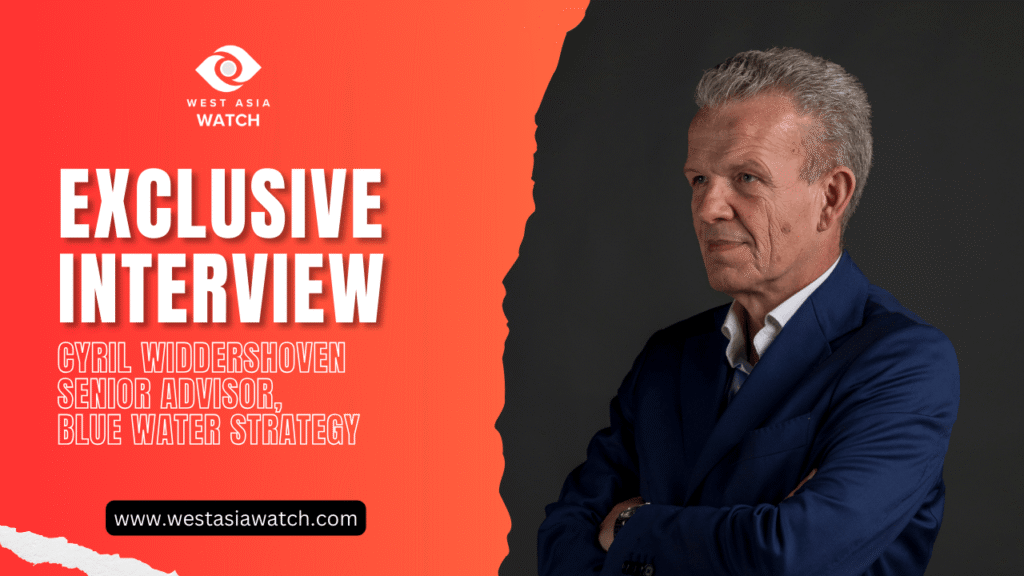
In this context, West Asia Watch spoke with Cyril Widdershoven, Senior Advisor at Blue Water Strategy and a geopolitical strategist specializing in maritime security, commodities, and supply-chain risks across the EMEA region. In this interview, he assesses the evolving security dynamics in the Gulf, the potential economic consequences of disruptions in the Strait of Hormuz, and how global shipping and energy markets are adapting to an increasingly volatile maritime environment.
1. How do you assess the current maritime security situation in the Gulf region, particularly around the Strait of Hormuz, amid escalating geopolitical tensions?
From the perspective of maritime operators, the main point at present is that Hormuz is now being shaped by hybrid denial tactics, which constitute a new reality rather than a classical declared blockade. Tehran has the capability and capacity, still, even after the US-Israeli operations, to put in mines, projectile attacks, and increase clear threats against passing ships. It is also related to the lack of a reliable naval escort at present. The market needs to understand that current naval power projections are needed to act on Iran and others. This combination makes the corridor commercially unusable even if, legally speaking, it is not formally closed. While this distinction matters in diplomacy, it doesn’t matter at all to shipowners, charterers, crews, or insurers.
2. What would be the potential global economic and energy market implications if shipping traffic through the Strait of Hormuz were significantly disrupted during a regional conflict?
The market signal is already visible, but, in my opinion, still too muted. Sources are reporting surging diesel and jet fuel prices. There is also a major concern that higher middle-distillate prices could lead to a significant slowdown in global economic activity. The situation is also putting a major strain on global supply chains, exceeding that during the Suez Canal blockade (EverGiven) and potentially rising even higher if prolonged, surpassing other crises. The U.N. has also warned that the conflict is already disrupting freight, food costs, and humanitarian logistics due to halted shipping through Hormuz and broader regional transport disruptions. It is no longer a Gulf energy story; it quickly becomes a global inflation, trade, and growth story.
3. From a maritime risk perspective, how vulnerable are commercial shipping routes in the Gulf and surrounding waters during periods of military confrontation?
Said they are all extremely vulnerable because the Gulf is a narrow, predictable, infrastructure-dense environment in which, in normal circumstances, large commercial vessels already have very limited room to maneuver. In the case of a relatively small number of mines, a handful of attacks, or even sustained threat messaging, this will have already created enough uncertainty to stop traffic. These factors are not hypothetical, even if US President Trump indicates this. Still, the latest reports indicate that there could be mine deployments and multiple vessel attacks. It is a real-time scenario.
4. How are shipping companies and insurers currently adapting their strategies to manage risks related to conflict in key maritime chokepoints such as the Strait of Hormuz and Bab al-Mandeb?
The main moves are clear, as they are shifting from efficiency-driven operations to defensive risk management. Shipping companies such as Maersk, Hapag-Lloyd, and CMA CGM are clearly rerouting vessels around Africa, in a move to avoid the Suez and Bab al-Mandeb channels. There are still a lot of companies, maybe thinking more defensively/conservatively or, in my opinion, a bit optimistically, keeping vessels offshore rather than attempting Gulf transits. Overall, the shipping market is accepting longer voyages and higher costs in exchange for lower immediate exposure.
5. In your view, what role can naval coalitions and international maritime security initiatives play in ensuring the safety of global trade routes during wartime conditions?
They remain essential, but the market and analysts should start to understand that their role should be described realistically. Even though naval coalitions can improve surveillance, intelligence sharing, mine-countermeasure capacity, escort planning, and deconfliction, this option will only be available when conditions allow. At present, this is not the case. Naval escorts are critical for reducing risk and for reopening sea lanes, but again, only when the situation is normalized, aka when forces are in place and available to act. Keep in mind, at present, the US Navy has not been willing to provide the shipping industry with regular escorts. According to the US Navy, the threat environment is too severe.
6. Looking ahead, do you foresee long-term shifts in global maritime trade routes or supply chains if instability in the Gulf region persists?
Yes. If Gulf instability persists, companies and states will accelerate a shift from lowest-cost routing to resilience-based supply chains. There are increasing signs that parties are considering rerouting around Africa, halting Hormuz exports, and using alternative export infrastructure. In the long term, there will be more investment in bypass routes, strategic storage, and diversified sourcing. For the market, the main strategy should be to recognize that non-Gulf bunkering, storage, and transshipment hubs will be of greater importance.

Parsa Imran is the Co-Founder and Managing Editor of West Asia Watch, a platform covering geopolitics, defense, technology, artificial intelligence, and real estate developments across the Middle East and West Asia. She is a strategic communications expert and geopolitical analyst whose work focuses on regional power dynamics, emerging technologies, digital transformation, and the intersection of policy, security, and innovation shaping the MENA region.



Leave a Reply