

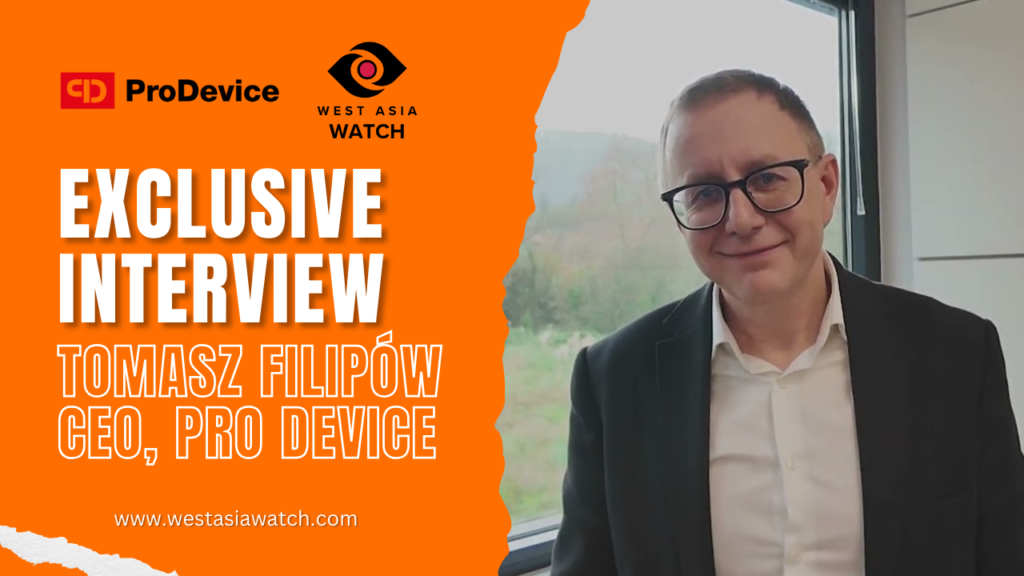
Pro Device is a Poland based security technology company specializing in advanced data protection, secure storage and irreversible data destruction solutions for defense, government and critical infrastructure environments. In an interview with Parsa Imran of West Asia Watch, Pro Device executive Tomasz Filipów discusses the unique security challenges of the Middle East, the protection of critical infrastructure, and the role of lifecycle-based security solutions in high-risk regional environments.
Q1: How do the unique security challenges of the Middle East influence demand for advanced screening and detection technologies?
Tomasz Filipów:
The Middle East combines high profile targets, geopolitical volatility and a dense concentration of critical infrastructure. This creates strong demand for systems that are fast to deploy, scalable and reliable under harsh environmental conditions.
Security technologies in the region must function consistently in high throughput and multi-tenant environments, while being supported by clear operational procedures rather than ad hoc setups. Importantly, the value of these systems must translate into measurable risk reduction, not simply the deployment of more technology.
This is why Pro Device develops integrated hardware and software solutions that work together, ensuring operational continuity, traceability and verifiable outcomes.
Q2: What role can Pro Device solutions play in enhancing security at airports, seaports, energy facilities and government installations across the region?
Tomasz Filipów:
These environments share a common requirement, which is the control of access alongside control of sensitive information and equipment. Pro Device solutions are compact, logistically efficient and easy to operate, making them suitable for deployment across airports, seaports, energy facilities and government installations.
In transportation hubs, governance of sensitive media and devices moving between secure zones must be auditable and verifiable. In energy facilities, protection against insider enabled incidents and data leakage is critical, requiring strict lifecycle control of equipment and media.
For government installations, strong chain of custody, verified handling and secure disposal of sensitive assets are essential. Pro Device’s ecosystem approach is particularly effective for multi-site operators and national level programs that require standardized, scalable and auditable security processes.
Q3: How critical is advanced detection technology in counterterrorism and internal security operations in high-risk regional environments?
Tomasz Filipów:
Advanced detection technology is critical, but its effectiveness depends on the full operational model that surrounds it. Detection must be supported by rapid response and strong evidentiary processes.
In high-risk environments, security technologies must enable fast operational decisions, be resistant to interference and provide accountability through traceability and post incident review. Pro Device solutions strengthen not only detection, but also the controlled environment around sensitive assets and information, ensuring that their movement, handling and disposal are properly managed and documented.
Q4: With the rise of smart cities and mega infrastructure projects, how can security systems balance public safety with operational efficiency?
Tomasz Filipów:
The most effective model is security by architecture and efficiency by design. This requires automation of compliance so that security measures do not slow down daily operations.
Role based workflows, measurable controls and clear procedures reduce friction while maintaining high security standards. Pro Device’s ecosystem approach helps standardize processes across large scale programs while keeping operations practical and efficient, particularly in complex multi stakeholder environments.
Q5: How important are local partnerships, regional presence and technology transfer when expanding into the Middle Eastern market?
Tomasz Filipów:
Local partnerships are essential. Successful expansion requires trusted regional partners who understand procurement processes, operational realities and deployment requirements.
For Pro Device, partnerships are not simply distribution channels. They are enablers of standardized workflows, training, operational documentation and long-term sustainability. Our partners must understand both the hardware and software components of our solutions and be willing to invest time in mastering them.
Where appropriate, structured technology transfer aligned with national strategies further strengthens long term cooperation and operational effectiveness.
Q6: What regulatory, cultural and operational considerations should international security technology providers keep in mind when operating in the region?
Tomasz Filipów:
Key considerations include data sovereignty and retention requirements, which are often stricter and more localized than in other regions. Procurement and certification frameworks can vary significantly by country and sector.
Operational factors such as climate, high throughput environments and multi operator facilities must also be taken into account. Cultural expectations around privacy and public sector governance influence what is acceptable in public facing deployments.
The most effective providers adapt workflows and assurance models to local governance structures rather than relying solely on standardized hardware.
Q7: Given the strategic importance of oil, gas and critical energy assets, how can advanced security screening mitigate both insider and external threats?
Tomasz Filipów:
Energy security is focused on preventing high impact events such as physical sabotage, operational disruption and information compromise. While screening is important, insider risk requires additional controls.
These include strict chain of custody for devices and media, verifiable decommissioning and disposal processes, controlled access to sensitive zones and full auditability to support investigations and continuous improvement.
Pro Device’s verifiable lifecycle approach directly strengthens resilience by ensuring that sensitive equipment and data are managed securely from deployment through disposal.
Q8: How does Pro Device align its offerings with defense and internal security modernization initiatives across the Middle East?
Tomasz Filipów:
Modernization initiatives increasingly demand integrated capabilities that combine technology, governance and measurable outcomes. Pro Device supports this by delivering audit ready processes alongside physical equipment.
Our ecosystem model enables multi-site standardization, scalable training and consistent documentation across national programs. This approach supports repeatability, accountability and rapid deployment, which are critical for large scale modernization efforts.
Q9: Does Pro Device plan to expand its footprint in the region through partnerships, joint ventures or local representation?
Tomasz Filipów:
Yes. Our regional growth model is partnership driven. We are actively developing cooperation frameworks that may include local representation, training centers, service capabilities and, where appropriate, production or assembly facilities.
Our priority is sustainable deployment through local training, maintainability and standardized operating procedures to ensure consistent outcomes over time. We are open to long term cooperation and believe that strong local partnerships are key to successful regional growth.




Leave a Reply