

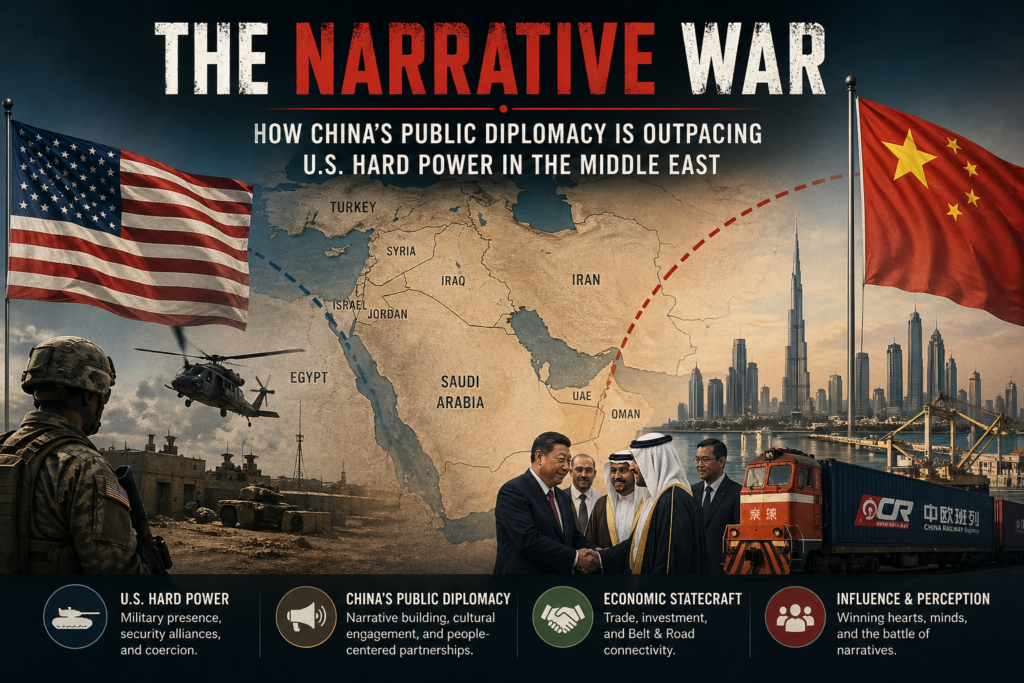
In the modern Middle East geopolitical landscape, the roar of fighter jets is being gradually overshadowed by quieter forms of diplomacy. There was a remarkable event in Beijing in March 2023. The Middle Eastern geopolitics had been shaped by two rivals, Iran and Saudi Arabia, for decades, and they shook hands and agreed to normalize relations and reopen their embassies and missions. No American diplomat was involved, nor did they try to break the deal. A Chinese diplomat quietly achieved what Washington, with all its military might, had failed to achieve through years of sanctions, pressure, and strategic positioning. The United States is still investing heavy resources in the hard power of the Middle East, while china is winning the region’s trust through a far more sophisticated strategy, it relied on soft power, diplomatic skills, and the use of strong narratives which is directly link to public diplomacy that refers to the use of communication, cultural engagement and strategic messaging by states to influence foreign publics and establish legitimacy in global affairs.
Hard power without strategic legitimacy
For decades, the United States maintained a strong hegemony in the region through hard power, military bases, carrier strike groups, and billions in security assistance. It launched its invasion of Iraq in 2003, a war that deployed 170,000 troops and caused 200,000 to over 500,000 civilian deaths, costing the US economy more than $2 trillion. Also, significantly expanded drone warfare in Yemen and the wider region. Alongside this, the US has also maintained an unqualified security alliance with Israel, particularly in the aftermath of the Gaza war, which has significantly alienated large segments of Arab public opinion. According to the Arab Barometer, during this period in the Arab world, the US favorability has dropped drastically and consistently. The United States possesses the strongest military in the history of mankind, yet it has started to lose regional narrative control. Despite heavy military interventions, base construction, and operational developments, the trust still collapsed.
Beijing’s soft power and strategic positioning in the Middle East
China’s approach to the Middle East is based on three structured instruments. Very firstly, it depends heavily on the media reach. Xinhua’s Arabic-language service and CGTN Arabic have built a sizable audience across the region. The narrative that China is a partner in development rather than a security threat is constantly being promoted by these platforms. With a narrative that clearly contrasts Chinese partnership with Western constraints, this is the propaganda that reaches Arabs via mainstream media and in their native tongues. Economic storytelling comes in second. Belt and road investments, whether in Egyptian infrastructure, Iraqi oil, or UAE ports, cannot be simply viewed from a commercial angle. They are strategically designed diplomatic instruments that are presented through a development narrative. Since 2013, China’s BRI has generated approximately $66.2 Billion in cumulative global engagement. When a country’s economy is tied to Chinese capital, trade, and connectivity, structural dependency builds, and this dependency influences perception, trust, and political alignment over time. The third and most crucial instrument is the identity of the broker. China presents itself as a neutral and non-interfering actor, most notably by the Saudi-Iran pact. Through this position, China has claimed moral high ground in politics, which was less occupied due to the US’s perceived role. As a result, China is now seen as an increasingly peacemaker while the United States is increasingly seen as a combatant.
Gaza, Iran, and the collapse of America’s Moral Narrative
The dynamic has accelerated dramatically at this moment. The Gaza war has shattered the US’s credibility in the Arab world. There are over 66,000 Palestinian deaths. And over 1.7 million people have been displaced. Many Arabs have long assumed that American principles are applied unilaterally, and its unwavering diplomatic and military support for Israel, despite the growing number of civilian losses, reaffirmed their suspicions. At the same time, rising tensions between Iran and the United States have kept the region tense and reinforced the image of America as a destabilizing rather than a stabilizing influence. China has firmly filled this space. Its non-interference doctrine, which was once criticized for being a passive strategy, now appears to be morally sound throughout the region. Beijing is not perceived as taking sides, but is seen as a neutral actor and above the conflict.
Limits and Contradictions in China’s Regional Image
The intellectual integrity requires taking this argument’s complexity into consideration. China’s international image is far from perfect. Even if governments have mostly chosen silence instead of censure, the persecution of the majority Muslim region, Uyghur Muslims in Xinjiang, has not been completely unnoticed in the Arab world. Over 1 million Uyghur Muslims and other minorities have been detained, and 12 million Muslims are under extensive surveillance and security restrictions. China’s surveillance-based model, democratic deficit, and deliberate self-interest in Gulf energy and trade routes complicated its “Neutral Partner” narrative. However, some Arab nations remain skeptical of China’s long-term goals. And yet in spite of all of this, China’s public diplomacy is still surpassing US perception management in the entire region. There is a valid counterargument. But it hasn’t changed the situation on the ground.
A Strategic Misreading of Power in U.S. Foreign Policy
A category error at the heart of US foreign policy is the deeper failure here, which is strategic. Washington still views the Middle East as a hard power competition, where arms trade, military bases, and the power of deterrence are used to measure influence. However, hardware is not the main weapon used in the battle for regional alignment in the twenty-first century. It is fought with narratives and with institutions. China has recognized and adapted to this shift, while the United States still operates on the mindset of the Cold War, which focuses on military dominance. As a result, it undervalues the importance of public diplomacy, which is not merely a supplement of hard power, but often more decisive than hard power in today’s information- driven world.
Conclusion
The next Middle East conflict may not be fought with missiles, sanctions, or naval power. In numerous ways, it is already taking place through media narratives, investment diplomacy, and discreet interactions that attract far less publicity than traditional acts of violence. Unlike traditional conflicts, this competition is settled through the gradual development of trust, which is seen as reliable and is considered a dependable partner rather than through surrender or peace agreements. In this evolving landscape, influence is increasingly defined by perception, presence, and consistency instead of hard power.

Asma Mubeen Malik
Asma Mubeen Malik is an undergraduate student of International Relations at Fatima Jinnah Women's University. Her areas of interest are diplomacy, global politics, security, economics, and development issues
Leave a Reply