

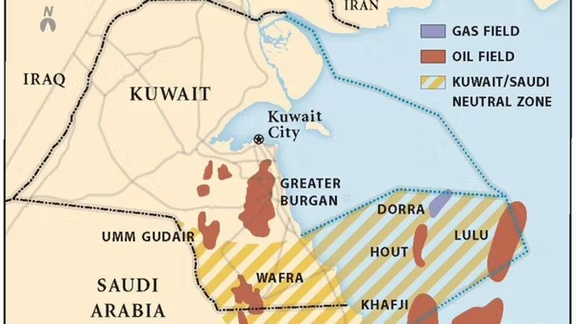
The prolonged dispute over the Dorra gas field, known in Tehran as “Arash”, clearly reflects the complex geopolitics of the Middle East. In my view, this is not merely a disagreement over energy resources; rather, it is a serious test of whether the recent attempts at improving regional relations can survive the pressure of national interests. Through open-source intelligence we can see that this gas field has become a key indicator of whether Saudi Arabia, Kuwait, and Iran can move beyond basic coexistence toward genuine cooperation.
The roots of this dispute go back to the 1960s, when Iran and Kuwait granted overlapping drilling concessions to foreign oil companies. This unresolved legacy has left long-lasting damage to regional trust. Today, the stakes are much higher. According to an open-source evaluation, the sector has more than twenty trillion cubic meters of gas, which is a highly profitable asset which everyone wants to control. This gas might boost Kuwait’s domestic reserves by around thirty percent, and it is a vital lifeline for Iran, whose economy is suffering under severe international sanctions.
Such economic pressure often produces political instability. The Atlantic Council notes that Iran has recently adopted a mix of incentives and pressure in its approach. On one side, Tehran has welcomed Kuwaiti officials for dialogue; on the other, it has warned Kuwait against unilateral drilling unless Iranian claims are acknowledged. This reflects a classic power contest. Iran is also attempting to create some distance between Kuwait and its larger neighboring ally, Saudi Arabia, by promoting bilateral cooperation. Its insistence on talking primarily with Kuwait rather than with both Gulf states appears to be intended at weakening Kuwait and Saudi Arabia’s combined position.
Nevertheless, the desired result has not been achieved by this divide-and-rule strategy. In response, Saudi Arabia and Kuwait demonstrated remarkable solidarity, portraying themselves as a united negotiation front. According to the open-source intelligence, both nations are currently restated that the field is inside their shared neutral zone, which eliminates any possibility of Iranian claims. This is a show of strength and determination rather than merely a disagreement over gas. The message to Tehran is clear: the Gulf Cooperation Council states are unwilling to compromise their maritime rights under pressure.
This dispute is much more important because it comes after the Saudi-Iran normalization pact of 2023. Many open-source intelligence observers believed that China’s mediation could open a new chapter of regional stability. The Dorra dispute, however, suggests otherwise. In my opinion, it represents the first real test of the durability of that agreement. If the parties cannot even agree on shared development of a gas field, it raises serious doubts about their ability to manage broader security challenges. Based on an open-source investigation, turbulence in the Gulf is often caused by national legal frameworks instead of adherence to global law, notably the UN Convention on the Law of the Sea. Iran’s refusal to acknowledge marine limits that contradict its Arash claim is a vivid example of this issue.
The issue is made more difficult by the participation of international players. The role of the EU and other international actors in promoting a solution, according to open-source view. While the EU has relied heavily on diplomacy, it lacks the military influence of the United States and the growing financial leverage of China in the region. Despite the value of international mediation, I believe lasting solutions must come from within the region itself. Regional leaders must decide whether short-term gains from gas revenues are worth the long-term cost to stability.
From a regional security perspective, the Dorra field is a warning sign of future challenges. The existing unstable peace involving Riyadh and Tehran may fall out if unauthorized drilling or naval confrontations escalate. As a substitute, a joint development pact like that of the North Dome/South Pars field arrangement between Qatar and Iran might be used as a template for future cooperation. In this case, Saudi Arabia and Kuwait would have to involve Iran in development talks even though they rejected its ownership claims, and Iran would have to moderate its inflexible stances.
The true answer is to adopt a mutually beneficial strategy instead of a zero-sum thinking. The period for making profits from natural gas reserves is getting slimmer as global energy markets shift and alternative fuels become increasingly common. It’s absurd that resources worth billions of dollars are left unexplored because of a boundary dispute that dates back decades. All three nations struggle to meet domestic energy demands due to gas shortages, according to open-source information. They are essentially vying for a resource that they desperately need but are unable to access due to ongoing hostilities.
In summary, Middle Eastern dynamics will be pushed to the utmost strain by the Dorra or Arash gas field. It compels regional players to decide between the growing demand for economic collaboration and outdated regional conflicts. I consider the current deadlock to be a major missed opportunity. These states must start by using this valuable gas field as a foundation for coordination if they truly want to change the dynamics of the region for the better. Calls for regional harmony will be little more than hollow platitudes in the absence of compromise.

Ayesha Mirza
Ms. Ayesha Mirza is a distinguished scholar who earned her MPhil in International Relations from Kinnaird College for Women University in Lahore, Pakistan. Currently, she serves as a Research Intern at the Maritime Centre of Excellence, where she contributes to studies on maritime security, energy security, regional geopolitics, and naval strategy in the Indo-Pacific. She can be contacted via email: ayeshaabdulmajid09.kinnaird@gmail.com

Syeda Fizzah Shuja
Syeda Fizzah Shuja is a Research Associate at Maritime Centre of Excellence (MCE), Pakistan Navy War College (PNWC), with expertise in maritime security, hybrid warfare, and seabed warfare.

Leave a Reply