

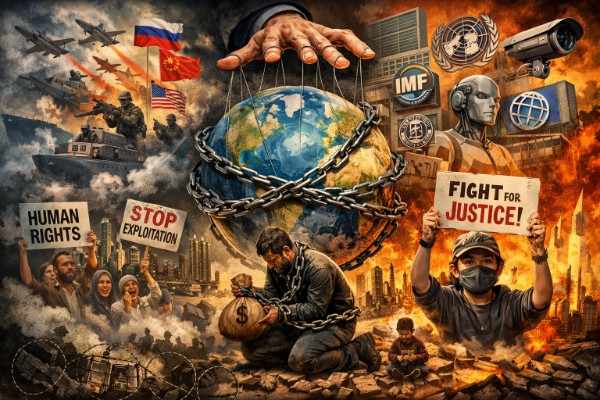
Contemporary discourse of liberalism – manifested through globalization, international financial institutions, global governance, human rights and democracy – is a new face of rule-based colonialism.
In the ancient times, the kingdoms used to pursuit their interests through territorial occupation for resource exploitation. In modern times, the states at the core are indirectly exploiting the periphery states through structural dominance. This new mercantilist approach causes the prevalence of epistemic marginality in the Global South. Since the end of cold war, this notion of liberal world order has dominated the global governance system with the slogans of equality and freedom. But in reality, with the rise of nationalism, populist leaders, protectionism and authoritarianism, the dynamics of liberal world order have gradually changed. Now the world is moving towards anarchism because of the “Westernization of Third World Countries” by U.S., and diffused polarity now dominate the world politics due to advanced industrialized age.
This indirect kind of colonialism has given rise to the power politics among great powers through the exploitation of third world countries which reflects the duplicity of global order and norms. In the present geopolitical order, number of great powers and extra regional powers are contesting each other over economic and power contingencies without given enough leverage to each other. As the prevalence of Russia-Ukraine war, US-China rivalry, conflicts in Middle East and South Asia, this changing world order is henceforth creating a phenomenon of “otherness” as colonial powers did in the case of East India Company. This selective liberalism is not only at the global level but also at the state level, hindering the space of human rights and creating marginalized communities within a state. In this the case study of democratic regression can be analyzed at the state level in both first world and third world countries. The central theme of liberalism is the democracy and human rights but what’s the reality of these slogans of liberal norms? Mere legitimacy codes both at international and state level? This paradox of developmental models restricts the human welfare and catalyzes the phenomena of elitist capture.
This new form of colonialism from the all economic, political and social domains has been drastically changing the geopolitical dynamics of modern world order. Now, the existence of structural rules and norms only serve as veil to cover the real face of domination. The new fragmented world order has created new vulnerabilities including fluid sovereignty, global inequality and structural marginalization. Is this structural dominance more dangerous than colonialism exploitation? In current geopolitical landscape, this exploitation has become obscure yet its existence and persistence cannot be denied. From terrorism to nuclear proliferation to global warming to artificial intelligence (AI), the scope and conduct of exploitation towards humankind is getting more intensified and unpredictable. In the contemporary period of power politics amid diffused polarity in increasingly complex geopolitics environment; we can call it “world disorder”. The already established international organizations like UN, UDHR, IMF, or World Bank, can be proclaimed as tools of superpowers. It can be argued that these international organizations have entangled the third world countries in the chains of international law and international community. But on flip side, these organizations are helpless against illicit and assertive actions of great powers or their allies. Israel’s persistent grave human right violations in Gaza and recent U.S. military operation against Venezuela are key example in this regard.
With gradual decline of liberal order, offensive realism has emerged as most relevant theory describing the transforming power dynamics of modern world. This theory, presented by John J. Mearsheimer, argues that “in an anarchic world, with no centerline authority, power is survival. And every state seeks power maximization to achieve hegemony”. This suggests that if the international environment itself causes an anarchic world, then it’s the beginning of crisis leading to conflicts and eventually wars. Therefore, there is growing need to undertake balancing approach and confidence building measures (CBMs) to avoid emergence of Cold War 2.0. In an increasingly digitalized world, which is redefining the very concepts of globalization, international community, states, and societies, each actor should pursue their national interest for comprehensive national security not for the power maximization. And the double-standards exhibited by major powers in the domain of international norms obligation and human rights safeguards, which are pushing the world towards another catastrophic cycle of violence, will yield nothing but collective damage to human-kind in longer run.
To preserve a meaningful dichotomy between liberalism and colonialism, states must move beyond power-centric approaches and place human capital development at the core of global governance. Liberal ideals lose their moral legitimacy when they are employed as instruments of domination rather than as frameworks for equity and inclusion. This challenge is further intensified by the emergence of Generation Z as a transformative force in global politics—one that is increasingly capable of identifying and questioning the concealed power asymmetries embedded within international institutions and policy making. If states, at both global and national levels, continue to privilege strategic dominance and elite interests over human development and social justice, they risk reproducing colonial patterns under a liberal guise. Just as earlier generations confronted overt colonialism, Gen Z is now exposing and resisting the hypocrisy of selective liberalism, particularly where it perpetuates inequality and exclusion. In this evolving world order, prioritizing human welfare, equity, and genuine development is not merely normative but essential to preventing the emergence of a new, more insidious form of colonialism.
Ahmad Ibrahim
Author is Research Associate at Maritime Centre of Excellence (MCE), Pakistan Navy War College (PNWC) Lahore.
Aqsa Hafeez
Author is Intern at Maritime Centre of Excellence (MCE), Pakistan Navy War College (PNWC) Lahore, and is currently pursuing M.Phil. Political Science from Government College University, Lahore.

Leave a Reply