
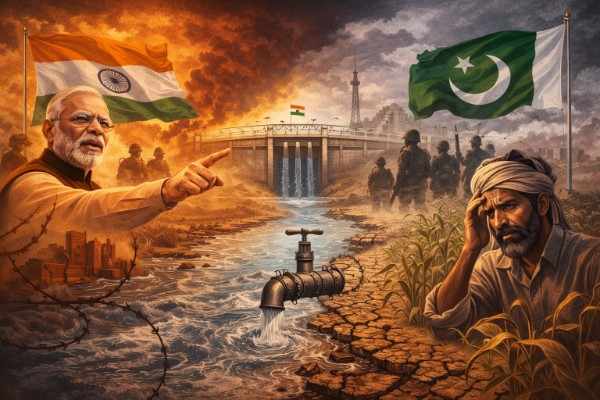
When New Delhi placed the Indus Waters Treaty (IWT) in abeyance in April 2025, the impact was not limited only to political and diplomatic corridors. It immediately shaped how people in both countries talk, feel and think about water. In Pakistan, the move was seen as a direct threat to national survival as it threatened the country`s lifeline, “agriculture,” and put in danger the survival of millions by creating uncertainty and fear. On the other hand, in India, it was hailed as a bold political step that showed strength and a strategy to avenge Pakistan in response to Pahalgam Attacks. Understanding these narratives is essential because they influence public opinion, policy debates and the future of cooperation over one of the world’s most important river systems.
After India suspended the IWT, the dominant narrative in Pakistan quickly became one of threat to survival. Across rural Pakistan, the Indus River is not an abstraction, it is life. The country`s 90 percent of agriculture depends on the waters of the Indus basin; a vast majority of cultivated land is irrigated through its tributaries. In villages from Punjab to Sindh, media narratives such as “India can starve us” have resonated deeply among farmers who are now uncertain about the water availability. This risk is not merely symbolic; for many rural families, this means threat of water scarcity, erratic canal flows, delayed irrigation, ruined crops and all of this can lead to more poverty and hunger. This has led to the emergence of a psychological narrative in Pakistan which links the availability of water with survival and which links suspension of IWT with threat to the survival of millions of Pakistanis.
The public and political discourse cast the blame on India. The unilateral suspension of the Treaty was referred to as “weaponisation of water.” Officials described the move as a violation of the Treaty obligations, a threat to national security, and a potential humanitarian catastrophe. Government and military statements describe India’s move as “illegal,” “hydro-terrorism,” even a potential “act of war.” Mostly, such securitization has two immediate effects: first, it deepens public anxiety; second, it shrinks the space for calm policy discourse. When water becomes a matter of national survival, gradual adaptation, storage infrastructure, demand-management, water-use efficiency, becomes politically difficult. Instead, there is public pressure for urgent action, retribution, and defensive posturing. The psychological atmosphere becomes charged with fear and anger. The same happened in Pakistan.
Moreover, this event helped politicians and policy makers to externalise the problem of water governance which they have already been doing for decades. Now, the problem of water management is seen as external; the victim is Pakistan; and the enemy is India. Such framing narrows complex structural challenges such as storage deficits, inefficient water management, inter-provincial water politics, climate change, into a narrative in which it is portrayed that only India is responsible for Pakistan`s water crisis. This victimhood frame is becoming powerful, emotionally resonant and politically mobilising. By externalizing blame, this narrative has obscured internal inefficiencies of water governance of Pakistan.
Furthermore, this suspension has resurfaced long-standing internal grievances, especially regarding the distribution of water between provinces. For many in Sindh and southern Pakistan, water insecurity is not only about India. They think in terms of intra-provincial allocation of water resources. When national water is already scarce, external shocks like suspension of IWT, tend to highlight existing inequities. Sindh’s farmers fear that upstream Punjab will receive preferential allocation. In this sense, the suspension of IWT threatens not only Pakistan’s relationship with India, but also the social cohesion within Pakistan itself. In such a context, water turns into a source of intra-provincial mistrust and potential domestic conflict.
Overlaying all, there is also the growing background of climate instability, i.e., melting glaciers, erratic rainfall and floods followed by droughts. Reports warn that Pakistan could soon face water scarcity which could be so severe that its population and agricultural patterns may need radical rethinking. The narratives of Indian threat and domestic faultlines merge with climate anxiety: water may not just be withheld by an upstream neighbour, but may simply become unreliable with inconsistent seasons, variable flows, and uncertain rains. This mix intensifies public anxiety about the future: not just this season’s crop, but generational stability.
When water is framed as a weapon, victimhood grips, scarcity looms, and climate threatens, the public’s psychological stance can shift from cautious hope to fatalism.
On the other side, in India, the suspension of the IWT triggered a different narrative in India which is rooted in sovereignty, self-interest, and strategic calculus. At the heart of India’s framing is that the water that flows through Indian territory belongs first to India. As the government’s Ministry of External Affairs put it, although the IWT was concluded “in the spirit of goodwill and friendship,” decades of, what New Delhi refers to, “cross-border terrorism” have invalidated that goodwill. Until Pakistan “credibly and irrevocably abjures” support for terrorism, the treaty will remain suspended. In an interview, Home Minister Amit Shah was even more unequivocal: “No, it will never be restored … We will take the water that was flowing to Pakistan to Rajasthan by constructing a canal. Pakistan will be starved of water that it has been getting unjustifiably.” Prime Minister Narendra Modi echoed the sentiment shortly after the decision: “Water and blood cannot flow together,” a statement which he had issued originally in 2016 after the Uri attack. Their stance is very clear: water is not charity, it is a sovereign right.
Also, water has become a tool of policy pressure in India. Analysts in Delhi no longer treat the IWT as a benign treaty, but a conditional agreement which is tied to security behaviour. As one former official put it, thanks to the abeyance, India is “no longer obligated to share water data with Pakistan,” or expose its water-management plans. For many Indians, this narrative transforms water from a shared resource into a bargaining chip and even retaliation. The decision to withhold, redirect river water becomes less about hydrology or ecology, and more about signalling strength and denying what the government now considers “unjustified” privileges to a hostile neighbour.
Another dominant narrative blends pragmatism with progress. Under this, the 1960 treaty is portrayed as outdated and one-sided, and a relic of a bygone era. Officials argue that increased population, altered hydrological realities, climate change and energy needs demand a “21st-century water policy.” The 1960 treaty was signed when population, technology and energy needs were different and these days, it is no longer fit for purpose. Climate change, hydropower demand, and domestic water-use pressure are invoked to justify a re-imagined Indian water policy. According to official sources, India may “amend the key water-sharing agreement in line with its interests within international law.” This narrative appeals to large sections of Indian society.
These narratives can lead to several consequences. First, claiming water as a sovereign right and framing its denial to the other side as “justified,” gives a sense of control and power. Water becomes a symbol of sovereignty, not something which can be shared. This would only worsen the relations of both countries. Second, when water is seen as a tool of strategy, human suffering downstream is ignored. The struggles of Pakistani farmers, delta communities, or climate-affected people would get little attention. Even in India, this would not help more than putting them into an illusion of progress. Denying water would become “new normal,” not a humanitarian problem. Finally, water could turn into a symbol of jingoism. Rivers would become “ours,” and their water is “our right,” and “giving it up would be seen as weakness.” It would lead to demands of immediate military action to get what is considered “ours”. Over time, this would make cooperation, ecological care, and water management across the borders much harder.
For India, Pakistan and indeed the region, the consequences of this re-framed water narrative will be long-lasting. The human cost of hunger, displacement, ecological damage, is becoming subordinate to power politics. Long-term regional stability, environmental balance, and shared climate vulnerability are being overshadowed by immediate political gain. If water is to remain a source of life- not a cause of war, a new narrative is needed. One rooted in shared human and environmental security, not in retribution. A narrative that recognises water as essential for all lives, irrespective of nationality as water does not obey politics; rivers flow through mountains, seasons, glaciers, and plains; they do not recognise borders drawn by treaties. Water should not be a weapon; it should be a common heritage.


Leave a Reply