
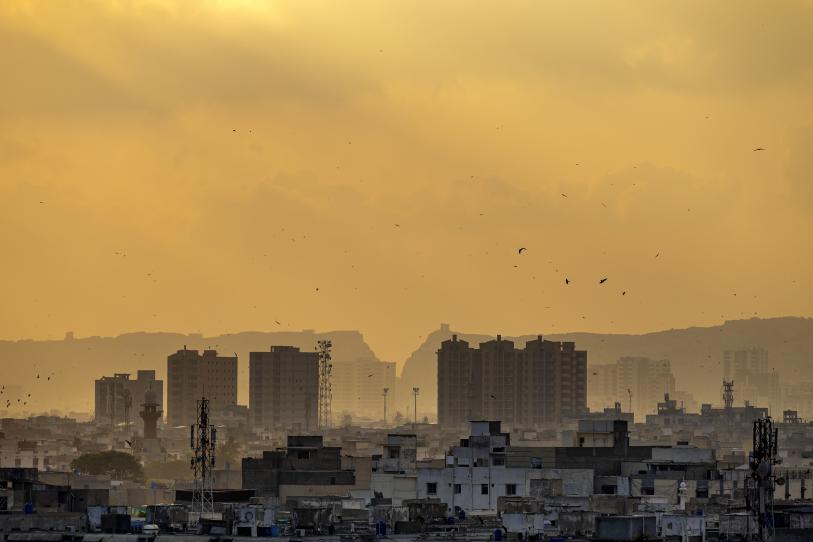
Daily commuting in Rawalpindi has become increasingly difficult. The ongoing construction at Katcheri Chowk, dug over for months, has funneled traffic over streets not meant for such volume with dust covering the sky. Roads, flyovers, and residential estates sprout up in the twin cities as development. But urbanization in Pakistan is a trade-off no one discusses: Pakistan’s cities are expanding rapidly, but much of this growth is occurring in ways that make them more vulnerable to climate shocks.
The unplanned urbanization in Pakistan is the current trend in the development process, which has caused environmental degradation across the country. Residential developments, expressways, and markets are presented as signs of progress, yet much of this growth occurs with minimal planning and weak environmental oversight. As a result, green landscapes, wetlands, rivers, and natural buffers which appeared to shield cities against floods and heat are destroyed.
The developed area in Lahore has increased at a rapid pace, consuming agricultural land and open space while vegetation cover declines. Rising surface temperatures, falling water tables, and increased flash flooding reflect the environmental consequences of impervious urban surfaces that prevent natural water absorption.
This trend does not just end in Lahore. The forested areas like the Shakarparian hills, which in the past formed a very important ecological buffer, have been subjected to pressure from development projects that prioritize commercial expansion over environmental preservation. Environmental advocates warn that weakening green infrastructure increases heat stress, reduces soil stability, and limits the city’s ability to absorb rainfall. Similar concerns surround the Ravi Riverfront Urban Development Project near Lahore, which aims to transform more than 100,000 acres along the Ravi River into a planned urban zone. Critics argue that large-scale construction along the river threatens natural floodplains and drainage systems, potentially turning seasonal waterways into flood-prone urban surfaces.
Karachi is one of the examples of such expansion. Once shaped by natural streams and coastal systems, the city has seen rapid urban growth that has blocked or eliminated hundreds of kilometers of drainage channels. In case of monsoon, these blocked waterways form pathways to floods, which destroys infrastructures and displaces people. Subsequent to the disastrous 2022 floods that were fueled by climate shocks and improper planning displaced millions of people in Pakistan, showing how urban areas inadequately planned have become vulnerable.
Such effects are most severely experienced by the vulnerable communities, which are mostly those that live in the low-lying floodplains or informal settlement areas that have no drainage and other basic amenities. The children, elderly and disabled residents are the most vulnerable in the case of disasters. Devoid of inclusive planning and social protection, the so-called development that promises economic opportunity can instead deepen inequality and climate exposure.
The question on whether or not Pakistan should build is not the issue, but how. The development model that puts more emphasis on concrete over climate protection is bound to disrupt the stability that it is purported to provide. Floods destroy infrastructure, strangle the health system through air pollution, and damage ecosystems, which are costly in the long term relative to being inexpensive in the short term.
Pakistan should not deny any development. It must reframe it. Stricter implementation of environmental policies should also come with any large undertaking. Green spaces and natural waterways as a climate buffer should also be acquired during city planning. Ecological growth can be achieved through investments in renewable sources, efficient transportation systems in the society, and decent housing to avoid devastating the ecosystems on which the cities exist.
The cities will not stop growing and they are bound to grow. The task is to make them stronger, safer, and better adjusted to climatic conditions rather than hotter, more polluted, and adopted to climate changes due to uncontrollable growth. The question of whether Pakistan is able to afford sustainable development or not is no longer the question. The question is whether it can afford to overlook it.



Leave a Reply