
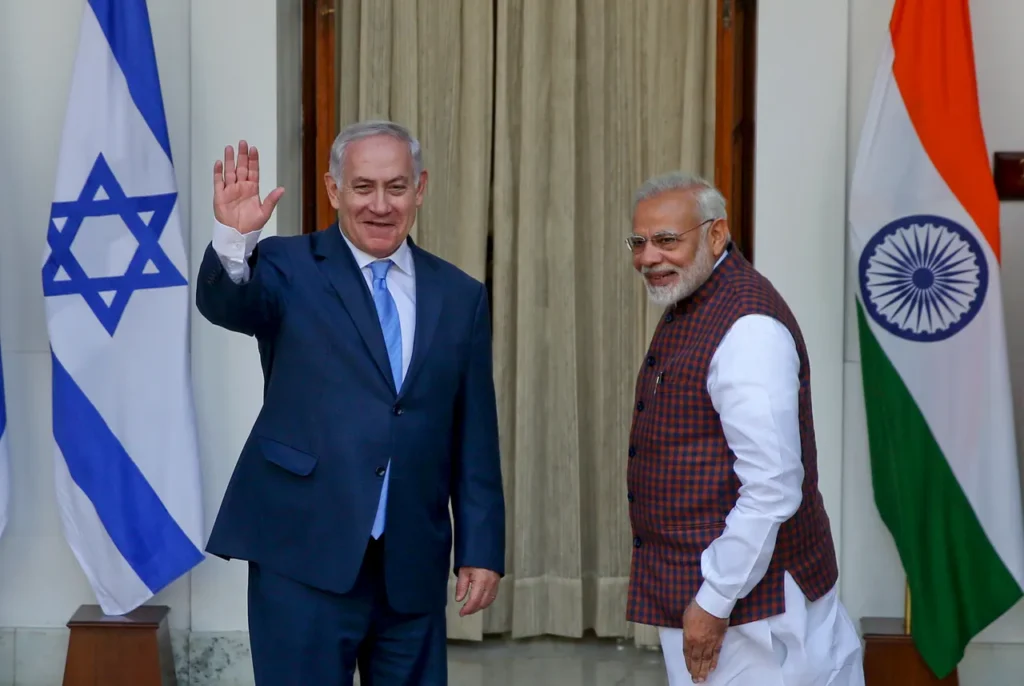
Israeli Prime Minister Benjamin Netanyahu, in early 2026, unveiled a vision of a new “hexagon” alliance comprising Israel, India, Greece, Cyprus, and other unnamed Arab, African, and Asian states. He cast it as a united front against what he called “radical” Sunni and Shiite axes in West Asia. Analysts call Netanyahu’s alliance pitch a ‘fantasy world’ as Israel faces growing international isolation. The announcement for this alliance came during Indian PM Modi’s two-day state visit to Israel from 25-26 February 2026. Although no state has confirmed joining the “hexagon” alliance yet, the reported inclusion of India has raised eyebrows.
The Israeli PM “needs global as well as regional consent” at a time when he faces various charges, ranging from genocide to crimes against humanity. An added factor is the fallout from the joint US-Israeli attacks on Iran, which killed Iranian Supreme Leader Ali Khamenei and escalated tensions into open conflict in the Middle East. In contrast, India has now emerged as Israel’s strongest non-Western ally. There is strategic cooperation and ideological convergence between the two, which actually strengthened during the course of this genocidal war. India has not criticised the genocide that Israel has been committing in Gaza, nor has it condemned the illegal war against Iran.
Since Modi’s premiership in 2014, India has managed to create a special relationship with Israel. He has also made history in 2017 by adopting a different strategy and becoming the first Indian leader to travel to Israel, solidifying ties with Tel Aviv in multiple areas, including defence, intelligence, and technology, in contrast to earlier Indian leaders who backed the Palestinian cause. Analysts have seen this as the convergence of Hindutva and Zionist radical ideologies of both states against the Muslims. Both have expansionist and exclusionist goals and run on narratives of historical grievance and civilisational greatness.
The ideological similarities, supplemented by more institutional cooperation in sectors such as defence, technology, and cybersecurity, might boost India-Israel engagement, particularly in light of Netanyahu’s newly proposed ‘hexagon’ alliance. India accounts for 34% of Israel’s military exports, making it Israel’s largest arms buyer. Even during the genocidal war in Gaza waged by the Netanyahu government, India supplied Israel with various weaponry components. For example, Adani-Elbit Systems manufactures the Hermes-900 drone, which has been used in Gaza, and the Tata Group works on Project Nimbus, which provides surveillance and targeting of Palestinians in Gaza. According to Indian analysts, India’s stance during the genocidal Gaza war as well as the Iran war is seen as an “unseemly embrace of Israel” and the US, and “post-haste dumping of Iran.”
Netanyahu stated the hexagon alliance’s purpose was to unite countries that “see eye to eye” against what he described as a “hard-hit radical Shiite axis” and an emerging “radical Sunni axis” of adversaries, implying a broader coalition of states with grievances against certain Muslim countries. Greece and Cyprus have a longstanding animosity with Türkiye, Israel has issues with the whole Muslim West Asia, while India has hostility with Pakistan. At the same time, Cyprus, Greece, and Israel already have a defence alliance. Inclusion of India in this new alliance will further expand such blocs, redefine regional rivalries, and draw new actors into West Asian as well as South Asian security dynamics.
Pakistan and Saudi Arabia, in September 2025, signed a Strategic Mutual Defence Agreement (SMDA) to boost regional peace, enhance military coordination, and protect shared interests against external aggression. Other Muslim states have also shared their interest in joining this agreement. Some analysts argue that a wider ‘hexagon’ configuration, particularly if India were included, could take shape as a strategic counter to both the Sunni SMDA framework and Iran’s Shiite bloc. By moving closer to this proposed bloc, India risks entering a dangerous geopolitical tango that could deepen rivalries rather than stabilise the region.
Even without formal membership, India’s growing alignment with Israel will raise concerns across the Gulf and Muslim-majority states, undermining decades of careful partnerships across the Gulf, potentially eroding any diplomatic gains that New Delhi hopes to achieve. India depends on billions in oil imports and investment from the Gulf, and some 10 million Indians live and work in West Asia. New Delhi also seems to be abandoning its traditional non-aligned posture, which allowed the country to project itself as a bridge between different blocs. Now, Modi’s government has little brand left of that strategy.
In conclusion, the proposed Hexagon appears less like a stabilising framework and more like a polarising geopolitical project crafted by Benjamin Netanyahu. The pursuit of closer strategic alignment with Israel may deliver symbolic gains for India, but it also ties it to an increasingly divisive regional agenda. In effect, India’s embrace of the Hexagon would turn its diplomacy into a dangerous tango, one that risks destabilising security dynamics across both South Asia and West Asia.

Abdul Wassay
Abdul Wassay is a Research Assistant at the Centre for Aerospace and Security Studies (CASS) Lahore. He can be reached atinfo@casslhr.com



Leave a Reply