
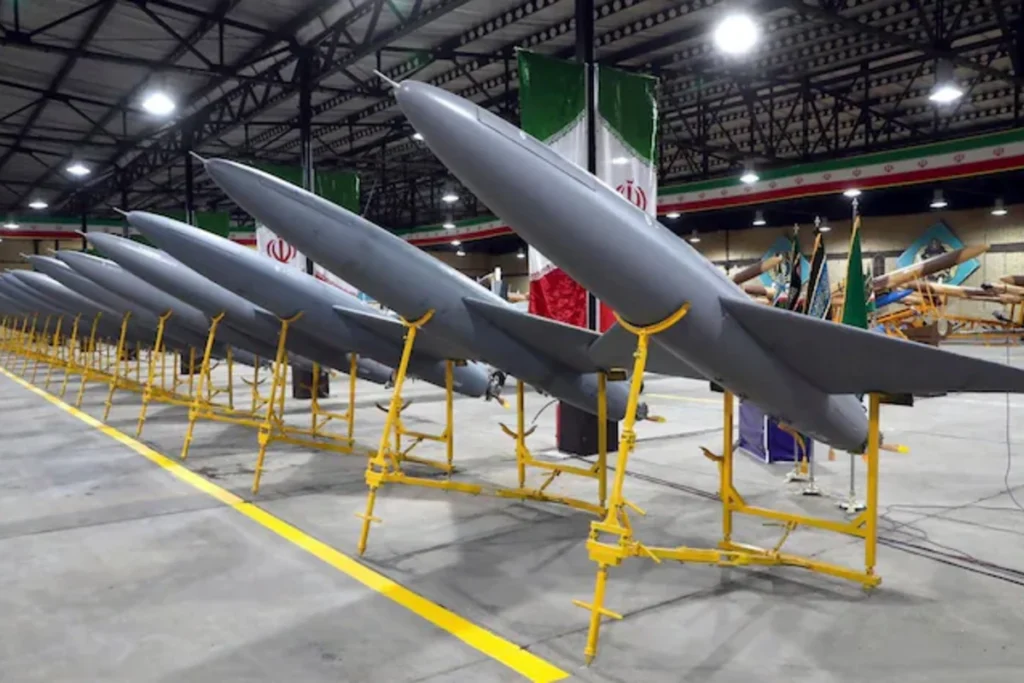
Beneath the daily headlines of strikes and counterstrikes in the Middle East, a seismic transformation of warfare is unfolding. In the first week of Tehran’s recent retaliation campaign, drones accounted for roughly 71% of recorded strikes on Gulf States, according to an analysis by the Center for Strategic Insights. The United Arab Emirates, for instance, reportedly faced 1,422 drones and 246 missiles in just eight days. While the use of drones in Ukraine had hinted at this trend, Iran has made the future of war unmistakably visible.
Michael Horowitz of the Council on Foreign Relations calls it the era of “precise mass in war.” For decades, precision meant a handful of Tomahawk missiles, stealth bombers, or fighter jets. Today, it can mean a one-way drone, assembled from commercial parts, launched in swarms, and capable of inflicting strategic damage. Tasks that once required the industrial capacity of a major power are now achievable by smaller states, turning the economics of war upside down.
Take the “Shaheed” drone as an example. Costing roughly $35,000 per unit, it contrasts sharply with the $4 million price tag of a Patriot missile interceptor. In this new arithmetic, attackers spend thousands, defenders spend millions. However, the revolution extends far beyond drones it is about a new military architecture. Cheap autonomous systems, AI-assisted targeting, commercial satellite imagery, resilient communications, integrated sensors, and cyber tools now operate together. The goal is not simply to strike, but to compress the decision cycle: to find, decide, and hit faster than the enemy can respond. The U.S. Air Force’s experiments last year demonstrated the power of such integration: machines generated recommendations in under 10 seconds and produced thirty times more options than human-only teams. In tomorrow’s conflicts, the side that wins may not be the one with the single best platform, but the one able to field many capable systems cheaply, rapidly, and intelligently networked. Ukraine has emerged as the proving ground for this new age of warfare.
Ukraine’s innovative adaptation exemplifies the trend. Its interceptor drones cost about $2,000, fly up to 280 km/h, and have neutralized thousands of Shaheed-class drones since mid-2025. Production has scaled to over 10,000 units per month, and training operators takes just three to four days for those already familiar with drones. On the software side, Ukraine has shared battlefield data with allies to train drone AI, enhancing pattern recognition and target detection. Defense Minister Mykhailo Federov notes that Ukraine now possesses battlefield data unparalleled anywhere in the world, including millions of annotated images from tens of thousands of combat flights. The implications are profound. Russia produces roughly 404 “heat-type” drones daily, aiming to reach 1,000 per day. By contrast, Lockheed Martin produced only about 600 Patriot interceptors in 2025, hoping to scale to 2,000 by 2027. The contrast 1,000 drones a day versus 2,000 interceptors a year illustrates the scale advantage of cheap, mass-produced systems. In the future, success in war will depend less on technological sophistication alone and more on the integration of industrial-scale software, rapid production, and lessons learned from the battlefield.
With these developments, battlefields extend beyond frontlines. Conflict is everywhere, and humans may no longer enjoy respite from combat zones. The democratization of deadly weapons means that terrorist groups, criminal gangs, and drug cartels can wage war once reserved for nation-states. While the Gulf War of 1991 showcased precision technology, today’s conflicts demonstrate something more consequential: precision is now mass-producible. The countries that prevail will combine small numbers of exquisite, expensive systems with vast numbers of cheap, networked drones. Over time, human judgment will increasingly yield to algorithmic decision-making. This future of war is arriving faster than anticipated.
Amid this revolution in military affairs, Iran is also recalibrating its nuclear strategy. Historically, until 2003, Iran pursued nuclear weapons ambitions. Then Supreme Leader Ali Khamenei sought a “threshold state,” permitting uranium enrichment without crossing the Rubicon. He reinforced this restraint with a religious fatwa forbidding nuclear weapons development. Today, Iran’s leadership is different. Mujtaba Khamenei, a young, radicalized leader influenced by the IRGC, is determined to secure the “ultimate card.” Proxies, militias, and conventional forces are no longer seen as sufficient for deterrence. Iran now has around 440 kilograms of uranium enriched to 60%, stored at fortified sites like Fordow, putting weapons-grade enrichment within reach. Paradoxically, actions aimed at preventing nuclear development covert strikes and sanctions may instead accelerate Iran’s push toward a bomb.
Israel’s recent miscalculations illustrate the danger of underestimating Iran’s resilience. While operational intelligence pinpointed key targets, strategists misjudged the regime’s cohesion. Attempts to decapitate leadership were assumed to trigger collapse, but the regime’s structure proved robust. As Israel and the U.S. navigate this new reality, options for a political off-ramp may be narrowing. Regional mediators, such as Oman or Qatar, could help negotiate an exit, but if decisive military action targets Iran’s infrastructure, escalation could be uncontrollable. The convergence of drone warfare, AI, mass production, and nuclear proliferation is reshaping global security. What we are witnessing is not just the evolution of tactics it is the transformation of the very nature of conflict. The Middle East may offer the first full-scale demonstration, but the lessons will reverberate worldwide. Countries that fail to adapt risk falling behind, not just technologically, but strategically.

Muhammad Shahzad Akram
He is a Research Officer at the Centre for International Strategic Studies, AJK. He holds an MPhil in International Relations from Quaid-i-Azam University, Islamabad. He is an alumnus of the Near East South Asia (NESA) Centre for Strategic Studies, National Defence University (NDU), Washington, DC. His expertise includes cyber warfare and strategy, arms control, and disarmament.


Leave a Reply