
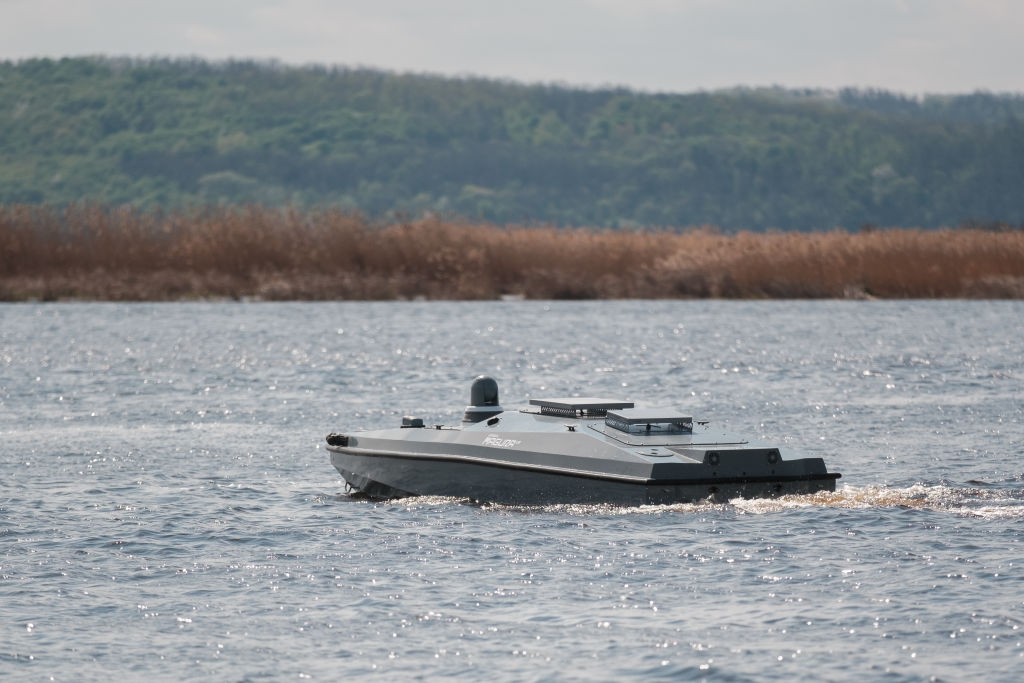
Autonomous systems are playing an increasingly important role in the changing character of modern warfare. They have evolved from simple reconnaissance tools into force multipliers that accelerate decision-making, extend operational reach, and change the cost equation of military action. As operations shift from a platform-focused approach to networked systems, autonomous systems, including ground robots, loitering munitions, and especially low-cost UAVs, deliver persistent, precise effects.
Many of these indigenously developed, overtly autonomous systems were on display during China’s Victory Day parade in September 2025. Loyal wingmen and reconnaissance drones handled flight control, mission planning, sensor analysis, and self-defence. This demonstrated the extent of China’s modernisation as well as the profound integration of autonomy and AI throughout its arsenal. In the air, the FH-97 stealth drone appeared as the J-20 fighter’s “loyal wingman”. China’s extra-large unmanned underwater vehicle (XLUUV), the AJX002, and its counterparts demonstrated their capabilities in extended patrols, mine clearance, and maritime surveillance. Besides, crewless vehicles, autonomous turrets, and robotic “dogs” were also revealed, indicating China’s ambition to integrate autonomy in the air, land, and sea. These developments indicate that China is rapidly overtaking and has already surpassed the US in critical autonomous system domains.
Similarly, at UMEX and SimTEX 2026 in Abu Dhabi, autonomous systems took centre stage. This suggests a larger trend toward modular, networked, and integrated military capabilities, with many countries investing heavily in UAVs. Turkey has made notable strides with drones like Akinci, the TB2 for precision strikes and the Kizilelma for stealth and agility, reflecting the growing focus on networked unmanned systems.
Drones have become force multipliers, providing militaries with cheap, real-time intelligence, constant surveillance, and precise strike ability while minimising risk and resource use. This trend is not merely hypothetical; recent conflicts have amply illustrated the use of drones. Russia’s use of Shahed-136 and its Russian-made derivatives, including the Geran-2 in the Ukraine war, have demonstrated the ability of low-cost, one-way attack drones to saturate the air defence systems and attack critical infrastructure. These drones are cheap, at just a fraction of the cost of traditional cruise missiles, yet they have made sustained long-range precision attacks a possibility, reforming the dynamics of the battlefield. At the tactical level, first-person-view (FPV) drones, initially designed as commercial racing tools, have evolved into precision-guided munitions, showing that combining technological sophistication with flexible deployment can deliver outsized effects.
The same dynamics are evident in the ongoing US-Israel war on Iran. For persistent surveillance and strike capability over extensive distances, Iran has developed long-range and low-cost unmanned systems like Shahed-131, Shahed-136, and more advanced Shahed-129. On the other side, the US has implemented architecture-based counter-UAS, such as the Coyote Block 2 interceptor, the AI-controlled radar networks, and advanced systems like Patriot or THAAD, intercepting Iran’s $20,000 drones with missiles costing up to $15 million each. Consequently, the US debuted the first combat use of its Low-Cost Uncrewed Combat Attack System (LUCAS) drones, which are made to be cost-efficient, with real-time connectivity, thus allowing operators to modify missions during flight and respond to evolving tactical situations.
These cases highlight three trends: autonomous systems provide persistent, low-cost capability; inexpensive drones create cost imbalances; and the constant interplay between systems and counter-systems makes innovation as crucial as the equipment itself.
For Pakistan, autonomous systems hold an opportunity and a strategic imperative. Pakistan has made significant progress in developing its capabilities, including UAVs, multi-domain operations, EW, IT-enabled systems, and other emerging technologies. National Aerospace Science and Technology Park (NASTP), spearheaded by Air Chief Marshal Zaheer Ahmed Baber Sidhu, has been a major part of this journey, which helped build the homegrown multi-domain kill chain of the Pakistan Air Force. These efforts proved decisive in Pakistan’s victory during the May 2025 war.
Following these achievements, Pakistan must accelerate the development and deployment of autonomous systems to counter evolving conventional and asymmetric threats, integrating combat drones and loitering munitions into intelligence, surveillance, and rapid-response operations for precise, cost-effective effect. Private-sector involvement remains critical as it has the potential to drive innovation. Additionally, coordinated efforts by the military, academia, and industry based on NASTP’s triple helix model can help achieve locally tailored solutions, reduce reliance on external suppliers, and optimise systems to meet operational needs.
Modern defence increasingly centres on counter-UAS systems such as EW suites and interceptor drones. At the same time, low-cost autonomous systems have sparked a race in offensive and defensive innovation, complicating deterrence and emphasising the need for legal, ethical, and regulatory oversight.
Autonomous systems are transforming warfare, prioritising speed, flexibility, and efficient resource use over costly platforms. Pakistan can build on its current efforts and accelerate the integration of these systems with clear strategies and local innovation. This will strengthen defence, enable faster responses to emerging threats, reduce reliance on external suppliers, and maximise the use of autonomy across all levels in an era defined by intelligent, integrated, and adaptable systems.

Ezba Walayat Khan
Ezba Walayat Khan is a Research Assistant at the Centre for Aerospace and Security Studies (CASS), Lahore. She can be reached atinfo@casslhr.com


Leave a Reply