
The Middle East is undergoing a profound transformation in its security architecture, shifting from localized crises to a complex, interconnected environment of multi-theater instability. From maritime chokepoints such as the Strait of Hormuz and the Red Sea to proxy-driven conflicts spanning Iran, Iraq, Lebanon, and Yemen, the region is increasingly defined by overlapping security dynamics that extend beyond traditional battlefields.
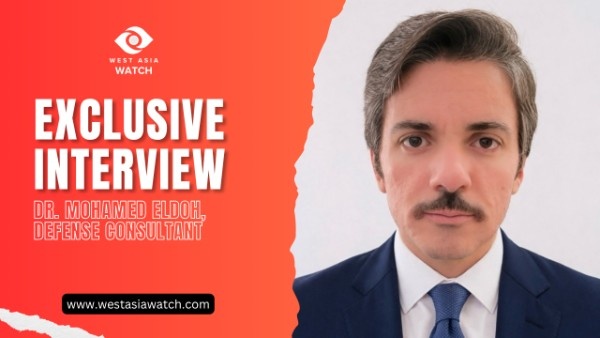
In this exclusive interview, Dr. Mohamed H. ELDoh, a business development and consulting professional in the defense and security sector. Mohamed holds a doctorate degree from Grenoble École de Management – France, an MBA from the EU Business School-Spain, and an Advanced Certificate in Counterterrorism Studies from the University of St. Andrews, UK. He regularly authors articles addressing defense cooperation, counterterrorism, geopolitics, and emerging security threats in the Middle East and Africa”
1) Dr. ELDoh, given your expertise in MENA defense, how do you assess the current security environment in the region, and what key trends should policymakers be most aware of in the next 5–10 years?”
The Middle East is no longer operating within a model of contained crises as it was the case for the past 3 decades, it has already entered a phase of systemic, multi-theater instability across multiple fronts that are somehow interlinked. What we are witnessing today is not a single conflict, but an interconnected escalation environment where developments in one geographical location, whether in Iran, Lebanon, Iraq, Gaza, Yemen or maritime corridors (including the Hormuz Strait and Bab el Mandeb) rapidly trigger responses across others.
Over the next 5–10 years, five structural trends will define the regional security landscape. First, long-range precision strike capabilities will become the primary tool for different regional and international actors. For some it will be a tool of coercion, or a tool of strategic deterrence, or a threat imposition tool (as demonstrated now by Iran towards Arab states). Second, regionally distributed proxy warfare will remain institutionalized, not episodic (unless successfully dismantled via legitimate strategic defense and security cooperation between Arab and Western forces). Third, maritime chokepoints such as the Strait of Hormuz and the Red Sea will increasingly be weaponized (again, unless a successful and effective multilateral, and mini-lateral defense cooperation comprising regional Arab and international Western forces takes place). Fourth, air defense will evolve into integrated, AI-enabled battle networks rather than standalone systems. In this respect, C5ISR frameworks capabilities comprising command, control, communications, computers, cyber, intelligence, surveillance, and reconnaissance, will become more important than ever given the increasing need for readiness towards continuous and yet emerging threat landscape which requires continuous situational awareness, operational readiness, and speed across all confrontation domains including air, sea, land, space, and cyber. Finally, critical infrastructure including energy, logistics, critical raw materials, and digital and communications networks, will become central targets in strategic competition.
2) With your experience in geopolitical analysis, how do you approach forecasting shifts in regional alliances and conflicts, and which emerging threats do you consider most critical?
My approach to forecasting is mainly grounded in three factors: capability, intent, and escalation behaviour. In the Middle East, alliances are rarely defined by formal agreements alone, they are revealed under pressure or fuelled by national and/or religious rhetoric. In this respect, who shares intelligence, who absorbs risk, and who seeks strategic ambiguity during crises tells us far more than official statements.
The most critical emerging threats are networked proxy escalation across different geographical locations, maritime coercion, drone-saturation attacks, and rapid miscalculation under compressed timelines. What makes the current environment particularly dangerous is not just the scale of individual threats, but the way they interact which then creates cascading escalation scenarios that are difficult to control once triggered. Thus, this places a burden on military strategists and intelligence operatives to always utilize scenario planning and prepare for multiple scenarios which can all be serious.
3) Based on your research, how should MENA countries adapt their defense strategies to balance regional stability with evolving global security challenges?
MENA states must shift from platform-centric defense models to system-centric architectures. The acquisition of advanced equipment alone is no longer sufficient. The real strategic security advantage lies in integrating air and missile defense, ISR, cyber resilience, maritime awareness, and command-and-control into a unified operational ecosystem which should also take advantage of the emerging AI capabilities that are becoming increasingly relevant to all defense domains’ applications.
At the same time, effective strategy requires balance. Stability will not come from force alone, but from a credible level deterrence combined with disciplined escalation management along with a resilient national infrastructure that can ensure civilian and economic security. The most successful states will be those that can defend their sovereignty, impose deterrence while avoiding entrapment in uncontrolled regional escalation cycles.
4) How is the integration of new military technologies, including drones and precision systems, reshaping defense strategies in the MENA region?
Drones and precision systems have fundamentally altered the regional balance by making strategic impact more accessible, scalable, cheaper and deniable. Today, both states and non-state actors can achieve effects that previously required conventional military superiority.
The real transformation, however, is not just technological, it is operational. Defense is no longer about protecting territory alone; it is about controlling tempo, detection, and decision-making speed. The next phase will be defined by AI-enabled ISR, coordinated drone swarms, and tighter integration between electronic warfare and precision strike capabilities. This will compress response times and fundamentally reshape deterrence as well as defensive and offensive dynamics.
5) In your analysis, what role do non-state actors play in shaping regional security, and how can governments effectively mitigate associated risks?
Non-state actors have evolved into strategic instruments of influence and escalation. Groups such as Hezbollah or the Houthis are no longer limited to local disruption. They emerged from being just a domestic insurgent group to regional actors that are capable of shaping regional security calculations by draining states’ resources by stretching a given state’s defenses, naval responses, and threatening global trade routes.
Mitigating this challenge requires more than tactical responses. It demands a multi-layered strategy combining targeted military pressure, intelligence penetration, financial disruption, and infrastructure resilience. Most importantly, it requires multistate cooperation more than ever. The key is not only to degrade capabilities, but to disrupt the ecosystem that is stretched across borders which then enables these actors to sustain and regenerate their operational capacity.
6) How do external powers influence security dynamics in the Middle East, and what strategies can regional actors use to safeguard sovereignty while maintaining strategic partnerships?
External and Western powers remain central to the regional balance due to their role in providing advanced capabilities, intelligence, and strategic backing. However, their involvement also introduces the risk of regional conflicts becoming extensions of broader geopolitical competition. This essentially requires the careful alignment of mutual and strategic interests of regional and international actors so that in times of crises or war spontaneous political disagreements does not take place.
For regional actors however, the priority should be strategic diversification without loss of sovereign decision-making. This means engaging with global partners while maintaining independent escalation thresholds, domestic defense capabilities, and strategic autonomy. True sovereignty today is not isolation, but it is the ability to partner without becoming dependent.
7) From a geopolitical forecasting perspective, what approaches have proven effective for managing crises and resolving conflicts in volatile areas of the region?
In the Middle East, effective crisis management is best understood as deterrence-backed de-escalation. Diplomacy is most effective when it is reinforced by credible power and clear consequences. A very popular notion by the US administration is the “Peace through Strength”. I believe this philosophy should be embraced where a certain level of deterrence coupled credible defense capabilities will always make adversaries reconsider any form escalation or hostile actions.
In this respect, three principles consistently prove effective: clear signalling to avoid miscalculation, controlled off-ramps to enable de-escalation at different points of confrontation, and compartmentalization to prevent conflicts from spreading across domains. The objective is often not immediate resolution but preventing escalation from crossing thresholds that lead to systemic regional conflict that involves usually well-armed proxy groups that still capable of invoking aggression and instability in the region via asymmetric warfare tactics.
8) Looking ahead, what emerging security challenges or opportunities do you foresee in the MENA region, and how should governments and institutions prepare?
The region has already entered an era of continuous, multi-domain competition, spanning land, air, sea, cyber, and the information space. This will place significant strain on traditional defense institutions in the region, many of which were designed for conventional threats rather than persistent hybrid conflict that is composed of asymmetric warfare which places a costly burden on traditional armies’ modus of operation.
However, there is also opportunity. States that adapt effectively can strengthen their position by investing in integrated air defense, maritime coordination, resilient supply chains, indigenous defense technologies, intelligence capabilities, and civil-military planning frameworks. The next decade will favour those who approach defense not as procurement, but as a comprehensive national system. In this respect, the economy of defense will be critical component of the wider national economy where investments in defense and security capabilities will translate to an enormous range of indirect benefits to the national economy. This is indirectly seen on how the public and civilian sectors feel secure in the state and thus, directly affecting but not limited to foreign direct investments, tourism levels, and efficiency of logistical and supply chain networks across different industries.
9) How would you assess the impact of US President Trump’s policies on the regional security landscape, particularly regarding Iran and broader U.S.-MENA relations?
President Trump’s approach has reinforced a model of hard deterrence, particularly in relation to Iran. His strategy clearly emphasizes direct pressure and rapid coercive leverage rather than gradual diplomatic sequencing. This is clearly understandable given that diplomatic negotiations with Iran have been failing for the past 2 decades in addition to Iran’s continuous destabilization actions directly and indirectly via its regional proxy groups towards neighbouring Arab states.
This has produced a dual effect. On one hand, it has strengthened deterrence signals and reassured certain regional Arab partners. On the other, it has increased the risk of rapid escalation and economic disruption, particularly when pressure intersects with critical chokepoints (like the Red Sea and Hormuz strait) and proxy dynamics. The long-term impact will depend on whether coercion is paired with disciplined diplomatic pathways or allowed to escalate unchecked. However, unless the threat is not contained or neutralized, escalation will likely continue on the near-term.
10) The Strait of Hormuz continues to be a flashpoint for maritime and energy security. How do you evaluate the current threats in the area, and what strategies could regional and international actors implement to reduce tensions?
The Strait of Hormuz has transitioned from a strategic vulnerability into an active instrument of geopolitical leverage used by Iran. It is no longer just a potential flashpoint, it is a live theater where maritime security, energy flows, and military signalling intersect. Accordingly, Hormuz strait has become one of the main pressure points utilized by Iran currently in an attempt to extend the war and therefore placing financial, trade, and economic pressure to the US, Europe, and the GCC.
Managing this risk requires more than naval presence. A sustainable approach must combine multinational maritime coordination, intelligence sharing and protected transit mechanisms, which are all not easy to attain. In parallel diplomatic engagement aimed at preventing escalation is required yet concerns over its effectiveness are valid given how we saw Iran indiscriminately targeted most of the GCC with ballistic missiles and drones over the past month and therefore placing itself as an enemy to the Arab world despite the GCC states showing self-restraint and intention of de-escalation from day 1 on the war. However, maritime security cannot be treated in isolation, it must be embedded within a broader strategy that addresses the political and military drivers of tension.

Parsa Imran is the Co-Founder and Managing Editor of West Asia Watch, a platform covering geopolitics, defense, technology, artificial intelligence, and real estate developments across the Middle East and West Asia. She is a strategic communications expert and geopolitical analyst whose work focuses on regional power dynamics, emerging technologies, digital transformation, and the intersection of policy, security, and innovation shaping the MENA region.



Leave a Reply